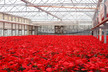

The domestic production of roses is growing, as communicated by a source through RusInform yesterday. Quote: "Consumers increasingly prefer the Russian version over the Dutch. This has everything to do with the price of the domestically grown rose, which is much more favorable.” Excluding transport costs Russian buyers pay about 63 roubles (0.85 euros) for a Dutch rose. For the more pocket-friendly priced Penza variant - a city in Russia - one pays 25 to 40 roubles (0.34 to 0.54 euros).
"The Russians are, in terms of raw materials, completely dependent on Dutch products," says Roodenburg, and that will not change easily. At the same time greenhouses are being built and the country is serious about developing domestic horticulture. The source cited by RusInform seems to confirm this: the area around Penza, a Russian city will now produce enough roses to provide the entire European part of Russia.
Quiet commercially
Whether this increasing competition is noticeable at the auction is difficult to say. Russia in itself has become a sensitive issue and is careful to come out with any information whatsoever. What is known is that the exports to Russia are already declining, in terms of sales, they have been surpassed by more and more countries, and the disastrously low rouble, will not change these developments for the better.
Last word
Concerning exports to Russia, the last word will not be spoken. "The VGB will, in cooperation with LTO, FloraHolland, Wageningen UR and the Minister of Economic Affairs, seek ways to avoid thrips," says Roodenburg. "They have submitted a grant application to top sectors (along with the fruit and vegetable sector). Now we search for two solutions, for the short term and for the long term. For the short term solution, it is important to combat these plant pests in the post-harvest phase; in the long term a way to look at the greenhouse level and to grow thrips free, should be found.
"As a final point to report, there has been a first, tentative breakthrough. For some time we have been trying through the Ministry to have contact with Russian authorities. They now seem to be open to this and a date is being discussed. It is of utmost importance to seek and carry out conversation," Roodenburg declares. "Because talking about each other all the time, but never talking with each other, gets no one absolutely nowhere."
Last word
Concerning exports to Russia, the last word will not be spoken. "The VGB will, in cooperation with LTO, FloraHolland, Wageningen UR and the Minister of Economic Affairs, seek ways to avoid thrips," says Roodenburg. "They have submitted a grant application to top sectors (along with the fruit and vegetable sector). Now we search for two solutions, for the short term and for the long term. For the short term solution, it is important to combat these plant pests in the post-harvest phase; in the long term a way to look at the greenhouse level and to grow thrips free, should be found.
"As a final point to report, there has been a first, tentative breakthrough. For some time we have been trying through the Ministry to have contact with Russian authorities. They now seem to be open to this and a date is being discussed. It is of utmost importance to seek and carry out conversation," Roodenburg declares. "Because talking about each other all the time, but never talking with each other, gets no one absolutely nowhere."