


Father's Day is around the corner, but before looking ahead to this holiday, it might be nice to once again look back on Mother's Day 2020 in the US this year. It was in the middle of the pandemic and despite everything, the results show that Mother's Day was a bright spot for both, the floral retailers as well as wholesalers. Lately, flower grower Equiflor, with farms in Ecuador, Colombia, and Costa Rica, shared two articles on their blog in which they reflect on the Mother's Day sales from both the US floral wholesales and floral retailers.

Below the articles with the statistics.
Retail Results
Last year, nobody could have predicted that the next Mother’s Day would land smack in the middle of a global pandemic. Going into Mother’s Day 2020, who knew what the demand would be? Yet, despite everything, the results show that Mother’s Day was a bright spot for floral retailers this year.
The Society of American Florists (SAF) conducted their annual survey after Mother’s Day, and the results were fantastic: 70% of those responding saw an increase in their Mother’s Day sales! Many of them also said that they could have sold even more if they’d been better prepared with more staff, and been able to get more product.
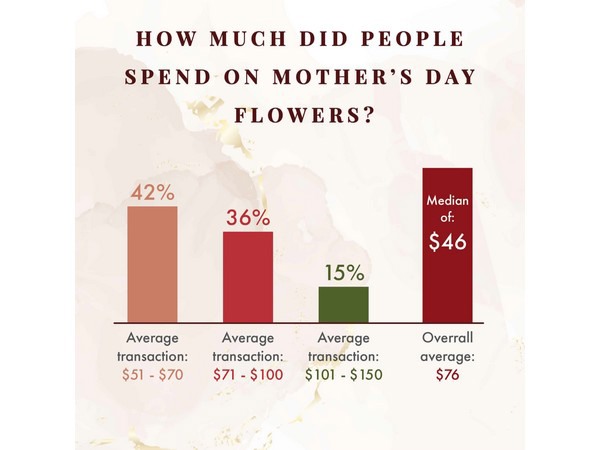
How much did people spend on Mother’s Day Flowers?
The median amount spent on Mother’s Day flowers in 2020 was $45, a $10 increase from the past two years. 42% of florists said that their average transaction was between $51 and $70; 36% said it was between $71 and 100; 15% said it was between $101 and $150. The average transaction was almost $76, compared to $68 in 2018.
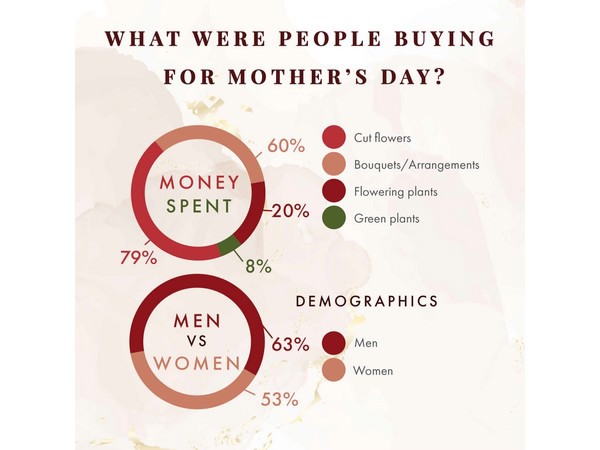
What were people buying for Mother’s Day?
Fresh flowers and plants continued to be the most popular floral gift item for Mother’s Day, purchased by 28% of American adults. Fresh bouquets and arrangements made up 60% of their floral purchases. Cut flowers were far more popular than other segments, with 79% of sales, followed by flowering plants at 20% and green plants at 8%. This trend is similar to past years, as fresh flowers continue to be the most popular type of flower purchase. Purchases of fresh flowers by men were 63%, and by women, 53%.
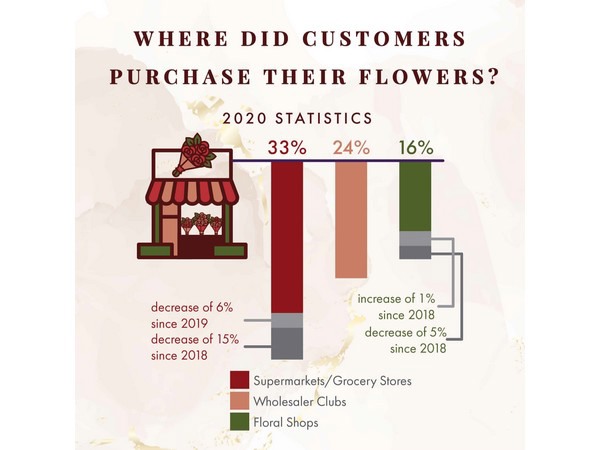
Where did customers purchase their flowers?
Supermarkets and grocery stores continued to be the location for most floral purchases at 33% of sales. However, this represents a drop from both 2019 (39%) and 2018 (48%). So, where are they taking their businesses? Mass merchandisers and wholesaler clubs, where 24% of adults purchased their flowers. 16% purchased at florist shops, which is slightly up from 2019 (15%) and down from 2018 (21%).
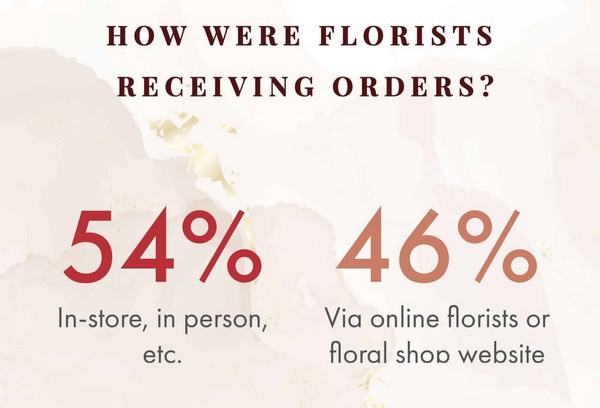
How were florists receiving orders?
Not surprisingly, consumer floral purchasing was mainly done on the internet this year: 46% of Mother’s Day orders came via florists’ websites compared to 20% last year. Many florists noted just how vital their sites were, and how important it was to limit their offerings and direct customers to more flexible options, due to supply issues.
How did retailers deal with supply issues?
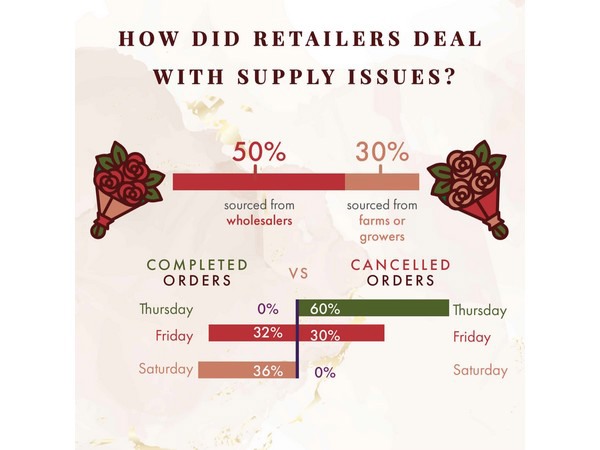
One of the biggest challenges this Mother’s Day was retailers getting enough product. Nearly 50% of respondents said they sourced more products from their wholesaler compared to last year, and 30% said they sourced more directly from farms and growers.
The lack of enough product caused retailers to pivot late in the game so that they could fill the orders they already had. 60% of survey respondents stated that they had suspended incoming orders by Thursday, May 7, with an additional 30% suspending orders by Friday. 32% cut off orders completely by Friday, and another 36% by Saturday.
Despite any supply issues, most floral retailers had a wonderful Mother’s Day. This is a great sign: Flowers are helping all of us move through tough times and into a brighter future.
Floral Wholesalers
Sure, we’re in the middle of a pandemic, and things have been unpredictable. There’s no way of knowing when—or if—things will go “back to normal” for the floral industry. Perhaps our industry will never be the same, but that doesn’t mean there hasn’t been good news for wholesale florists! Mother’s Day sales were far better than expected, and the lessons learned from this holiday will help all wholesalers refocus their efforts towards a bright future.
More people sent flowers than expected
With all the pent-up frustration of not being able to share Mother’s Day in person, people turned to flowers in higher numbers than wholesalers anticipated. A survey conducted on the website flowersandcents.com showed that nearly 52% of wholesalers reported Mother’s Day 2020 to be “Way better than expected,” and 33% said it was either “Good” or “Great.” That’s encouraging news to be sure!
Mass market stores were the center of floral sales
Supermarkets are booming in floral sales, and Mother’s Day was no exception. While many floral shops had to close for some time during COVID-19, supermarkets and mass-market retailers never did. As a result, many consumers went to their local grocer or big-box store to purchase their bouquets. Plus, as some wholesalers were closed or had to cut back their product severely, many retail florists went to mass market stores to add to their stock.
This trend of mass-market floral sales shows no signs of slowing down, plus market prices remain strong due to a limited supply. While continuing to provide flowers to retailers, wholesalers must pay close attention to the mass market to sustain future growth.
Wholesalers overcame some significant challenges
Since Mother’s Day demand proved to be so much higher than expected, it brought many challenges to the floral wholesalers. Their sales depended on florists being open, and regulations varied from state to state. Some wholesalers had no choice but to close down, while others didn’t.
Also, back in March, many growers were forced to reduce their staff, and some cut back crops in anticipation of a slow Summer. Then, when Mother’s Day demand was so high, they couldn’t catch up, resulting in a lot of empty flower buckets at floral wholesalers.
There were also logistical challenges: With so many commercial airlines cutting back their flights, the cargo that would have shipped in passenger planes had to ship in cargo planes, including much-needed PPE. This airline situation continues to make once-reliable floral shipments highly unpredictable.
With all those challenges, wholesalers still managed to reap the benefits of Mother’s Day—a beacon of hope in an unpredictable time. Using what they’ve learned, smart floral wholesalers will align their business to meet the demand and ensure a bright future for the floral industry.
The power of flowers is still going strong!
For more informati on
on
Equiflor
www.equiflor.com