
Florall in Waregem, Belgium, attracted about 300 visitors on Tuesday. The regional ornamental plant show had fewer exhibitors than previous editions. According to the organizer AVBS, the sector federation of Flemish ornamental plant growers, the reason for this decrease is the booming market. Many tree growers are partly sold out and therefore have nothing to show at the fair. This, on top of the inflation, and the war in Ukraine dominated the fairs' discussions. Some exhibitors see their exports to Russia come to a halt.
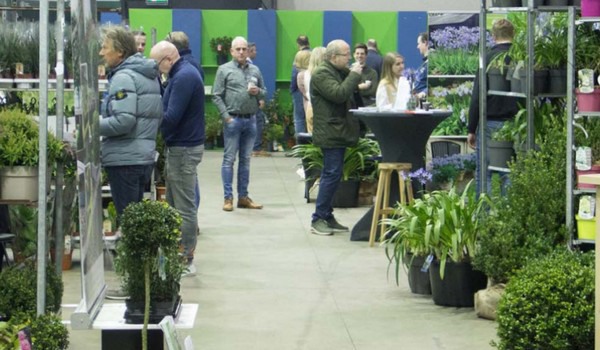
The spring edition of the floriculture trade show Florall in Waregem attracted 61 producers and about ten supply and export companies as exhibitors. With that, there were fewer exhibitors present than in previous editions. "Some usual participants chose not to participate because their production for this spring was already sold out," says Miet Poppe, secretary of AVBS, the sector federation of Flemish ornamental growers.
Among the participating ornamental growers - many tree growers - there were also a lot of positive words about the market. "We can always use new customers, but the market is indeed good at the moment. There are shortages, so we can also pass on sharply rising raw material costs," says someone from Tree Nursery Peers in Ranst. "Participating in fairs is also good for maintaining contact with customers," he adds. The tree grower does worry about inflation and rising raw material costs.
Uncertainty about inflation and war
Inflation and the war in Ukraine are worrying more companies, such as tree nursery Willy De Nolf. "About ten percent of our sales go to Russia, Ukraine, and other former Soviet republics. Since the outbreak of the war, this trade has been at a standstill, and there is a strong question as to what will happen to the orders," says Lucas De Nolf, co-founder of the tree nursery.
Poppe of AVBS indicates that more Flemish ornamental growers have exported to Russia and other former Soviet republics. Part of it goes directly, and partly goes indirectly, through countries like Poland and Lithuania. "Especially tree nursery products, such as conifers, for example, go in that direction. Hopefully, the conflict will resolve soon. For the trade, but especially for the humanitarian suffering there."
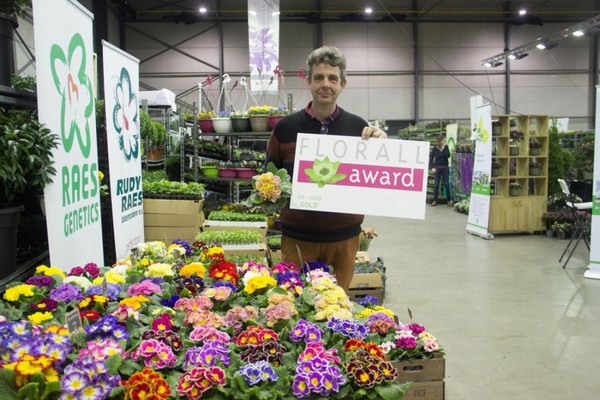 Wouter de Meester with the Primula acaulis Rubens Antique rose from breeder Rudy Raes
Willy De Nolf is a familiar face at the ornamental plant show. Therefore, participation is not a point of discussion within the family business. "It would be crazy if we were not there," says De Nolf junior. "Our company is based in Waregem. For us, it's a home game, as it were."
Florall Award for innovative plants
The tree nursery wins prizes at the Florall Awards ceremony every year. Whereas the company often takes first places, this time it was not to be found on the podium. "You can't always win. We award the others as well" it sounds sporty.
The Florall Award is a prize for an innovative plant or concept and is presented by an independent jury consisting of experts from the industry. From thirteen entries, the Primula acaulis 'Rubens' from breeder Rudy Raes in Destelbergen was declared the winner. The jury thought the color was innovative and could appreciate the unique positioning and surprising fragrance of the flowers on top of the compact flowering form. "The plant forms many flowers, and the petals have fringes. Also, an added value is the sturdiness of the plant, which makes it able to withstand weather and wind in the spring flower boxes."
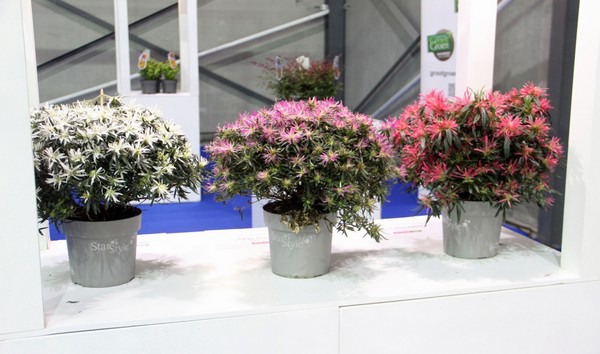
Second place went to Dutch tree grower R. van Opstal for his Leucothoe axillaris 'Opstal55' characterized by its curly leaves. The bronze medal was for the Flemish creation of Bloemisterij Leybaert from Moerbeke. The azalea grower marketed the Azalea Star Style, an azalea with star-shaped flowers. The compact azalea blooms for up to 4 weeks in spring and thrives best in sun or semi-shade. The hardy Azalea is available in 3 colors (pink, lilac, and white). It was the lilac-colored variety that won awards at Florall.
Source: VILT
Image: AVBS