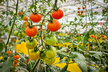


In 2022, Dutch greenhouse growers bought in less CO2, down five percent from 2020. Purchases in 2022 amounted to 700.000 tons of CO2. That is according to Wageningen Economic Research's 'Energy monitor of Dutch greenhouse horticulture 2022'.
The researchers ascribe this decrease primarily to greenhouse horticulture companies being extremely selective when buying CO2 outside of fixed supply/purchasing deals. That is due to the high prices. As a result, there were fewer local deliveries than the decrease in central delivery. There, a unit of CO2 (kg) generally costs less.
In 2022, an average of less than 7kg/m2 of external CO2 was used on the sector's total acreage. Of the greenhouse farms using external CO2, the average was between 20 and 30 kg/m2.
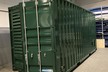
A liquid CO2 tank being placed in mid-July 2022 at a Dutch cucumber farm.
Availability is crucial
When replacing fossil fuels with non-CO2 energy sources, like renewable heat, CO2 from flue gases falls away. It is used as fertilizer in greenhouses and is thus an essential production. The researchers say that the transition to renewable energy and buying heat and electricity is impossible without external CO2.
Using external CO2 can reduce summer heating, too. Greenhouse farms concerned that the potential risk of harmful elements in flue gases is too great also use external CO2. Summer heating refers to CO2 production from natural gas without full heat utilization.
To further develop renewable energy use and heat and electricity purchasing, an increased amount of external CO2 is needed. Improved supply security is also paramount. External CO2 becomes available as a by-product of industrial processes, including refining and residual stream processing. There is a difference between CO2 of fossil and biogenic origin and central and local supply (see the figure below).
External CO2 used in the greenhouse horticultural sector is largely by means of a central supply of pure CO2 distributed via a pipeline network. Local delivery primarily concerns the delivery of pure CO2 by axle. That has been increasing in recent years, especially in areas without a pipeline network.
How purchasing (central and local) external CO2 by the greenhouse farming sector has developed (in Mton), 2022 figures are preliminary.
Source: Energiemonitor WUR