

There won't be another 1,000 of them built anytime soon, but the new machine that allows freesia bulbs to be evaluated and selected in terms of quality is a fine example of innovative technology and cooperation. With the GearVision, produced by Gearbox and commissioned by and in cooperation with Van der Bos Flowerbulbs, a process has now been automated and optimized, raising the standards in output control for the bulb supplier and subsequently bringing profit to the growers. With it, the personnel's current knowledge can be logged in AI and allow for constant improvement.
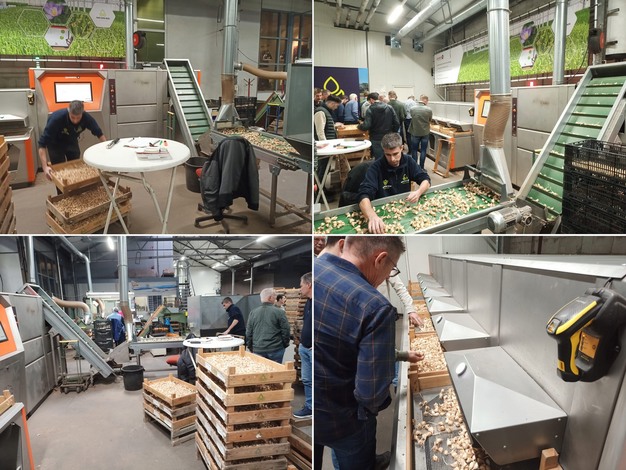 Hard to showcase the machine in just 1 picture. Clockwise from top left: the bulbs are placed on the belt, an employee does a rough (but not necessary) pre-selection, and the bulbs come out of the machine sorted in various categories.
Since 2018, a lot has been talked about automating a tricky job, namely evaluating and selecting freesia bulbs. Basically, the goal is to filter out petrified, dried, soft, or spotted bulbs so that the customer, i.e., the grower, receives a high-quality batch. Ideally, selection can also be made on weight, which positively contributes to the plant and flowering quality, and furthermore, there must be speed in the process, given that millions of bulbs need to be evaluated during the season. Handling 20,000 bulbs per hour is now a realistic goal.
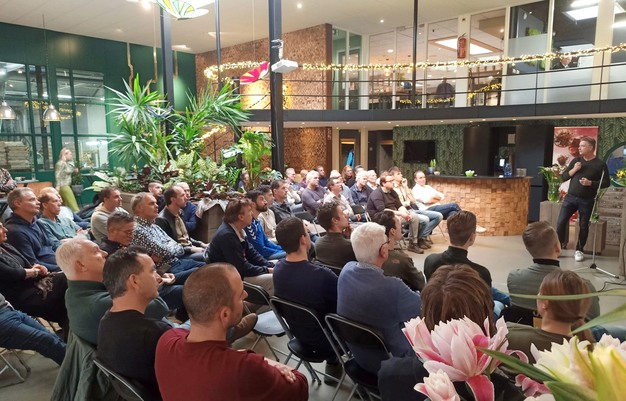 Jeroen Mol, from Unicum, talked about the activities of Versnellers sustainable floriculture.
A lot can be achieved with cameras and smart computer technology, but the real challenge, according to Gearbox sales manager Ab van Staalduinen, was the determining of weight. This is necessary to pick out the dried and soft bulbs, for example, but a camera cannot see what an employee can feel. Photographing 20,000 bulbs is one thing, but weighing 20,000 bulbs is even more complicated. The solution was found in advanced camera technology, which allows you to look inside the bulb, so to speak, and discard any tubers that are not good inside, and then the size and weight are determined fairly accurately.
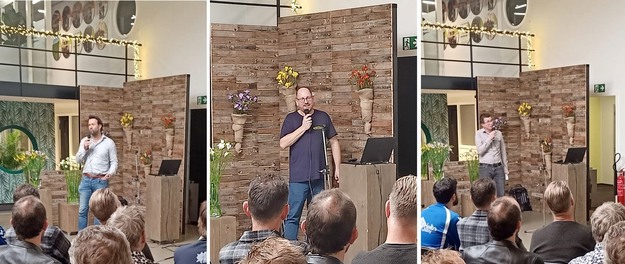 From left to right, Jorrit Koeman from Glastuinbouw Nederland, Joop Woelke from Control in Food & Flowers, and Daan Vermeer from Van der Bos.
The result is a machine where bulbs are introduced on one side, and on the other you get not only the good and rejected specimens automatically separated into crates, but the good bulbs can also optionally be further sorted into five different weight classes. Logically, in every batch, a large majority of the bulbs fall into one or two categories, while only a few specimens fall into the rare ones. The manual selection of bulbs is thus becoming a thing of the past, with AI setting new and stable quality standards.
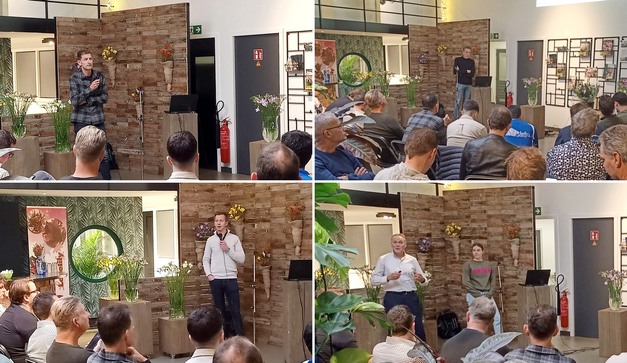 Clockwise from top left: Pip Tesselaar from FPC Freesia; Ferry Haring from RFH; Gerard Gardien and Lotte van der Meer from Fabulous Freesia, and Ab van Staalduinen from Gearbox.
The GearVision was presented a few days ago at an event organized for and by freesia traders from Glastuinbouw Nederland and Royal Flora Holland at Van den Bos Flowerbulbs facilities in Honselersdijk. It was an annual meeting where the ups and downs of the FPC, marketing, sales, or cultivation, as well as the usual topics regarding sustainability and certifications, were addressed. About 50 people, most of whom were growers, therefore representing the vast majority of the national freesia-producing sector, attended the meeting.