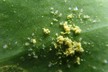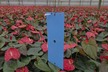

Cyclamen plants were submitted to the UMass Extension Plant Diagnostic Lab recently. Russeting was observed on the undersides of the leaves. Cyclamen mites were discovered inside of the cyclamen flowers.
Cyclamen mites (Phytonemus pallidus) are tiny (0.10-0.25 mm long). They have a broad host range and feed on numerous floriculture and edible crops. Their feeding causes russeting of leaf, stem, and fruit tissues, bud and leaf malformation, and plant stunting. Populations of cyclamen mites are increased by high relative humidity and temperatures of 60-70°F. The mites are spread by air currents, plant-to-plant contact, and cultivation.
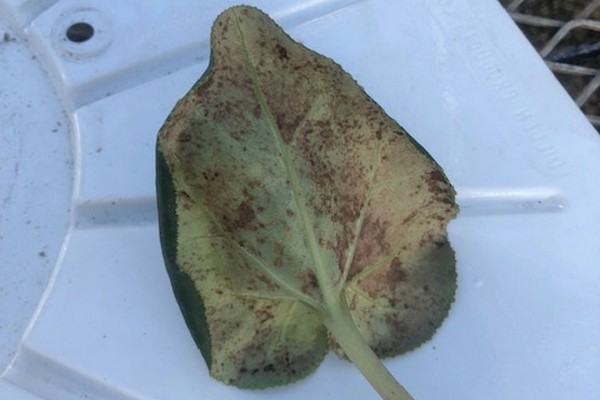 Russeting symptoms on a cyclamen leaf caused by cyclamen mites (P. Kelley)
Prevention of cyclamen mite infestation through scouting and early intervention is more effective than trying to control dense populations. Inspect new plants thoroughly for signs of mite damage before bringing them into the greenhouse. Plants showing cyclamen mite injury should be removed and destroyed to prevent spread. Immersion of infested plants in hot water (110°F) for 30 minutes can give satisfactory control. Test one of each plant species first, as some will not tolerate this treatment.
Chemical control is difficult because the preferred feeding site of the mites deep within the buds reduces their exposure to the materials. Miticides registered for cyclamen mites include Avid, Pylon, Kontos, Savate, and Sirocco. Only Kontos is xylem-mobile, while the others have contact and/or translaminar activity. Alternate active ingredients to prevent resistance development. Consult the New England Greenhouse Management Guide for more information: https://www.negreenhouse.org/pest-guides.html(link is external)
The predatory mites Amblyseius andersoni and Neoseiulus cucumeris are available for biological control of cyclamen mites. Biological controls can be very effective in greenhouses but must be used as a preventative measure as they do not provide sufficient curative action once an outbreak has occurred.
Source: umass.edu