


Women's Day in Poland is one of the biggest "flower" holidays of the year. "It can only be compared to Mother's Day, which is celebrated annually at the end of May. Back in the communist era, Polish men traditionally gifted women a pair of tights and a bouquet of carnations. But times have changed, and so have preferences. On March 8, the store shelves were filled with a wide variety of flowers." This is explained by Bohdan Tustanivskyi of Profiflora, a cut flower supplier, who visited together with his team several supermarkets in Poland on this holiday. "We usually visit supermarkets in different locations and check out all the major retailers in the market. This helps us analyze the assortment, understand customer preferences, and offer trending SKUs in the future. It also allows us to track pricing."
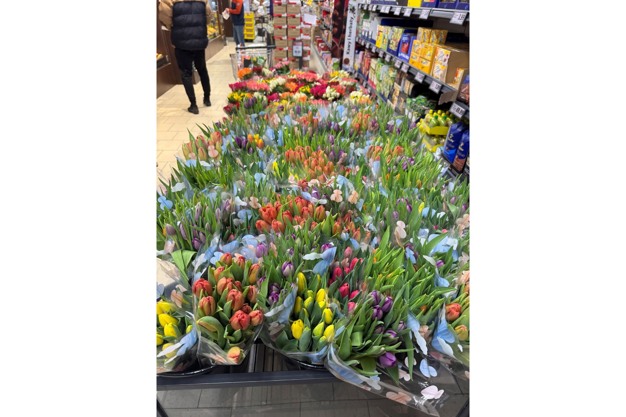
Tulip is the number 1 flower
In general, what are the trends? Tustanivskyi: "The main focus and the number one flower for Women's Day is, of course, the tulip, taking up approximately 60-70% of shelf space. In second place is the rose 20-25%, with the rest of the assortment including Alstroemeria, Daffodils, Spray Carnations, Irises, etc. A key difference between Poland and wealthier Western countries (such as Germany and the Netherlands) is the relatively low presence of floristic bouquets in supermarkets. Instead, mono-bouquets dominate the market. However, with economic growth, this trend is expected to shift—when people earn more, they will be able to afford designer bouquets, which typically cost €10 or more, compared to mono-bouquets priced between €2.5 and €7."
The tulip price shock of 2024
This year, the biggest concern was the price of tulips, he continues. "As is well known, in 2024, the cost of tulip bulbs skyrocketed by approximately 35%, shocking the market. In previous years, tulip prices had remained relatively stable, so when buyers and suppliers sat down for negotiations in October and November, it led to significant challenges. Supermarkets were uncertain whether they could sell the same volume of tulips as in previous years and were cautious with their orders and suppliers hesitated to commit to contracts with tulip growers due to the high prices. Despite these challenges, store shelves were fully stocked with tulips, and as always, men are buying them for the women in their lives."
Supermarket price battle
Despite the high procurement costs, they were seeing a price war between supermarkets. "The two biggest competitors, Lidl and Biedronka, launched direct marketing campaigns against each other, offering the following deals:
- Lidl: Buy 3 bouquets (7 tulips per bouquet) for 14.99 zł and get 3 more bouquets for free. That means the price per bouquet is 7.5 zł (€1.78).
- Biedronka: Buy 1 bouquet of tulips for 11.99 zł and get 1 more for free. This results in a per-bouquet price of 5.99 zł (€1.43).
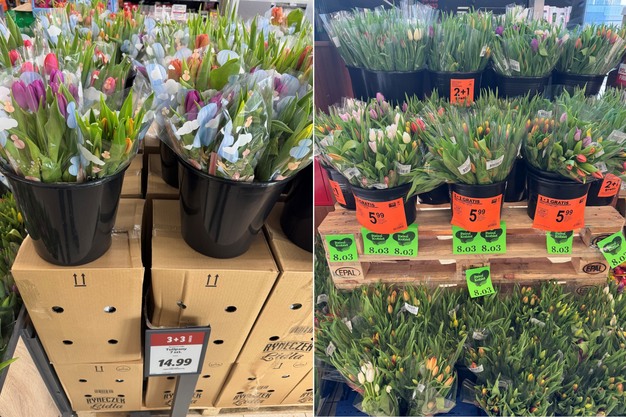
On the left: At Lidl, on the right at Biedronka. (Click here to enlarge)
These prices apply mostly to Dutch tulips", he says.
Meanwhile, some supermarket chains focus exclusively on Polish-grown tulips. "For example, the large Polish-owned chain Dino successfully sells only Polish tulips (which typically have a heavier stem of 26+ grams and a larger bud) at 14.49 zł, catering to a loyal customer base.
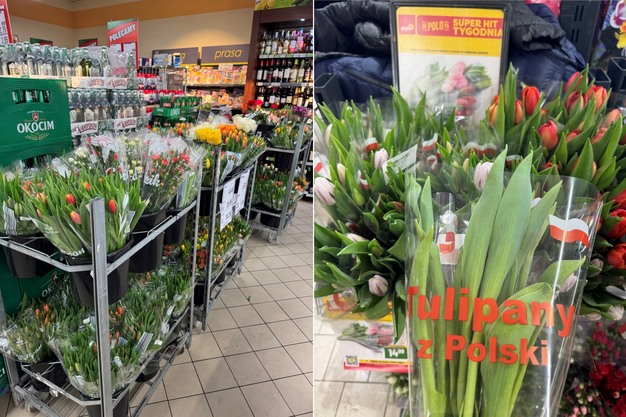
Some retailers even emphasize packaging to highlight the origin of the flowers. A great example is Polo Market, a smaller chain that promotes its sales of exclusively Polish tulips. "
For more information:
Profiflora sp. z o. o.
Profiflora.pl
Bohdan Tustanivskyi
Email: [email protected]
https://www.facebook.com/bohdan.tustanivskyi