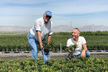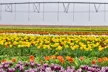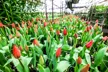


"There was absolutely nothing, just bushland, chickens, goats, and a whole lot of mud." That's how Olav Boenders describes the land at Wagagai when he and his wife Marion arrived in Uganda in November 1999 to support the De Witte family in setting up what was then a rose nursery. Now, more than 25 years later, Wagagai has grown into a successful propagation company in Africa, recently acquired by Selecta, with a bright future ahead. So how do you achieve something like that?
Olav is someone who has seen it all in horticulture—most of it twice. Before his adventure in Uganda, he had already spent five years working in Kenya for Deliflor. "My father was a development economist, and I studied tropical agriculture and development economics myself," Olav explains. "Pim and his father Wim de Witte had leased land in Uganda to establish Wagagai, but it turned out to be quite a complex operation. They asked my father and me to help set up the financial and operational side of things."
 © Yeald
Not a viable business
And so, in 1999, Olav arrived at a few empty hectares on the shores of Lake Victoria, about an hour's drive from the capital, Kampala. "It took another two years before the financing was sorted out, even though the greenhouses had already been ordered," Olav says with a grin. "By January 2000, we were exporting our first roses. But during our time growing roses there, the price dropped from twelve cents per stem to six cents. That just wasn't a sustainable business model for us."
Not long after Wagagai was up and running, Olav's former employer, Deliflor, reached out to ask whether they could produce chrysanthemum cuttings. "Uganda really has the perfect climate for chrysanthemum propagation—that was already well known," Olav explains. "Warm night temperatures and high humidity. The crop was an immediate success. So successful, in fact, that we started leasing more land to expand capacity and began trialing poinsettia and begonia cuttings as well. And those performed brilliantly too."
The logical next step was clear: Wagagai would become a propagation company. "It's a stable business with long-term contracts. Plus, alongside Deliflor, we'd also brought Selecta on board as a client, and we started producing cuttings for both. That strategy worked far better than growing roses for the volatile spot market."
 © Yeald
Zero experience with horticulture
Wagagai laid out a clear vision for building long-term resilience as a company. "We were able to spread overhead costs across two customers whom we had brought together," Olav explains. "We were doing something that neither company could manage on their own at the time, propagating cuttings on 30 to 40 hectares. We've always worked as efficiently as possible without compromising on quality. Premium quality, grown as sustainably as possible, at an affordable price, that was always our guiding principle."
"At the time we started, there was no knowledge of propagation in Uganda, and no infrastructure to support it," Olav continues. "There was zero horticultural experience. Even the international airport didn't have cold storage facilities, just to give one example. So we began training people ourselves. We quickly learned that the success of any horticultural business in Africa hinges on the quality of the local operational management."
"In addition, we joined forces with around twenty floriculture companies active in Uganda to form the Ugandan Flower Exporters Association. Uganda is very entrepreneur-friendly and has a positive outlook on foreign investment. By collaborating as a group, we were able to solve many challenges in partnership with the Ugandan government. We also combined forces in R&D, trials, and testing, which significantly strengthened the sector."
 © Yeald
Strong local management
In addition to training staff and investing in Uganda's business climate, Wagagai has always taken good care of its people and the wider community. "From the very beginning, we wanted to empower our employees," Olav explains. "NGOs play an important role, but with our background in development economics, we also understood that businesses can be a powerful driver of prosperity in a country like Uganda. Even when we weren't yet profitable, we invested in childcare, a small clinic, and social activities on the farm—Marion played a vital role in all of that."
By 2009, Wagagai began turning a profit. Operationally, the company was in a strong position, backed by a solid local management team. Olav returned to the Netherlands in 2011, followed by Pim in 2014. "We were able to facilitate everything from the Netherlands, although we still flew back six to eight times a year. When COVID hit and we, like everyone else, had to shift to digital communication, we realized that—with a strong management team in place—much could be handled via video calls and email. It's in a crisis like that when you truly recognize how much skill and expertise you already have within your organization."
 © Yeald
Tropical years
What also changed over time was the energy Olav and Pim could still devote to Wagagai after 25 years of entrepreneurship. "Running a business in Africa is like doing tropical years," Olav says with a laugh. "And we didn't have a direct successor. That's when we started discussions with YEALD. COVID and the war in Ukraine delayed the process, but in the end, we found the perfect match in Selecta to take over Wagagai and breathe new energy into it."
"I believe Selecta took over the company at exactly the right time. They bring a new long-term vision and strategy that will only drive Wagagai forward," says Olav. "And without YEALD, this process would never have succeeded. We're truly grateful for what they've done for us—selling a company is a specialty in itself."
 © Yeald
Creative Dutch entrepreneurial spirit
And so, a long African horticultural adventure gradually comes to an end for Olav, a man with a deep passion for horticulture and a wealth of experience. "When you operate internationally, it's essential to strike the right balance between the creative, entrepreneurial spirit of the Dutch and the local culture. A strong local management team is absolutely crucial, that's one of the key lessons we learned at Wagagai. It also means that, as a Dutch entrepreneur, you sometimes need to have patience and understanding when things are done differently from what you're used to."
But Olav is certain that opportunities remain for Dutch horticulture. "Across the globe, we're seeing enormous pressure on land and food production. Dutch horticultural technology and production methods can play a vital role in addressing that. Making cultivation more efficient and less reliant on chemicals and fossil fuels, that's the future."
For more information:
Yeald 
[email protected]
https://yeald.nl/nl/