

Can sea urchins (long considered pests in marine ecosystems) hold the key to healthier, more resilient crops in greenhouses? Researchers at the Norwegian Institute of Bioeconomy Research (NIBIO) believe they just might.
The Department of Biomarine Resource Valorisation, a relatively new unit at NIBIO, is led by Dr. Johan Johansen. "We're the only 'blue' department in the institute," says Johansen, referring to the team's focus on marine sectors like fisheries and aquaculture. "We're looking at how to make typically linear and waste-heavy value chains more circular and profitable."
The unexpected star of this circular transformation is the humble, and often problematic, sea urchin.
Restoring coastal ecosystems and finding hidden value
In recent decades, coastal kelp forests in Norway have suffered severely from overgrazing by sea urchins. "Without top predators like cod and wolffish to control their numbers, sea urchins have multiplied and created what we call 'urchin barrens' which are underwater deserts where nothing grows," Dr Johansen explains.
The team's goal is not just to remove sea urchins, but to restore balance to these marine ecosystems. To make that sustainable, they've developed a harvesting tool that can collect sea urchins on an industrial scale, and then turn this underutilized biomass into something of value: a biostimulant for agriculture. The tool is being developed by AVA Ocean AS, as part of a project called OceanGreen, endorsed by the The UNESCO UN Ocean Decade.
"The urchins are not the focus," he clarifies. "The focus is restoring kelp forests. But if we can make money from the urchins, we create a natural incentive to remove them, much like the Danes did with sea stars affecting mussel farms."
From the ocean to the greenhouse
Early data for the idea of turning sea urchins into plant boosters is promising.
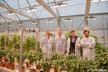
Research Scientist Abirami R. Ganesan, who leads greenhouse trials at NIBIO, reports that the SU-biostimulant (derived from sea urchin biomass) has shown statistically significant yield increases in green lettuce when applied as a seed priming and foliar spray. "Among several concentrations tested, 1.5% SU showed the highest increase in both fresh and dry weight," she says. While results varied slightly across growth cycles, trends were consistent and positive.
Even when compared to commercial biostimulants like Acadian (a well-known seaweed-based product), the urchin-based formulation performed competitively. "Acadian is fully water-soluble, while ours is about 70%," she notes. "Yet the SU-biostimulant still significantly promoted growth compared to untreated controls."
 © NIBIO | AVA Ocean
Enhanced nutrient uptake and morphological benefits
Greenhouse growers are especially attentive to the nutritional balance of their crops, and here the sea urchin product shows additional promise.
"We observed a marked increase in leaf greenness index and a substantial rise in calcium levels, between 32,000 to 38,000 ppm, in lettuce plants treated with higher concentrations of SU," Abirami says. Other essential minerals like copper, manganese, potassium, and zinc also showed dose-dependent increases, suggesting improved nutrient uptake.
Though root structure wasn't evaluated in the initial trials, the foliar application method every 14 days at 0.6–1.5% concentration has proven effective, with no adverse effects observed.
Formulation, stability, and local advantage
Stability is often a concern with natural biostimulants, but here too, the SU-biostimulant performs well. "We've added a food-grade preservative that gives it a shelf life of over 90 days," Abirami confirms.
The formulation is still being refined to improve solubility and sprayability, which will help maximize nutrient delivery. But from a supply chain standpoint, the product holds major potential. "Raw material costs are practically zero as the sea urchins are considered waste. And they're available year-round along Norway's northern coastlines."
Other crops and applications
Lettuce was just the beginning. Trials on mizuna and other leafy greens are scheduled for this summer, and there are plans to expand testing to herbs, tomatoes, and more.
There's even an unexpected use: gastronomic mushrooms. "We have a colleague, Delphin Ruché, who added crushed sea urchin to mushroom growth media, and the results were astounding," Dr. Johansen shares. "Massive increases in yield and quality." Delphin leads a Citizen Science NGO in Tromsø.
This success story is especially relevant for specialty growers, from greenhouse farmers to gourmet food suppliers.
Room for collaboration
For greenhouse operators interested in trialing the biostimulant, NIBIO welcomes collaboration. "We can provide protocols, guidance, and possibly even product samples," Dr Johansen says, "The more growers engage, the faster we can fine-tune this for commercial use."
And while biostimulants are sometimes seen as a silver bullet, and often misrepresented in the market, both Dr. Johansen and Abirami urge caution and evidence-based application.
"There's a flood of poorly documented products out there," says Dr. Johansen. "But what we're working on is specific, scientifically validated, and designed for high-value crops under controlled conditions."
Sea urchin biostimulants offer a rare mix of ecological benefit and agricultural potential, and could become a valuable tool for greenhouse growers seeking to boost productivity while cutting reliance on imported inputs.
For more information:
AVA Ocean AS
avaocean.no
NIBIO
Abirami R. Ganesan
[email protected]
Dr Johan Johansen
[email protected]
www.nibio.no
RISSA Citizen Science
www.rissa-cs.org