
In the Grower's Voice series by Little Spider, growers share their experiences of working with natural pest control. In this edition, we meet Julia de Pater from Kwekerij Daylight.
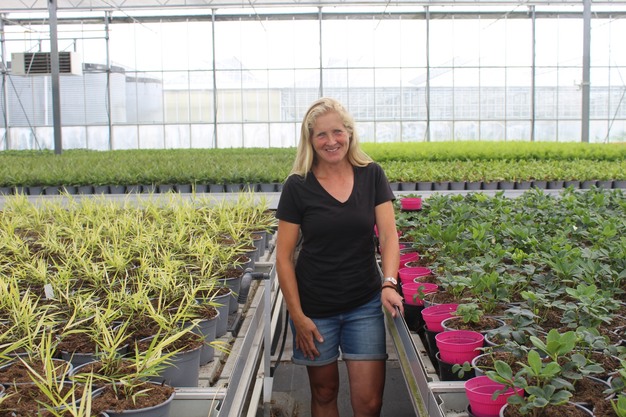 © Little SpiderJulia de Pater of Kwekerij Daylight
Who are you and what do you do?
"I'm Julia de Pater-Bakhuijzen, born and raised in Boskoop. My oldest sister and I work in the nursery together with my husband and brother, so we really are a family business in perennials. We grow a wide assortment of potted plants, partly in the greenhouse on rolling benches with an ebb-and-flow system, and partly outdoors. Growing runs in our blood: my father used to run a nursery too. Back then, pots were expensive, so we collected old butter tubs and used those to sell our plants. Today, we're a modern company on the very same land where I walked as a child along the garden paths."
How did you come into contact with Little Spider?
"My brother read about it and was immediately enthusiastic. After an information session, we started in October. Because of our ebb-and-flow system, we came up with a smart solution: using separate soil pots to keep the spider nests dry."
Do you notice any difference yet?
"Absolutely! We now use far fewer crop protection products. In some sections of the greenhouse, we haven't had to spray at all, whereas normally we would have treated at least twice by now. In Helleborus, aphids have almost disappeared. And the best part is, you can actually see it happening. Sometimes cuttings arrive with pests already in them, and the very next day you'll spot webs, the spiders are already at work."
What do you like the most about working with spiders?
"It feels natural, and it teaches you to look at things differently. You start spotting webs and noticing movement, it makes you enthusiastic, and the same goes for my brother and husband. Even customers and colleagues get curious when they see the Little Spider logo in our email signature."
What is the biggest challenge?
"Trust. You don't always see the little spiders, but they're still doing their job. It requires a different mindset: less control, more confidence in nature."
Why did you start doing this?
"Not because of one specific pest, but because of the future. With fewer and fewer pesticides available, we believe this is the way forward. We're not doing it for the money; for us, having healthy, fresh plants is far more important. And we love the fact that we get to work with a young, dynamic company like Little Spider."
For more information:
Little Spider
[email protected]
www.littlespider.nl
Kwekerij Daylight
[email protected]
www.kwekerijdaylight.nl