
Mealybug continues to be one of the trickiest pests in gerbera production. They're hard to control because the nymphs hide under their mother, settle deep inside the plant, or protect themselves with a waxy layer. This makes it difficult for most conventional products to reach them. Early detection is therefore essential. For growers, biological control remains the best option. Practical trials by Harmke Broekhuis of Agrobío at Mans Flowers in Brakel, the Netherlands, have shown promising results.
Agrobío is working closely with Royal Brinkman in the search for new biological solutions that perform well under Dutch growing conditions. Harmke Broekhuis, as a practical researcher at Agrobío, runs trials directly with growers. She investigates new options while also testing new combinations of existing products. The real strength of the collaboration lies in teamwork: Royal Brinkman's ICM specialists look at the overall crop health, assessing both pests and diseases, then work together with Agrobío and the grower to design a system-based approach.
 © Royal Brinkman
Research in practice
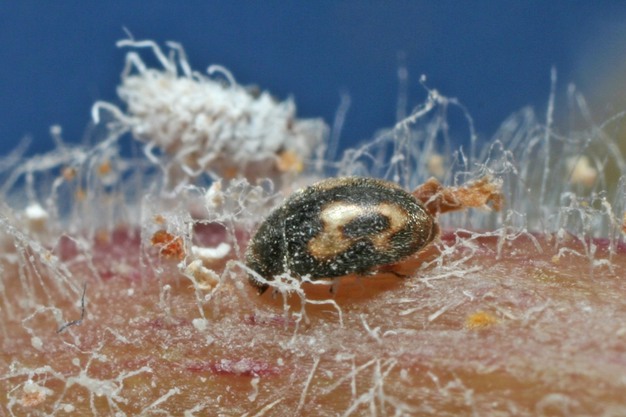
At Mans Flowers, Harmke has been experimenting with the use of two predatory beetles. "The ladybird beetle Cryptolaemus montrouzieri (CRYPTOcontrol from Agrobío) is particularly effective in tackling heavy mealybug infestations," she explains. "But when it comes to a more preventive strategy, they don't always do the job on their own." That's why in Agrobío's research, Cryptolaemus now gets a helping hand from another predator, Nephus includens.
This smaller beetle moves faster and more easily through the dense gerbera canopy, reaching exactly those hidden spots where mealybug loves to hide.
 © Royal Brinkman
Decrease in pest pressure
The combined system approach has already led to a noticeable drop in mealybug pressure. Bas van der Wal, crop protection specialist at Mans Flowers, confirms: "We've seen less visible damage and a clear reduction in Solenopsis mealybug populations. The two beetles complement each other perfectly. One works more curatively, cleaning up infestations, while the other is more preventive and can survive longer without food."
Harmke adds: "This combination strategy fits very well within organic production systems. Nephus includens is extremely sensitive to chemicals, which makes it less suited for integrated approaches where sprays are still in use. The beetle has a slow metabolism, so chemical residues tend to build up. Research from Agrobío has shown, however, that this combined approach works not just against Solenopsis but also against other mealybug species such as citrus mealybug, longtailed mealybug, and Viburni."
 © Royal Brinkman
From scouting to solutions
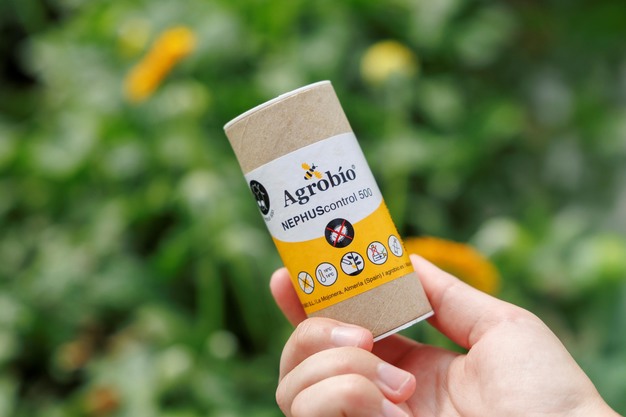
Thanks to positive results from trials in both the Netherlands and Spain, Agrobío has now decided to make NEPHUScontrol available to Dutch growers as well. Developing new biological control agents depends heavily on applied, practical research like this. The challenge is to steadily reduce the use of chemical crop protection products, and the demand for effective biological alternatives is stronger than ever.
Royal Brinkman has been supplying Agrobío's biological products to growers for many years. Agrobío itself is a trusted producer with research and development at its core. Based in La Mojonera, near Almería in southern Spain, the company breeds bumblebees and natural enemies for professional greenhouse horticulture. On several hectares of modern production facilities, they rear bumblebees alongside predatory mites, parasitic wasps, predatory beetles, and true bugs.
For more information:
Royal Brinkman
Tel: +31 (0)174 446 100
[email protected]
www.royalbrinkman.nl