

In this third part of the series on biological crop protection at Gerbera United, the spotlight shifts to the role of the supply chain and the end customer. Inside the greenhouse, the fight against pests is no longer waged with chemicals but with natural allies: tiny predatory mites, bugs, and beetles that keep the crop in balance. "We're not doing this because we have to," the growers explain, "but because we can – and because it's better for the environment, for our employees, and for the future."
But the success of biological crop protection isn't just determined inside the greenhouse. It also depends on everyone further down the chain. Quality inspectors need to learn to judge flowers differently. Buyers need the confidence to explain why a bloom might look a little different. Florists need the courage to tell the honest story. It's something we all need to contribute to.
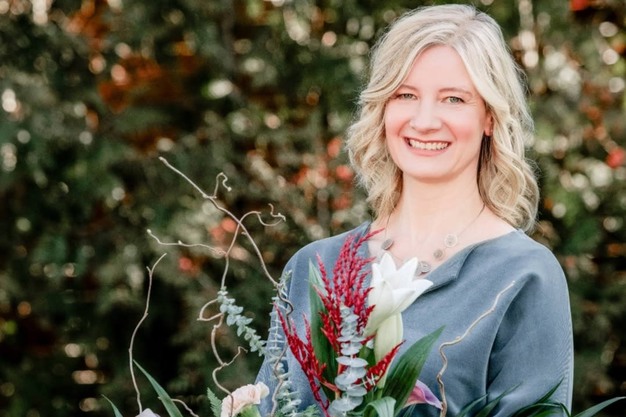
Stephanie Steichele, a sustainable florist at Blumen Kuhn Floraldesign in southern Germany and customer of FM Group, doesn't hesitate when asked what drives her. "We work with nature every single day. So of course we treat her with respect. Sustainability isn't a strategy for us – it just makes sense."
 © FM Group
For Stephanie, her shop is about more than aesthetics. "When a customer takes home a bouquet and knows where it comes from, how it was grown, it carries a completely different value. That's rewarding – both for them and for me."
A stubborn reality
Flowers with a few insects on them? In theory, no problem. In practice, it's trickier. "For me, a harmless little bug isn't an issue," Stephanie explains. "It actually shows that no chemicals were used. But many customers still see it as a flaw."
This highlights a tension that runs through the chain. In part two of this series, a quality inspector put it simply: "The customer won't accept it." Now we hear the same from the florist: "My customer doesn't accept it." Everyone points to the next link. But who takes the lead? Perhaps customers are more open than we think – if we tell the story the right way. As long as no one starts the conversation, the misunderstanding remains. And if we all wait for "the other" to take action, we hold each other back. It's time to break that cycle.
Away from the old standard
For decades, the standard of quality in flowers was simple: flawless, spotless, perfectly uniform. But that ideal doesn't fit with sustainable growing. We can't keep chasing perfection and at the same time demand less chemistry.
It's time for a new definition of quality. One that leaves space for authenticity, for character, for the story behind the flower. Other sectors are already shifting – bent cucumbers are no longer waste, but proof of less food waste. Why should floriculture cling to clinical perfection?
Sustainable growing sometimes means a bent stem, a spot on a leaf, or a visible trace of life. These are not mistakes, but signs of a flower grown with care and respect. We need to embrace those imperfections – and show their beauty. That takes collaboration. And a story that runs from greenhouse to shop counter.
Change requires courage
Working sustainably means making choices, and they aren't always easy. For florists like Stephanie, the biggest challenge is sourcing. Smaller, local growers often work sustainably but lack certifications. "Customers want proof, seals, guarantees. And as a florist, you can't just put a label on something – even if you know it's good. But we are making progress. Thanks to FM Group, I can now filter for sustainable products directly in their webshop. That helps a lot. We know what we're buying, and we can be transparent with our customers."
What florists need
So, what can growers and wholesalers do to help communicate the story of biological crop protection? Stephanie suggests three things:
Be transparent: share background information on products, growers, and origin.
Provide visual support: clear labels, recognizable symbols.
Share knowledge: offer training materials or short explanations.
"FM Group is already leading the way here," she says. "I don't know any other cut flower wholesaler that shows so much product information. That's unique."
Florists may be the final link in the chain, but they are also the most important storytellers. They see the customers, they hear the questions, they can make the difference – by being open about the choices they make, by explaining what a tiny spot or bug actually means, and by showing that sustainability adds both beauty and meaning.
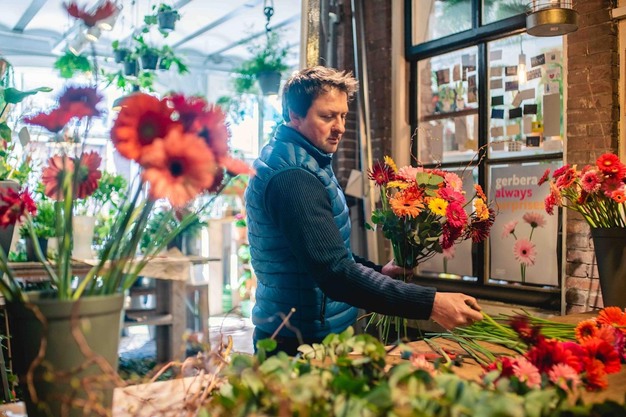
Stephanie does this through her website, during consultations, and even with small signs in her shop. "We still do it too little," she admits. "Because it feels so natural to us. But actually, it's vital to keep repeating the message."
 © FM Group
What you sell matters
Her advice: don't be afraid to start small. "You don't have to be perfect. Every step counts." A biologically grown gerbera with a tiny predatory mite is not a flaw. It's proof. Proof that the grower chose a different path. Proof that the florist supports that choice. Only together can we shift perception.
For those who want to see the real story up close, the doors at Gerbera United are always open. "Transparency is in our DNA. So if you're curious about what biological crop protection looks like in practice, you're welcome to visit. Walk through the greenhouse, ask your questions, see it with your own eyes. The coffee is ready – and so is the story."
 For more information:
Gerbera United
T: 079 5931 252
[email protected]
www.gerberaunited.nl
FM Group
[email protected]
www.fmgroup.fm