
"Sustainability may sound like a big word, but for us it has become very tangible," says Jeroen van Splunter, Sustainability Manager at Van der Plas Group. Since 2019, the company has been working with Greenhouse Sustainability (GHS), well-known in the floriculture sector for their footprint calculations. "At first, we mainly focused on our own company footprint. With the arrival of the CSRD legislation, the scope has shifted to the entire chain, from grower to customer. GHS was the first to come up with a solution, using FloriPEFCR (Flori Product Environmental Footprint Category Rules) to calculate the impact across the whole supply chain."
 © Van der Plas Group
Roadmaps for every division
Within the group, sustainability is now being approached in a structured way. Every business unit, from retail to wholesale, is developing its own roadmap with concrete targets. These range from making packaging more sustainable and improving transport efficiency to investing in solar panels, optimizing buildings, and smart water management. There are also overarching goals, such as Van der Plas Group's ambition to purchase 100% FSI-certified products by 2027.
Retail and trade
For retail clients, FSI certification is already a strict requirement. In the wholesale market, however, the priorities differ. "For florists, quality usually comes first, and sustainability often comes second," Jeroen explains. "Still, we want to bring that group along with us. We offer as many FSI-certified products as possible and also support florists in practical ways, such as helping them recycle packaging."
Closing the recycling loop
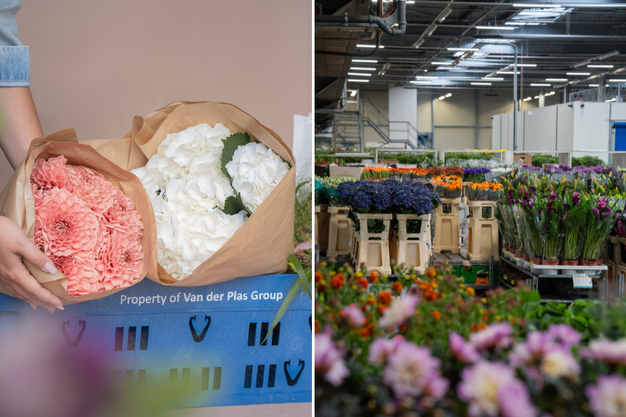
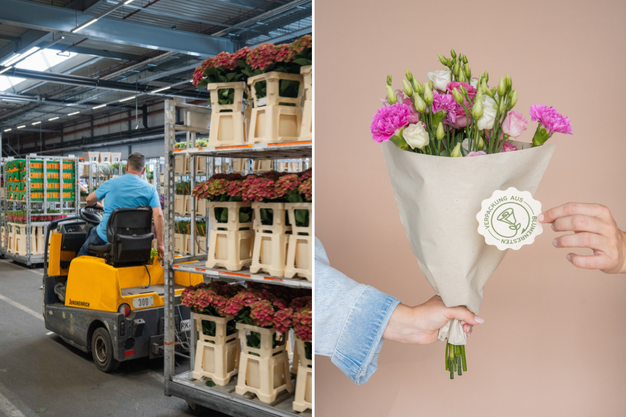
In France, where the group supplies cash-and-carry outlets, florists can return their packaging waste. While this system is still small-scale, Van der Plas Group already sees more German customers sending back their used packaging. The waste is then processed in the Netherlands, creating a recycling loop. Whenever possible, the company has also switched from cardboard boxes to reusable crates that can be used hundreds of times. "This way, we can influence the market ourselves and move toward our goal of using only recycled packaging materials by 2030."
Collaboration with competitors
The partnership with GHS goes well beyond footprint calculations. Van der Plas Group also takes part in the so-called 'Accelerators' group, alongside DFG, Royal Lemkes, FM Group, RFH, and VGB as chair. In this network, tools are tested and experiences shared. "It's special to see competitors working together. We set competition aside because sustainability serves a greater purpose," says Jeroen.
There's also 4Bulk, a packaging materials company co-owned by Van der Plas Group and FM Group. In collaboration with GHS, they've developed a footprint tool that calculates the environmental impact of all packaging materials. "All the data is stored in a central database. That allows us to see exactly how each type of packaging scores in terms of environmental impact. It gives us both better insight and better decision-making."
Digitization
In the years ahead, Van der Plas Group wants to accelerate digitalization. Sustainability data is currently reported monthly by all business units, but the aim is to transfer this automatically through API connections to central systems. "You need to be able to measure progress continuously. If you only discover after a year that emissions went up instead of down, it's too late. By reporting every month, we can act quickly."
 © Van der Plas Group
SBTi
From 2026 onwards, the group will also commit to the Science Based Targets initiative (SBTi). This global program requires companies to set both long-term and short-term goals, which are externally audited. "That's a serious motivator," says Jeroen. "It also helps that large retail organizations have already signed up. For us, it means we won't have to fill out endless questionnaires anymore, because our footprint will already be externally verified."
No sitting back
Even though the CSRD deadlines have been pushed back slightly, Van der Plas Group is not slowing down. "We notice that in the sector the sense of urgency sometimes fades, but we want to keep the momentum going," says Jeroen. That's why this year the group will publish a 'light' version of the CSRD report in the form of an ESG Report. This will give internal insight into the sustainability goals. "It helps us communicate with customers, but also keeps our own organization focused. You need clear, tangible goals, and a sustainability agenda supports that."
Structural cooperation
Here too, GHS plays an essential role. Besides providing footprint tools, GHS also organizes knowledge sessions and presentations, such as a recent SBTi briefing for Van der Plas Group's board. "We buy in their expertise and use their specialist knowledge to help our organization move forward," Jeroen concludes. "Sustainability is not a one-off project, but a journey full of new questions. With GHS as a partner, we have the support to keep finding the right answers."
For more information:
Greenhouse Sustainability
[email protected]
www.greenhouse-sustainability.com
Van der Plas Group
[email protected]
https://www.vanderplasgroup.com/