

Thanks to the shared use of nodes installed for the LED lighting in a recently completed Canadian greenhouse, the fans can now also be steered individually, and gradually. This approach, realized by Mechatronix and Svensson, reduces the need for traditional control cabling, lowers installation complexity, and provides growers with flexibility in grouping and operating the fans. "By using the same wireless dimming technology that already exists for LEDs, we can now apply full flexibility to fans and jets as well. This makes it possible to create the right air movement at the right time, with full flexibility in zoning."
 © Mechatronix
Chosing ClimaFlow
According to Dustin Mater, Svensson North America, the choice for ClimaFlow was driven by the growers' goal to create a more uniform climate, and to save energy. "They were looking to improve their climate and airflow in the greenhouse and to achieve a more uniform climate across the crop."
It's an important topic for growers switching to 100% LED, says Koen Vangorp with Mechatronix, emphasizing that lit crops require an active climate to reach their full potential. "If you don't create that active climate, you won't get the full efficiency out of the crop," he explained. "Something needs to stimulate more evaporation, and today, fans and jets are the most affordable solution for that."
As an example, Dustin explains that growers notice less heat at the head of the crop. "HPS fixtures release considerable radiant heat downward, which LEDs lack. The ClimaFlow fans help push the heat from the fixtures, which would normally rise into the curtain, back down into the canopy. That complements the LEDs and brings the heat to where it is needed."
ClimaFlow system
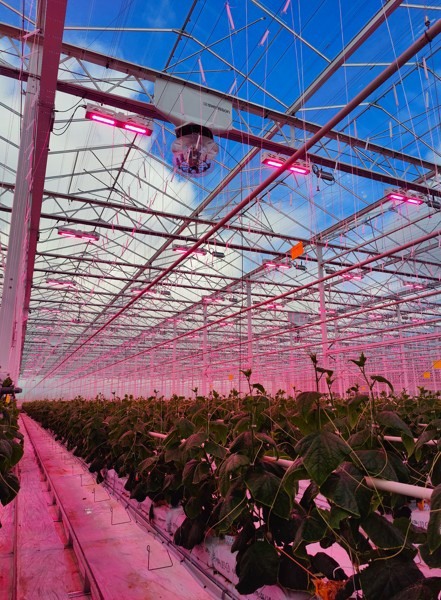
The ClimaFlow system is built around two parts. The VentilationJet is a white duct placed above the crop, drawing air from above the closed screen. This air, typically drier and cooler, is then introduced below the screen. Beneath the Jet, the ClimaFlow Fan ensures the air is distributed evenly across the crop. By ventilating in this way, the system creates a humidity difference between the air above the screen and below it. The drier air from above the screen is mixed into the crop environment, helping to manage relative humidity levels without requiring screen gapping. As the jets and fans can be controlled separately, the advantages continue when the screens are closed. "When the screens are closed, the jets bring in cooler, drier air without gapping, which means energy can be saved while maintaining humidity control. When the screens are open, the fans continue to mix the air in the crop", Dustin explains.
This separation of functions allows growers to respond to crop needs and climate conditions. "In high-transpiration crops like tomatoes, the need for active dehumidification is high, especially when energy curtains are closed. By using jets to bring in drier air from above the screen, growers avoid opening screens and losing energy. At the same time, the vertical fans continue to circulate air through the canopy, evening out temperature gradients and supporting CO₂ distribution."
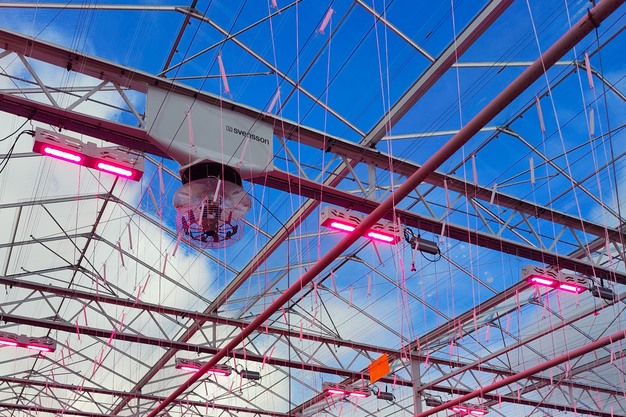 © Mechatronix
Nodes for fan control
Dominique Blok with Svensson explains that normally, fans are connected to a control cable and are hardware-defined to a specific climate group. However, by connecting the fans and jets to the same wireless system as the lighting control technology, the same flexibility we know from the lighting installation becomes available for ventilation control. The idea was first introduced by advisor John van Dijk, advisor with Looije Agro Technics, and the teams decided to go for it.
"With nodes, every fan receives its own address. For example, a façade group, a path group, or a central group can be defined in the climate computer. They can be grouped flexibly and reassigned later, so growers can adapt climate zones over time without hardware changes", Dominique explains.
The flexibility also extends deep into climate strategy, as all information is aligned via the Horti Lighting Protocol, connecting the lights to the climate computer. "In practice, you can now steer a cold façade separately from central crop rows or walkways," Koen added. "The climate computer – in this case Priva – creates these ventilation zones just like lighting zones, so growers can add 20 or more extra climate zones in their control tables. It's the same logic as light zoning, but now applied to air movement." And Priva has shown strong support as well, Koen noted. "They immediately saw the potential. The wireless network is already there because of the lighting, and now fans benefit from the same infrastructure."
Construction and maintenance
The node-based approach also influences the practical side of greenhouse construction and maintenance. "Cables can be a source of both cost and potential failures. With fewer control cables, installation is faster, less labor-intensive, and leaves fewer points of failure", says Dominique. "With nodes, there is no control cable to trace in case of failure. The system is also easier to maintain."
A final relevant detail is that the network continues to be used over summer, as the lights might be off, but the network remains active for the fans' control. This approach also opens doors for other greenhouse technologies. "Anything that doesn't just need an on/off switch but benefits from percentage-based steering could be connected in the future," Koen suggested, without revealing further details.

For more information:
Ludvig Svensson
[email protected]
www.ludvigsvensson.com
For more information:
MechaTronix
https://www.horti-growlight.com/
www.linkedin.com/company/mechatronix-led
[email protected]