


 © Thijmen Tiersma | FloralDaily.com
Five speakers gathered Thursday afternoon at Tomatoworld to share the latest updates on developments within the Do IoT Fieldlab. Yet the biggest attention-grabber of the day wasn't one of the speakers — it was someone, or rather something, that couldn't speak at all.
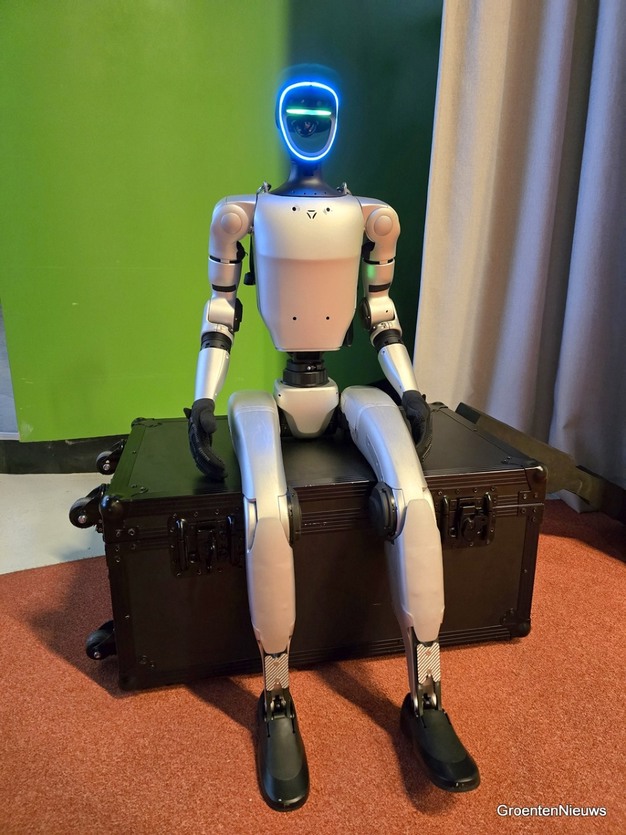
The star of the event could walk, wave, give high fives, and even shake hands (if you're brave enough). Soon, it will also be able to work inside a greenhouse. This human-like robot, a humanoid, has been acquired for research purposes within the Do IoT Fieldlab.
The greenhouse with 5G: A new export product
Over the past few years, the Do IoT Fieldlab has been testing how wireless communication can support the rapidly evolving greenhouse sector. At Tomatoworld's demonstration greenhouse, researchers have been exploring how 5G technology could be used in practice. The idea is simple but ambitious: if Dutch experts can operate greenhouses remotely via 5G, the "greenhouse with 5G" could become a brand-new export product for the Netherlands.
5G versus WiFi
Two speakers, Bas Piek from MCS and Stan van Nieuwamerongen from TNO, discussed 5G and its role in horticulture. Bas highlighted the unique characteristics of 5G and compared it with WiFi. One major advantage of 5G is the ability to set up a private network. Because such a network requires an official license, it is more secure and controlled than WiFi, giving operators full authority over who can access it.
Other benefits include extremely low latency and strong, stable connectivity, even when moving faster than 5 kilometers per hour. These features make 5G particularly suitable for agricultural and horticultural applications, where robots might be operating on such networks. Low latency is critical here, if a robot receives signals too slowly, it might constantly miss its target, for example, reaching for a tomato and grabbing just next to it.
Can 5G withstand tomato plants, and can tomato plants withstand 5G?
Wireless communication in a greenhouse comes with challenges, especially when there are tall tomato plants between the transmitter and receiver. Stan explained that TNO tested signal strength inside Tomatoworld's tomato greenhouse. At a relatively low transmission power of 100 milliwatts, the 5G signal reached about 37 meters, slightly less than WiFi.
However, 5G allows for higher transmission power, which extends its range. The technology still needs further refinement for greenhouse use, though. For example, the ideal modem hasn't been developed yet, and current devices drain batteries too quickly, requiring replacements every few months, which isn't practical for large-scale operations.
Researchers are also studying whether 5G has any effect on crop growth or pollinators such as bumblebees. So far, no negative effects have been observed on plants or pollination behavior.
Real-time monitoring of bumblebee movement
After the technical discussions, Wouter Stam from PATS shared a more hands-on example of 5G's potential applications. PATS' systems, including the PATS-C and the TrapEye, currently run on 4G, which still works perfectly well. According to Wouter, 5G remains too expensive for their current operations, but the company expects demand for high-speed data transfer to grow rapidly.
One of PATS' current projects, driven by market demand, focuses on monitoring bumblebee movement in real time. When a grower closes the screens in the greenhouse, for instance, they want immediate feedback on how this affects bumblebee activity, and consequently, pollination efficiency.
With 5G technology, such real-time insights may soon become standard practice in smart greenhouses, helping growers fine-tune both technology and nature to achieve optimal results.
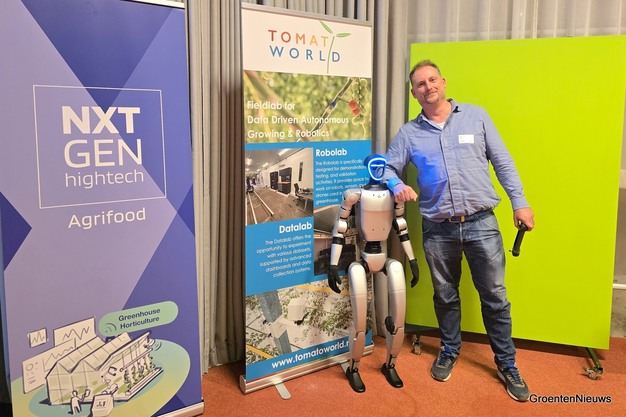 © Thijmen Tiersma | FloralDaily.comMartijn Lukaart next to the humanoid
Time for the humanoid
In the corner of the room, the humanoid patiently waited the entire time. Martijn Lukaart from Look-E explained to the thirty or so attendees, including several vegetable and ornamental growers, some of whom had even traveled from the Venlo region, why his team chose to work with Chinese robotics technology.
The humanoid at Tomatoworld is the Unitree G1, go ahead and look it up. It's the most affordable version currently available, capable only of performing pre-programmed actions. Martijn shared his ambition to jailbreak the humanoid, meaning he hopes to modify its software and hardware to make it more suitable for horticultural research. For now, the focus lies on improving the coordination between the robot's arm and hand.
Martijn is also involved in the Odd.Bot project, an autonomous weeding robot for agriculture, showing his broader interest in developing robotics for practical use in the field.
Futuristic?
To wrap up the afternoon, Aart van den Bosch from Tomatoworld played a short video filled with bloopers of humanoid robots struggling to walk or perform simple movements. It was a light-hearted reminder that, at this stage, even walking can still be a challenge for human-like robots.
For many growers, the idea of humanoids working in the greenhouse might still sound like science fiction, especially for those hoping for short-term automation to help solve labor shortages.
However, the Dutch horticultural sector has never been afraid to think ahead. Research is already underway to explore how humanoid robots might one day assist with simple tasks in and around the greenhouse. Picking tomatoes may still be a step too far for now, but repetitive manual tasks could soon be well within reach, or rather, within the grasp of a robotic hand.
For more information:
Do IoT Fieldlab
[email protected]
https://doiotfieldlab.tudelftcampus.nl/
MCS
[email protected]
https://www.mcs-nl.com/
TNO
https://www.tno.nl/nl/
PATS
[email protected]
www.pats-drones.com
Look-E
www.dexy.diy
Tomatoworld
www.tomatoworld.nl