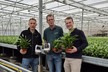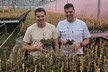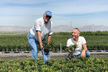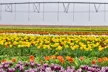


Ralaba, a modest village near Hinjilicut in Odisha's Ganjam district, has undergone a transformation evolving from a traditional rice-vegetable cultivation belt into a vibrant centre of tuberose (Rajanigandha) production. Guided by scientific interventions, institutional support, and the resilience of its farming community, Ralaba has demonstrated how high-value floriculture can emerge as a sustainable and profitable pathway to rural prosperity.
For decades, the village's farming families depended primarily on rice, vegetables, and betel vine. However, repeated cyclones and subsequent crop failures pushed the community into economic distress. Seeking a more reliable and remunerative alternative, a few progressive farmers began experimenting with tuberose cultivation on small plots. Their early success revealed the flower's strong market demand and higher returns, laying the foundation for a village-wide agricultural shift.
 © ICAR
A turning point in Ralaba's agricultural journey
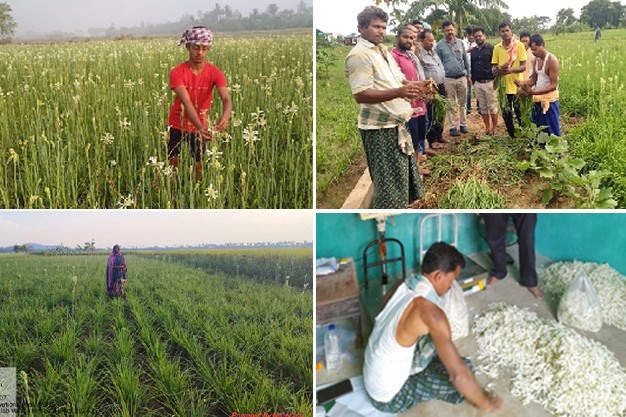
The real momentum began when Mr. Jhumar Dalei, a forward-looking farmer, learned about tuberose cultivation during an agricultural extension programme. With quality bulbs supplied by the horticulture department and the adoption of scientific practices, appropriate spacing, organic manuring, and timely disease management, he cultivated tuberose on half an acre and earned nearly ₹1.10 lakh in a single year. His success story inspired neighbouring farmers, and over time, vegetables were gradually replaced by tuberose as Ralaba's primary commercial crop.
Today, around 35 hectares in and around Ralaba are devoted to tuberose cultivation, supporting nearly 100 farm families who have established a stable livelihood around floriculture.
A journey of growth and opportunity
Tuberose blooms almost throughout the year, offering farmers a dependable income stream. Flowers from Ralaba now reach major markets such as Kolkata, Berhampur, Bhubaneswar, Cuttack, Puri, Sambalpur, and Rourkela, with traders from Andhra Pradesh procuring in bulk as well. With facilitation from the KVK, farmers formed the Ralaba Flower Growers' Association, strengthening collective marketing, improving price realization, and securing long-term market linkages. Demand peaks during festivals and wedding seasons, significantly boosting farmer earnings.
The transformation of Ralaba owes much to the sustained efforts of KVK Ganjam II, working under the technical and strategic guidance of ICAR ATARI Kolkata. KVK scientists trained farmers in scientific flower cultivation along with Integrated Nutrient Management and Integrated Disease Management. They introduced improved varieties such as Arka Prajwal from ICAR IIHR Bengaluru through frontline demonstrations. They also promoted soil test based fertilization, biofertilizers, OUAT consortia, vermicompost, and karanja oil cake to boost yield and flower quality. Support from the District Horticulture Department helped farmers access planting material, input subsidies, and technical assistance. KVK further encouraged collective marketing and strengthened farmer associations to build a sustainable enterprise.
Building an ecosystem for floricultural expansion
Ralaba's success is rooted in effective convergence among research, extension, and development institutions. KVK Ganjam-II, as the nodal facilitator, linked farmers with multiple support systems. The Department of Horticulture provided quality inputs, technical guidance, and subsidy assistance, while ICAR-IIHR, Bengaluru strengthened varietal improvement through field demonstrations. Schemes such as MIDH and the State Horticulture Mission provided additional financial support, training, and marketing infrastructure. Local governance bodies, banks, and farmer associations also played critical roles in ensuring sustained credit access and market integration.
This convergence model illustrates how coordinated institutional efforts can upscale niche agricultural enterprises and transform them into sustainable livelihood options for rural communities.
The shift to tuberose cultivation has significantly enhanced income and employment opportunities in Ralaba. Many farmers now earn several times more than before, while regular labour demand in floriculture has created steady employment for local workers. Women have emerged as key contributors in harvesting, sorting, and marketing activities, fostering both economic and social empowerment. Collectively, tuberose farming now generates over ₹1.2 crore annually, sustaining nearly 100 farm families. Ralaba has become a model village for floriculture, attracting farmers from neighbouring areas eager to emulate its success.
Ralaba's journey is a testament to the transformative impact of scientific guidance, community resilience, and coordinated institutional support. Through the combined efforts of KVK Ganjam-II, ICAR-ATARI Kolkata, and the village's determined farming community, a once-vulnerable agricultural landscape has blossomed into a thriving hub of high-value floriculture.
Today, Ralaba the "fragrance village" of Odisha—stands not just as a success story but as a living example of how knowledge, innovation, and collective will can convert ordinary soil into lasting prosperity. Its story embodies the spirit of Atmanirbhar Krishi and contributes to the broader national vision of Viksit Bharat, proving that the true fragrance of fortune blooms where science meets community spirit.