

In the evolving landscape of controlled environment agriculture (CEA), airflow is emerging as a critical yet often misunderstood variable. While engineers and plant scientists use the term differently, aligning these definitions is essential for optimizing plant health and productivity in advanced growing environments.
This Insight highlights how airflow—specifically the movement of air around the leaf surface—directly influences photosynthesis, transpiration, and nutrient uptake, especially calcium, which is vital for preventing disorders like tip burn.
With increasing investment in growth chambers, walk-in rooms, and vertical farms, growers and researchers can benefit from an understanding of how airflow disrupts the boundary layer, why poor airflow leads to physiological disorders, and how to measure and optimize airflow.
 © Conviron
Plant scientists and engineers often have different definitions for similar environmental metrics, one being airflow. Engineers define airflow as a volume of air that is moved from one location to another and is measured in volume over time (m3/s). In plant research and crop cultivation, plant scientists often use the term airflow to define the flow of air around and in close proximity to the leaf. However, the engineering term for this is airflow, sometimes referred to as air speed, and is measured in distance over time (m/s). The horticultural term airflow will be used herein.
Why is airflow important?
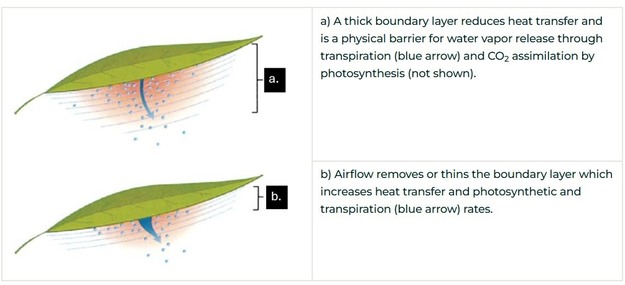
Airflow is important for healthy crop production because it impacts heat transfer from the leaf, photosynthesis and transpiration rates. In still air, microclimates form around the leaf creating a layer of stagnant air known as the boundary layer which can slow the diffusion of gasses into and out of the leaf. Stomata are pores, typically on the underside of leaves where gas exchange takes place, CO2 enters the leaf for photosynthesis and water vapor (H2O) exits through the process of transpiration.
In controlled environments, proper airflow plays an important role by creating a physical environment that will improve plant growth through increased heat dissipation, photosynthesis and transpiration rates. As air flows past the leaf, the boundary layer is disrupted and thins allowing faster diffusion of heat and gasses into and out of the leaf.
Figure 1. The boundary layer is a calm layer of bulk air that is dissipated by air flowing across the leaf.
 © ConvironFigure 1
Airflow & tip burn
Tip burn is a common problem that affects many cultivated crops grown in the field, however it is more prominent in indoor grown crops. It is a physiological disorder that causes necrotic or burned looking margins in young, newly emerging leaves or fruits.
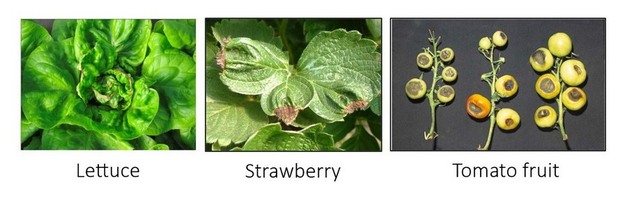 © ConvironFigure 2. Examples of tip burn in lettuce, strawberry and tomato fruit (blossom end rot)
In the field, tip burn can be attributed to nutrient deficiencies, pests, disease, heat or drought among others. In contrast, in controlled environments it is typically caused by local calcium deficiencies due to thick boundary layers caused by poor airflow around the leaves [10]. Unlike many nutrients, calcium is passively drawn into the root and pulled up the plant through the xylem by the force of transpiration. To avoid tip burn in growth chambers reducing plant density will help but the most effective way is adjusting the airflow to enhance transpiration. Even when calcium is abundant and available, transpiration is required to pull it up and distribute it throughout the plant.
How to measure airflow
When publishing research experiments, The International Committee on Controlled Environment Guidelines recommends reporting airflow by describing the sensor type, predominant flow direction, the number of measurement points, and their location relative to the plant canopy. There are many instruments available for measuring airflow (m/s) in field or greenhouse conditions, but they are large and cannot measure low air velocities that occur in growth chambers. The hot-wire anemometer is a good choice for measuring airflow in environmentally controlled growth chambers and rooms as it has high sensitivity at low airflows, linear output of data, rapid response, small size, cosine corrected and temperature compensation.
A disadvantage of many hot-wire anemometers is they are directional, however omnidirectional are available and useful for measuring airflow around leaves and within the canopy in confined spaces. When using a hot-wire omnidirectional anemometer it is necessary to take the average of at least 10 readings at each location in a grid across the grow area.
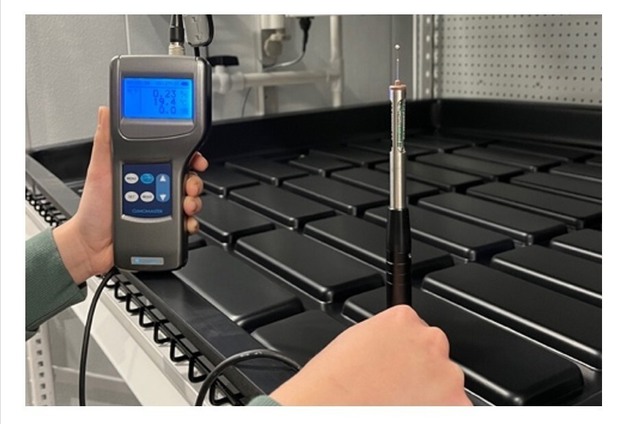 © ConvironFigure 3. Example of a hot-wire omnidirectional anemometer measuring airflow in a Conviron MTPS 288. The average of 10 measurements were calculated for each of the 9 locations in a 3x3 grid on each shelf. These are good anemometers for low velocity environments.
How much airflow do plants need?
In the field crops experience air velocities ranging between 0.0-8.0 m/s with wind gusts up to 20 m/s. In large greenhouses airflow is typically set to approximately 0.3 m/s. In controlled environments such as growth chambers, walk-in growth rooms or vertical farms it is recommended that airflow received by the plants should be between 0.3-1.5 m/s [14,15,16]. Air velocities will depend on the type of crop and if it is being grown under high light, high temperatures or high humidities. When airflow is too low photosynthesis, transpiration and growth slows down and tip burn can be induced and when it is too high it can cause excessive transpiration and growth abnormalities.
For more information:
Conviron
Phone: +1 701 280 9635
www.conviron.com