

Innovative nursery techniques are being used in South Africa's Western Cape to supply growers with strong, healthy trees ready to hit production in the second year.
Combining tissue culture rootstocks with 'green-grafting' techniques and bag-grown trees, South African Cape Sweet Nursery is able to produce robust 1.8m whip trees with strong root systems and the flexibility to plant outside the traditional winter/spring planting window within 22 months.
What first began in 2014 as an experiment by grower ZZ2 to address a shortage in dwarfing rootstocks such as M9 to underpin orchard intensification, a decade later supplies around 230,000 trees a year commercially from a base under nets at Koue Bokkeveld, in the Ceres region of the Western Cape and has plans to expand further.
In June, growers on the 2025 APAL International Tour were given a comprehensive tour of the impressive 2-hectare site by Hendrik Pohl, of Holistic Horticulture, and an insight into the techniques, the meticulous process and why the trees reward the higher outlay.
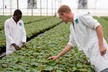
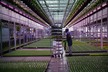
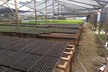
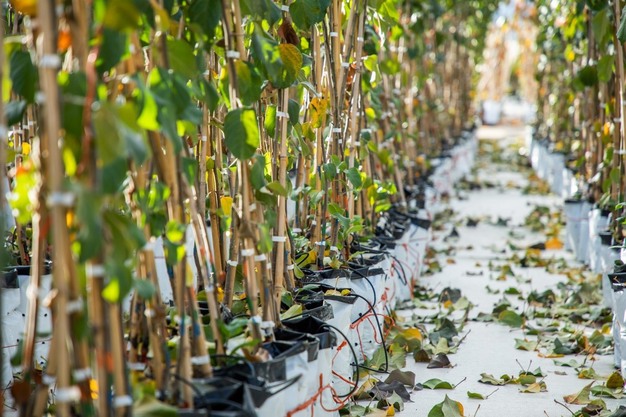
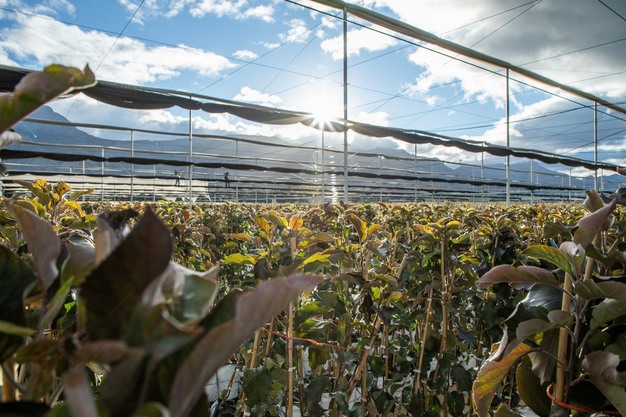
As workers tightrope walked the netting supports overhead to roll back nets, visitors were shown through rows and rows of tightly packed bagged-trees, where everything from the medium, irrigation and light could be manipulated to produce the best trees.
The aim, Hendrik said, was to provide consistent, healthy trees with roots intact that could be in the ground in time to capitalise on the autumn root flush and achieve strong early growth.
"The goal is to prepare trees that will establish well after transplanting," Hendrik said. "The reason to do it is to set up a new orchard that will bear fruit from the second leaf. This may be a small crop of 10–15 tonnes/ha, but the fruit are essential to enable a well-balanced tree and to set the planting up to have an accumulated crop yield in year six in excess of 300 tonnes per hectare."
Hendrik said in low chill areas it was better to plant a tall tree than a small tree and try to grow it high. Newly planted trees struggled in low chill areas to develop a good dominant leader.
 © iSee Creative
"The success of the trees is not the size, it is in the conditions in which they grow; the nursery is in a good high chill area, preparing the trees to be well adapted in year one after transplanting," he said.
'Green-grafting'
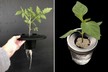
Trees are produced by either bench or 'green-grafting' the scion to tissue-cultured rootstocks in the spring, after which they are grown to 20–30cm before being transferred to a bag for a further 9 months over the summer, to produce a 1.8–2m tree within 22 months.
Tissue-cultured rootstocks are sourced locally from plant biotechnology company – and partner, with ZZ2, in Cape Sweet – Vitroplant SA. Tissue-cultured rootstocks are preferred not only for the fast-tracking of supply of in-demand rootstock cultivars they provide, but for uniformity, quality and disease-free status.
"The trees cost more because of the tissue culture, but there are less losses," Hendrik said.
The nursery is moving from bench to 'green-grafting', a technique where the rootstock is grafted to the scion while it is still green using a green-graft to form a strong graft union.
While grafting is traditionally done in late winter when trees are dormant to reduce the risk of shock and allow the scion time to heal before spring, Hendrik said grafting with green rootstock and scion worked well, producing a good, strong graft union as well as providing flexibility of timing.
"While both rootstock and scion are still green material, the whole stem diameter is part of the union, and not only the outer cambium as in traditional methods," he said. "It produces a good graft union on new generation rootstocks that are less prone to break off at the graft union, with less risk of disease, that also produce larger trees at the time of delivery.
"The only constraint is that scion wood has to be green," he said.
Visiting growers were shown just how effective the technique was as Hendrik cut into a previously grafted tree to reveal almost no visible sign of the graft.
 © iSee Creative
The young trees are transferred to 7.5 litre bags the winter prior to delivery and grown out in a medium of coco peat, compost, wood chip and gypsum, drip irrigated and fertigated.
Netting and irrigation are used to manipulate growth, with black nets closed up in spring to reduce light and encourage growth and reopened 6–8 weeks prior to delivery to harden trees up. Hardening or maturing of the leaders is essential for good transplant, Hendrik said.
"Customers pay for large trees and should be able to utilise the size after transplanting, by not cutting leaders back," he said.
Available by order only
Given the time and investment involved, trees are produced to order only and a lead time of at least two years is recommended.
The nursery services all South African growing regions and, as trees are supplied to order and allocated to a grower at the start of the propagation process, Hendrik said the nursery could supply any type of tree the customer ordered.
Source: APAL