


WUR researcher Eveline Snelders and two PhD candidates have mapped the spread of the (drug-resistant) fungus Aspergillus fumigatus across the Netherlands. This fungus can cause life-threatening infections in people with weakened immune systems. While the fungus is ubiquitous in the air, the resistant variant was found more often in greenhouse horticulture and flower-bulb regions. A ban on fungicides will not solve the problem in the short term, Snelders says. "What could be effective is removing piles of green waste - where this fungus naturally thrives - more quickly."
Which fungus is this?
"Aspergillus fumigatus is a common fungus found worldwide, including in the Netherlands. It grows well in organic waste, such as large piles of agricultural plant waste. From these piles, spores spread through the air. Everyone inhales these spores daily; with a healthy immune system this causes no problems. People with severely weakened immunity - think ICU patients or those who have undergone chemotherapy - cannot clear the spores from their lungs effectively, which can lead to infection. An estimated two hundred people die from this each year in the Netherlands."
 © Wageningen University & Research
How did you carry out the research?
"Two years ago we invited citizens to take part in the measurements. PhD candidates Bo Briggeman and Hylke Kortenbosch set up and supervised the project with me. To achieve good national coverage, we divided the Netherlands into 100 equal areas and aimed to select three citizen scientists per area to hang a trap to capture airborne fungal spores. After a media call-out, more than 8,500 volunteers registered within days. We ultimately sent the sampling kit - with trap and adhesive seals - to 500 participants, giving excellent coverage across the country. Over four weeks, the traps collected pollen, dust and fungal spores from the air. When the seals were returned to the lab, 80% of the samples proved usable. In total, we cultured A. fumigatus spores from 355 traps."
How did the culturing work?
"The adhesive seals carried many different fungal spores, but we only wanted to culture Aspergillus fumigatus. We therefore used a selective growth medium and incubation temperature on which only this species can grow. We used three Petri dishes per trap. Petri dish 1 allowed all A. fumigatus spores to grow; Petri dishes 2 and 3 contained two different antifungal agents. This allowed us to determine how many spores were resistant to these medicines."
How many spores did you find?
"A lot. Most plates had at least thirty A. fumigatus colonies; some had as many as 150. A colony arises from a single spore that grows into a fungal network and can be counted with the naked eye."
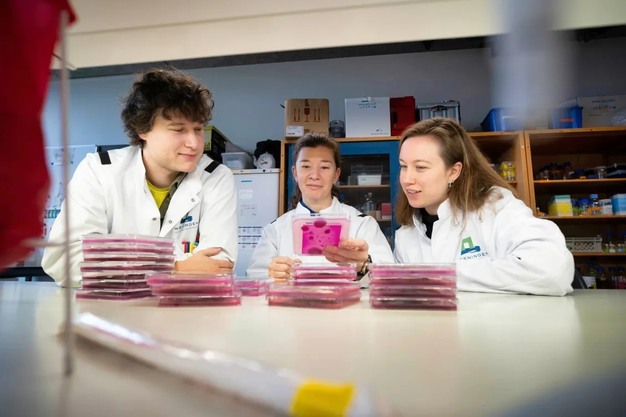 © Wageningen University & ResearchResearchers Hylke Kortenbosch, Eveline Snelders and Bo Briggeman.
Where was the fungus found?
"Everywhere - we detected the fungus in the air across the Netherlands, with little difference in overall spore loads between regions; only near the sea did we observe slightly lower concentrations. However, the proportion of resistant spores in the air did vary.
We analysed land use around 355 sampling points using the "Land Use of the Netherlands" map. This map distinguishes 51 classes, including major crops, forest, water, nature and urban areas. Around each sampling point we drew a 10-km radius circle and calculated the share of each land-use type within it. This enabled us to test whether local land use predicts how many resistant spores occur in the air."
Where did you find more or fewer resistant spores?
"We found relatively few resistant spores in urban areas and in regions with extensive maize cultivation. By contrast, we observed relatively high levels of resistant spores in areas with many greenhouse horticulture and flower-bulb production."
Are these fungi resistant because horticulture and bulb growers use many azole crop protection products?
"We did not investigate how resistance arises; we only measured where resistant spores occur in the air and in what quantities. From earlier work we know three factors play a role. First, the presence of plant-waste piles – such as large waste heaps that are present in the horticulture and bulb sector where this fungus thrives. Second, the presence - even at low concentrations - of antifungal agents in those piles, including azoles. (Azoles are a widely used group of antifungal agents applied in both medicine and agriculture.) Third, at some companies the heaps remain on site for a long time rather than being removed quickly, for example when composting is done on-site. In that situation, and in the presence of antifungals, the resistant variant gains a growth advantage and ultimately can become more prevalent in the air."
Is recycling a risk in this case?
"Correct. Over the past decade, farmers and growers have been encouraged to work circularly - recycling on site or sourcing locally - but this creates a risk of selecting for resistance in this fungus. To be clear: growers do not use products to control Aspergillus fumigatus itself. The fungus does not damage crops; it breaks down plant waste. It naturally occurs in waste heaps. But if growers use fungicides, these can end up in the waste heap together with A. fumigatus. Under those conditions, resistant fungi can outcompete susceptible ones."
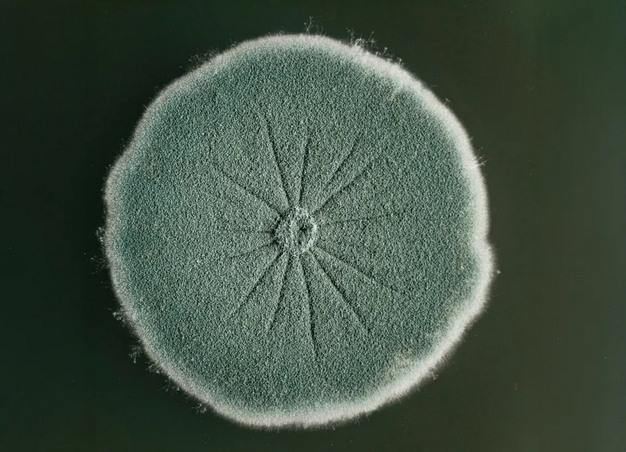 © Wageningen University & ResearchAspergillus fumigatus
Which resistances challenge healthcare?
"In the Netherlands, two mutations in A. fumigatus are most commonly found in patients. We detected spores with the TR34 mutation nationwide across all land-use types, though slightly less frequently in urban areas. The TR46 mutation, however, was more frequently found in areas where greenhouse horticulture and bulb production are dominant - sectors with high use of antifungal agents. Historically, TR34 was detected ten years earlier than TR46. TR46 is now more common in greenhouse regions, but we do not yet know why. Is TR46 perhaps less fit than TR34 outside waste heaps containing antifungals, making it spread less easily? Or will TR46 spread more widely across the Netherlands in the coming years and eventually become more common in patients as well? These findings help us understand the current distribution of the resistant fungus but also raise new questions. The RIVM and Radboud University Medical Centre would like to investigate these further. For example: do patients with TR34 or TR46 infections predominantly live in areas with particular land-use patterns?"
What is the solution: fewer azoles or fewer piles of green waste?
"We expect that stopping the use of a single antifungal class to which the fungus is resistant will not rapidly reduce resistance levels in the air. The fungus is also resistant to other antifungal compound classes, which can persist in the environment for a long time.
Focusing on waste-stream management is likely to be more effective. Removing waste heaps sooner and avoiding large piles left in the open for long periods may help reduce the release of new resistant spores into the air."
Who will look into this?
"Our study raises new questions and offers opportunities to better understand the observed differences in airborne resistant spores. We can, for instance, take targeted samples from waste heaps in areas with high versus low levels of resistance, to clarify risk and the origins of resistance selection. It would also be valuable to repeat this study in a few years - to track the spread of (resistant) A. fumigatus or, better still, to measure the impact of interventions on airborne levels. We now have an effective, low-cost monitoring method, and public participation was a major success. It would be excellent if one of the relevant ministries, together with RIVM, will follow this up."
For more information:
Wageningen University & Research
www.wur.nl