

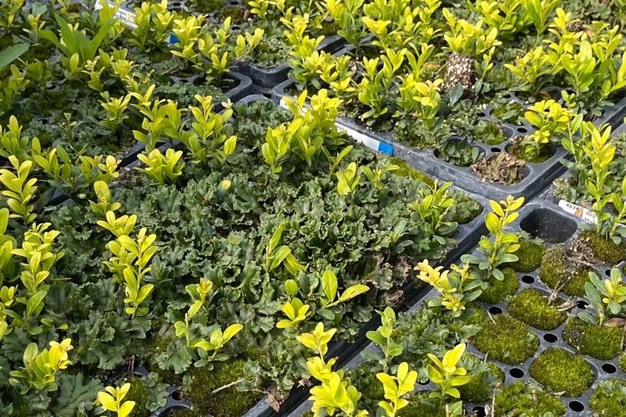
Liverwort (Marchantia polymorpha) is a key greenhouse weed that competes with the ornamental plant for soil, nutrients, water and space within greenhouse containers. When the growing substrate is covered in liverwort, there is a decrease in the quality, aesthetic and market value of the ornamental plants. Currently, there is only one herbicide (i.e., flumioxazin) labeled for liverwort control in nursery production, but not inside the greenhouses and no other chemical options are available for managing liverwort.
 © Heidi Lindberg, MSU Extension
With funding from the Western Michigan Greenhouse Association and the Metro Detroit Flower Growers Association, Debalina Saha, PhD, of Michigan State University Extension, and her lab sought to develop an effective and economic method of liverwort control for greenhouse container production of ornamental plants. Their previous research on non-chemical methods has shown that sub-dressing controlled-release fertilizer can reduce liverwort growth in container production. They also found that extracts from organic rice hull mulch can provide 80% liverwort control for four weeks as a biopesticide due to its allelopathic properties and ability to keep the substrate dry.
Based on previous research results, the goal of this project was to further investigate the efficacy of a fungicide/sanitizer, Zerotol (hydrogen peroxide), and an organic miticide called TetraCurbMax (castor oil plus rosemary oil plus clove oil plus peppermint oil) for preemergence liverwort control inside greenhouses. Zerotol and TetraCurbMax are already labeled for inside greenhouse uses for controlling fungus, bacteria, mites and insects and have a 0-hour restricted entry interval (REI). Hence, these products are safe and easy to use by the workers inside the greenhouse.
Methods
In order to test the products, nursery square containers were filled with standard substrate (Suremix) amended with osmocote fertilizer and were irrigated and kept inside the greenhouse for one day. After one day, the pots were taken out from the greenhouse and treated with either 0.25X, 0.5X, 1X, 2X and 4X rates of fungicide Zerotol (hydrogen peroxide) and organic miticide TetraCurbMax (castor oil plus rosemary oil plus clove oil plus peppermint oil). A combination of Zerotol and TetraCurbMax (1X rates each) was also included. The pots were inoculated with the gemmae of liverwort one day after chemical preemergent treatment and then weekly to each container for seven weeks.
For liverwort inoculation, gemmae were collected by first scraping gemmae cups of vigorous common liverwort stock plants and releasing the gemmae into a 250-milliliter bowl of tap water, where they separated out from their clumps. A plastic spoon was used to apply approximately 5 milliliters (1 teaspoon) of water from the bowl, which contained approximately 20-25 gemmae, across the surface of each container.
For data collection, a visual estimation of the percent control of liverwort was done weekly for seven weeks after treatments, where 0% means no control and full of liverwort and 100% means total control. The fresh weights of liverwort were also recorded at seven weeks after treatment.
Results
Gradually, the substrate surface became completely covered with liverwort over the course of the seven-week experiment. There were no significant differences between treatments (Figure 1). However, on the third week, Tetracurb Max provided the highest liverwort control, where only 23.3% coverage was recorded (Figure 2). This is followed by Zerotol (24.7% coverage) and then Tetracurb Max plus Zerotol (25.6% coverage).
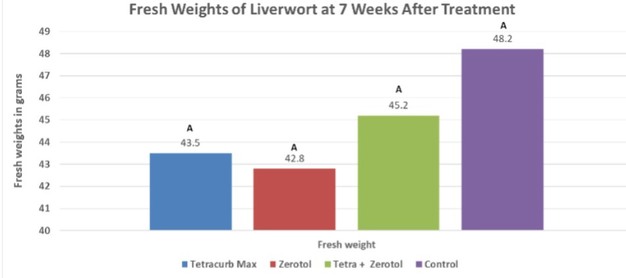 © Michigan State UniversityFigure 1. The graph shows the fresh weights (in grams) of liverwort at seven weeks after treatment.
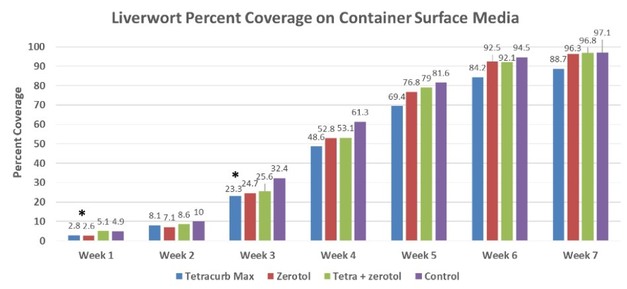 © Michigan State UniversityFigure 2. The graph shows the visual estimation of liverwort percent coverage on container surface media.
Tetracurb Max provided the best liverwort control for three weeks. This fungicide and miticide can be applicable for short-term (about three weeks) liverwort suppression only. For a longer-term liverwort control, growers need to follow integrated approaches where different methods, such as cultural (mulching, sanitation) controls, are used in combination with chemical methods.
Source: Michigan State University