

Sustainability begins in the DNA. At Schoneveld Breeding, specialists work every day on genetics that are ready for a sustainable future: strong plants that grow efficiently while requiring minimal energy and chemical inputs. Growing support specialist Hassan Hadid and area manager South America Jerry van der Spek share their vision on low-input breeding. "Our plants aren't just beautiful, they grow efficiently and require fewer resources. Low-input breeding as a sustainable strategy."
 © Schoneveld Breeding
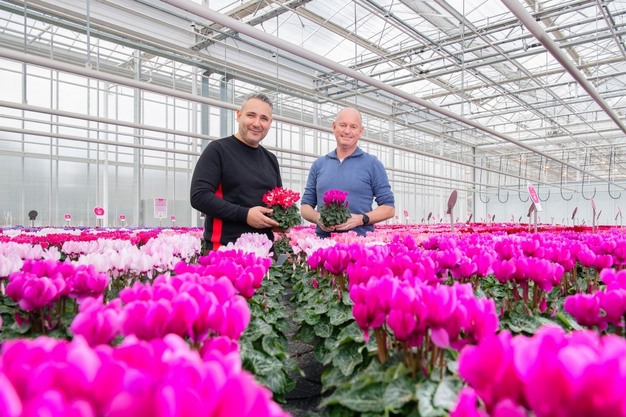
Hassan and Jerry
Schoneveld Breeding stands for N-xt Gen genetics: genetics that benefit both the planet and the grower. "Of course, it's about varieties that are attractive and uniform," Jerry explains. "But above all, they're stronger. Plants that thrive with less chemistry, fertiliser, growth regulators and energy." And the demand from growers for these kinds of varieties is rapidly increasing. Risks must be low, and so must the cost price.
Sustainable DNA
"Sustainability has been part of our DNA from the very beginning," says Hassan. "We believe real progress starts with smart genetics. When a plant is naturally efficient, everyone benefits." The biggest challenges facing growers today are energy costs and labour costs. At the same time, fewer chemical products are permitted. "That's why we develop plants that make it easier for growers to work sustainably," Hassan explains.
Low-input breeding
Concrete results show that Schoneveld Breeding is on the right track. Jerry: "Growers notice they need less fertiliser, less water and less energy. Savings can reach 10 to 15 percent, while maintaining the same level of quality." As Jerry puts it: "Less input, same output. That's what we call low-input breeding."
An important part of sustainable breeding is natural resistance to disease. "We don't use fungicides on our breeding plants," says Hassan. "That helps us identify which plants are naturally strong. Those are the plants we use for further crossing and testing. The varieties that follow have their own defence mechanism and therefore require fewer crop protection products."
Water management also plays a key role. Jerry: "We test extensively how plants respond to different levels of irrigation. The plants that perform best with limited water are selected for further breeding."
A diverse range of sustainable genetics
The biggest leap forward, according to both Hassan and Jerry, has been made in Cyclamen breeding, with strong genetics that require less input and offer high resilience. But improvements are visible across other crops as well. Primula Paradiso requires fewer growth regulators and has a naturally robust habit. Ranunculus Sprinkles performs strongly under energy-efficient cultivation, has strong foliage and offers long-lasting shelf life.
"And take Gerbera Joybera," says Jerry. "It's a uniform plant with a compact growth habit, allowing growers to reduce the use of growth regulators." Gaultheria Ciao Bella shows strong resilience against diseases, and Illusia offers exceptional shelf life, essential for both retailers and end consumers.
Sustainable production
Sustainability at Schoneveld Breeding goes beyond genetics; it is also embedded in its working processes and production facilities. At the main site in Wilp, a closed water system is in operation. The facility reuses heat and treats wastewater. "Our greenhouses and LED lighting are energy efficient as well," Hassan explains. "We also have solar panels, and we're in discussion with the waste processor across the road to potentially use their biogas."
A sustainable future
Low-input breeding is increasingly becoming the norm, Hassan expects. "Schoneveld Breeding is ahead of the curve with genetics that perform optimally under low-input conditions. Innovation is shifting more and more towards efficiency." The ongoing challenge is to balance sustainability with commercial demands. Jerry: "A sustainable plant must be strong, but still meet the market's expectations in colour, size and shelf life."
X-tra value
Across the chain, delivering added value is always central. Hassan: "From breeder to consumer, everyone benefits from more efficient and sustainable genetics. That's what we stand for at Schoneveld Breeding: we always deliver x-tra value, today and for the future."
Schoneveld Breeding
Sluinerweg 15
7384 SC Wilp
Tel: +31 (0)571 27 17 17
[email protected]
www.schoneveld-breeding.com