
The propagation of orchids is characterized by a long cultivation period and a high heat demand. How can this cultivation process become smarter, cleaner, and future-proof? Rather than searching for answers individually, several orchid growers have joined forces and are investing in innovative solutions. Together with PlantLighting and Certhon, they are investigating whether fully daylight-free propagation could be a breakthrough. The results so far are promising.
Collaboration as the key
The initiative began at the end of 2023, when Ter Laak Orchios and Certhon started discussing further sustainability pathways within Phalaenopsis cultivation. Various brainstorm sessions and technical calculations revealed that fully daylight-free propagation could drastically reduce heat demand compared to traditional glass greenhouses. Moreover, much of the electricity required for lighting can be generated locally. The key question remained: is it possible to grow a high-quality orchid without sunlight?
Richard ter Laak explains why collaboration is essential: "We are all facing the same challenges, and together you get further. You can try to reinvent the wheel on your own, but that doesn't work. By sharing knowledge, you make fewer mistakes and reach solutions faster that benefit the entire sector."
Because the ambition to cultivate more sustainably and energy-efficiently is shared across the sector, the Pot Orchid Crop Cooperative submitted a subsidy application to Kas als Energiebron to thoroughly investigate this cultivation concept. The result is an innovation project centered on collaboration and knowledge sharing. In addition to Ter Laak Orchios, several leading growers are participating, including Opti-flor, Levoplant, Anthura, Pikoplant, and Floricultura. Together, they form a supervisory committee that visits the trial location every two weeks to advise and exchange knowledge.
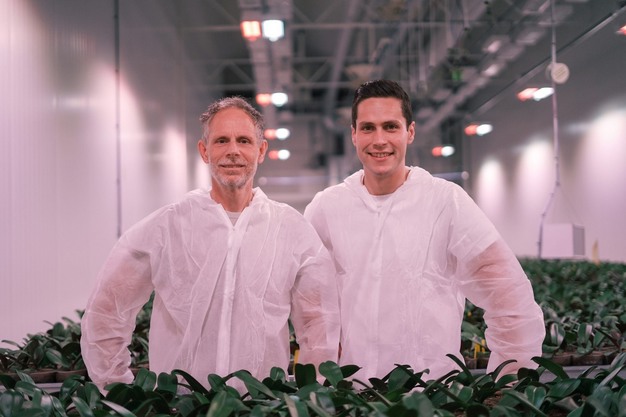 © CerthonRichard Ter Laak and Jaap Weerheim
The need for an innovation partner
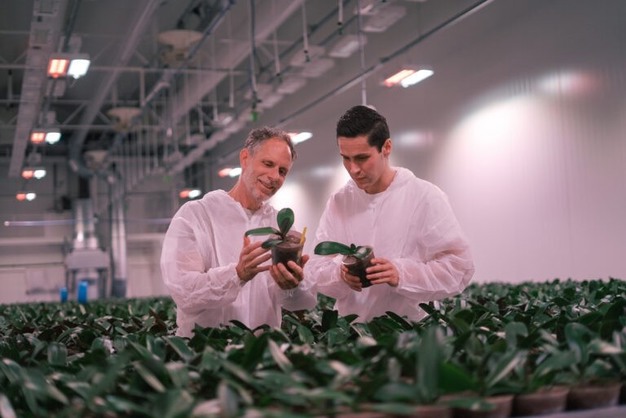
The practical trial is taking place at the Certhon Innovation Centre, in two daylight-free cultivation cells of 160 m² each. Orchids are propagated here under fully controlled conditions. Sandwich panels replace the traditional glass greenhouse roof, retaining heat inside. Solar panels on the roof generate energy for LED lighting. An air handling unit with heat recovery ensures efficient dehumidification, while air distribution via ducts precisely controls evaporation.
"The orchid propagation phase is ideally suited for a daylight-free climate chamber," says Jaap Weerheim, Technical Specialist at Certhon. "The crop requires a lot of heat and relatively little light. In a closed cell, you can regulate that balance much more precisely than in a greenhouse, where systems constantly need adjustment."
All processes are monitored, analyzed, and controlled by the renewed Certhon Control System, which continuously optimizes growing conditions. Scalability was a key consideration in designing the test cell: the applied installations serve as a blueprint for commercial application.
According to Ter Laak, this combination of expertise and facilities is decisive: "What makes Certhon unique is the Certhon Innovation Centre. Having your own R&D facility as a greenhouse builder is incredibly valuable. The short communication lines, expertise, and ability to make immediate adjustments truly make the difference. Proper integration of climate, lighting, and humidity is essential."
A future-proof cultivation method
The results are encouraging. Heat demand has been reduced by nearly 70% compared to a traditional greenhouse, while the additional electricity consumption is largely offset by the solar panels on the sandwich roof. Plant quality and growth speed are increasingly approaching those of the reference cultivation, and uniformity is visibly improving. While the project is not yet complete, the trend is clearly positive.
 © Certhon
"It would be great if we could make a significant step forward in sustainability," Ter Laak emphasizes. "This means cost savings, energy savings, reducing the footprint, and ultimately delivering a better, cleaner product that remains affordable for both growers and consumers."
Daylight-free cultivation also offers operational advantages. Control becomes more autonomous, growing conditions remain constant, and external influences no longer play a role. Integration with sustainable energy sources is also more effective. The heat demand of daylight-free cultivation is more evenly distributed throughout the year, allowing geothermal energy, for example, to be used much more efficiently than in traditional greenhouses, where heat demand fluctuates significantly.
From trial to practice
The current trial demonstrates that daylight-free propagation is technically feasible and energy-efficient. Investment costs are comparable to those of a modern glass greenhouse equipped with screening systems, while operational returns are considerably more favorable. The technology is primarily intended for new construction projects. Retrofitting existing glass greenhouses with sandwich panels is usually not technically feasible.
According to Weerheim, the greatest value lies in the realistic nature of the trial: "We are not testing in a laboratory environment, but in a setup that can be directly translated to commercial cultivation. Everything we learn here can be applied immediately by growers with the right technologies and resources. That's what makes this trial so valuable."
The next step is already underway. At the end of October, a new trial started: one cell repeats the previous test, while the other explores opportunities for further energy savings.
"This orchid trial shows that collaboration truly moves us forward," concludes Ter Laak. "Not just for us, but for the entire sector. By sharing knowledge and risks, we are taking steps toward a future in which we cultivate more sustainably, intelligently, and reliably.
For more information:
Certhon
ABC Westland 555
2685 DG, Poeldijk
Tel.: +31 (0)174 22 50 80
[email protected]
www.certhon.com