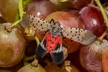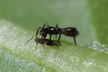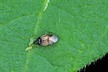


The two-spotted cotton leafhopper, Amrasca biguttula (Ishida) (Hemiptera: Cicadellidae), is an invasive species native to the Indian subcontinent and an emerging pest of cotton, okra, eggplant, and hibiscus (Hibiscus syriacus; Malvaceae) in the southeastern United States.
Its presence in ornamental nurseries has not been previously documented, posing a serious threat to hibiscus. This study aimed to evaluate the incidence of feeding damage and the potential spread of the pest across plant species within a nursery; thus, a study was conducted in a Georgia (USA) wholesale nursery in 2025. Researchers used leaf samples to determine establishment, and leaf discoloration to categorize damage. Researchers used yellow sticky cards to detect the presence of adults. Results showed that the life stages of A. biguttula were more common in the upper canopy than in the middle and lower levels. Both leafhopper numbers and exuviae were higher on the 'Bali' cultivar of H. syriacus compared to 'Dark Lavender Chiffon'. No stages were found on neighboring species, including abelia, vitex, and rose. Yellow sticky card captures confirmed that adults were present on hibiscus cultivars. Feeding injury on H. syriacus was characterized by yellowing at the margins that spread inward and puckering of young leaves. Feeding damage ratings were significantly higher on 'Bali' than on 'Dark Lavender Chiffon', and adult captures were positively linked to damage severity.
This is the first report of A. biguttula infestation and related injury on hibiscus in a U.S. wholesale nursery.
Attia, S.; Joseph, S.V. Incidence of the Two-Spotted Cotton Leafhopper (Hemiptera: Cicadellidae) Infesting Hibiscus syriacus in Ornamentals. Agronomy 2026, 16, 32. https://doi.org/10.3390/agronomy1601003
Source: MDPI