
Warmer winters may be changing the flowering times of plants, with a domino effect on all forms of wildlife. Since 2011, the Botanical Society of Britain and Ireland (BSBI) has collated data on what is in bloom at the very end and very beginning of the year. The New Year Plant Hunt is the BSBI's primary outreach activity, suitable for beginners and experts alike. This citizen science initiative reveals winter flowering patterns and provides insight into climate change, while also offering participants an opportunity to explore local flora and spend time outdoors.
This was the first year the Irish Wildlife Trust (IWT) organised groups to take part, with outings in Dublin and Kerry. What follows is a summary of how these outings went, alongside an overview of broader results from the BSBI and what they suggest about biodiversity and climate change.
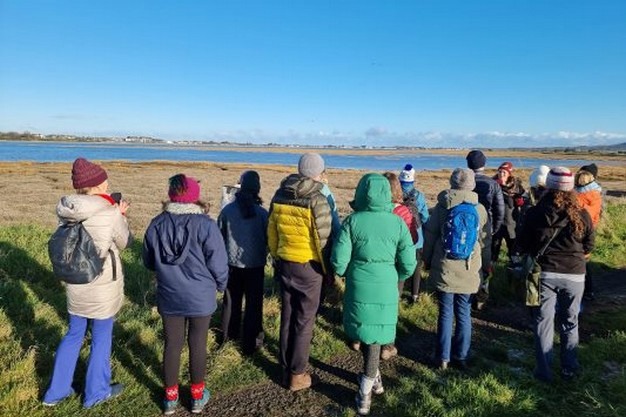 © Kim LakeIWT x BSBI New Year Plant Hunt on North Bull Island, 3 January 2026
IWT New Year Plant Hunt on Bull Island
For the inaugural IWT New Year Plant Hunt, participants explored North Bull Island in Dublin. The group met at the Tree of Life sculpture just outside St Anne's Park, where recording began. They walked down Causeway Road, surveying both sides of the road without entering the sensitive salt marshes, and finished around the back of the Interpretive Centre.
Originating as a by-product of coastal engineering, Bull Island demonstrates a dynamic interaction between nature and human influence. In 1981, it was designated a UNESCO Biosphere Reserve, now part of the Dublin Bay Biosphere, and it carries multiple other conservation designations. Covering just under 15 km², it supports nine habitats and is notable for its uninterrupted sequence of plant communities, from intertidal mudflats to salt marshes and sand dunes. Around 30% of Ireland's flora may be found here, including flowering plant species protected under Irish law such as Lesser Centaury (Centaurium pulchellum), Red Hemp-nettle (Galeopsis angustifolia), and Meadow Saxifrage (Saxifraga granulata). The island is also known for hosting several orchid species, including the Bee Orchid (Ophrys apifera). While none of these species were found in bloom in January, the IWT group recorded 26 plant species flowering in just under two hours.
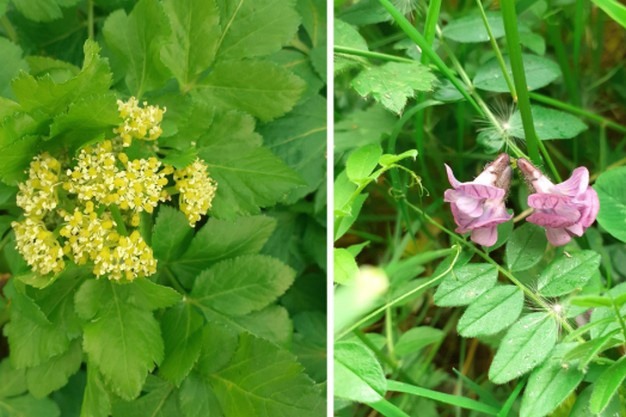 © Irish Wildlife TrustAlexanders (Smyrnium olusatrum) and Bush Vetch (Vicia sepium) in full bloom
Bull Island is known for unexpected discoveries, and Saturday 3 January was no exception. While eight of the top ten most frequently recorded species were logged, there were also some unusual finds. One of these was Rapistrum rugosum, commonly known as Bastard Cabbage or Turnipweed. This was the only survey in either Ireland or Britain to record the species. An annual herb found mainly on waste ground, it was located behind the Interpretive Centre toilets. Bastard Cabbage is now naturalised in a range of habitats and can be invasive, particularly in open grassland. Native to the Mediterranean region and south-western Asia, it is introduced through grain and birdseed. Although it is not expected to become widespread on Bull Island, other introduced plants have caused significant issues. Both Sea Buckthorn (Hippophae rhamnoides) and Common Cordgrass (Spartina anglica) were introduced to combat dune erosion, but instead they threaten rare plants by forming dense thickets and altering habitats. This highlights the difficulty of engineering ecological balance and the challenges of managing conservation in a novel ecosystem such as Bull Island.
Many familiar species were also recorded during the New Year Plant Hunt, including Winter Heliotrope (Petasites pyrenaicus). This plant was introduced to Ireland around 200 years ago, roughly the same time Bull Island formed, from the Mediterranean region. It has since become invasive due to its spreading habit, which allows it to shade out other species. All known naturalised plants in Ireland and the UK are male and spread clonally. As a result, the strongly scented flowers, often described as smelling of liquorice, cherry, or vanilla, are all male flowers and do not produce seed.
Some unexpected species were also found in bloom. Vicia sepium (Bush Vetch) and Smyrnium olusatrum (Alexanders) are not typically expected to flower in January, yet 18 New Year Plant Hunts across the island of Ireland recorded Bush Vetch and seven recorded Alexanders this year. Bush Vetch usually blooms between April and October, while Alexanders typically flower from February to June.
Alexanders originated in the Mediterranean region. Its name is linked to Alexander the Great, as the plant is thought to have been used by him and later brought to Britain and Ireland by the Romans as a potherb. Many coastal plants are edible; for example, Sea Beet (Beta vulgaris subsp. maritima) is the ancestor of beetroot and chard.
The Irish Wildlife Trust would like to thank the 15 people who took part in the IWT New Year Plant Hunt on Bull Island, with particular thanks to Kim Lake (BSBI Botanical Skills Project Manager, Northern Ireland), Maria Long (NPWS Grasslands Ecologist), and Niall Mac Coitir (IWT Dublin Branch), who shared their expertise in plant identification and helped run the event. Further outings on Bull Island, including Niall's summer Wildflower Walks for the IWT Dublin Branch featuring several orchid species, can be found on the IWT Events page.
Kerry IWT plant hunt
At the same time, the IWT Kerry Branch worked with Tralee Tidy Towns along the Tralee to Fenit Greenway. Seven separate New Year Plant Hunts were organised, with local community groups each surveying a section of the 13 km Greenway route. As on Bull Island, participants enjoyed crisp, fine weather. The IWT Kerry Branch, led by Ger Scollard, took part on Friday 2 January. Over three days, 31 people participated in the plant hunts along the Greenway. Almost 40 flowering species were recorded, including commonly logged plants such as Gorse (Ulex europaeus) and Herb Robert (Geranium robertianum), as well as more unexpectedly, Primrose (Primula vulgaris) and Knapweed (Centaurea nigra).
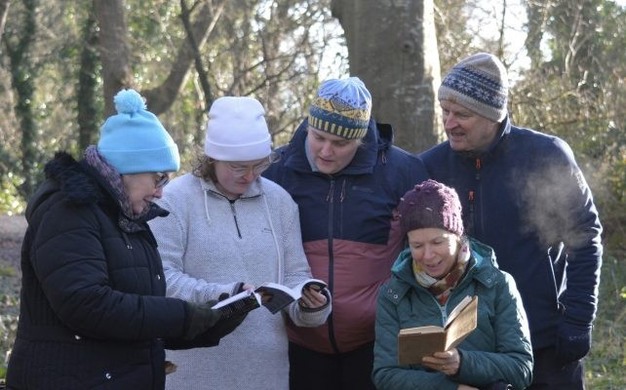 © Ger Scollard Getting serious on the plant hunt when the books come out (IWT Kerry Branch at Ballyseedy Woods)
The Greenway New Year Plant Hunts formed part of the Community Foundation Ireland-funded project Dúlra Thrá Lí, a Community Biodiversity Action Plan for the Kingdom of Kerry Greenway, covering the Tralee to Fenit route. The initiative provided an opportunity for community groups along the Greenway, including Fenit Town Hall, Kerry FC, Fenit Coast Conservation, Spa Tidy Village, Tralee Bay Swimmers, and the IWT Kerry Branch, to connect with one another while contributing valuable data to local biodiversity knowledge and to the wider BSBI project.
On Saturday 3 January, the IWT Kerry Branch also surveyed Ballyseedy Wood, where eight species were found in flower, including Nipplewort (Lapsana communis) and Holly (Ilex aquifolium).
The BSBI New Year Plant Hunt and climate change
The UK Met Office has analysed New Year Plant Hunt data from the past ten years. Using detailed climate records, the analysis revealed a strong linear relationship between the average number of plant species flowering around the New Year and the average temperature during the preceding two months. The results suggest that for every 1°C increase in average temperature during November and December, approximately 2.5 additional plant species are in flower.
In Ireland, six gardens have systematically collected around 7,500 observations since 1966 on the timing of major seasonal changes in plants. Valentia Observatory in Kerry and the National Botanic Gardens in Dublin hold the most complete historical records. Met Éireann uses this data for climate research, while organisations such as the Central Statistics Office publish reports based on these findings. These gardens are part of a European network of International Phenological Gardens, allowing Irish data to be compared with records from other countries.
Early flowering plants such as dandelions and Alexanders play an important role, as they provide vital resources for pollinators emerging in early spring, including bumblebee queens. However, trends recorded by the BSBI indicate that increasing numbers of plants are flowering out of season, leading to potential mismatches with animal life cycles.
The New Year Plant Hunt outings also demonstrate that while climate change is affecting wildlife, communities can take practical action. By recording biodiversity, participants help build connections between communities and between people and nature. This increases awareness and appreciation and supports advocacy and action for nature.
Source: Irish Wildlife Trust