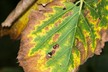


While inspecting holly (Ilex sp.) liners, Olivia J. Liebing and W. Garrett Owen of Ohio State University observed curling leaves with chlorotic (yellow) spotting or stippling across the upper leaf surface. Webbing was present on the undersides of leaves along with small crawling pests. Dry winter greenhouse conditions, combined with heat from nearby radiators, created an ideal environment for spider mite (Tetranychidae) populations to increase rapidly. If left unmanaged, this type of infestation can result in significant economic losses and reduced crop marketability.
To control spider mite infestations, proper integrated pest management (IPM) practices must be implemented. Effective management begins with accurate identification of signs and symptoms. Signs are the physical evidence of the pest itself, while symptoms are the visible responses of the plant to pest activity. In simple terms, signs represent the cause and symptoms represent the effect.
Spider mite populations often go undetected due to their small size and tendency to feed on the undersides of leaves. For this reason, routine and targeted scouting programs are critical. Tools such as a hand lens or loupe can help magnify clear indicators of spider mites, including webbing, shed skins, eggs, and the mites themselves. These signs may also be detected by gently rubbing the leaf surface, which can feel gritty to the touch. When combined with focused inspection of leaf undersides, these scouting practices allow for early detection of spider mite infestations.
The combined effects of webbing, leaf discoloration, and overall plant decline can greatly reduce the visual quality of holly liners and lower their value as transplants for later production stages. Early recognition of these signs and symptoms enables growers to implement IPM strategies to mitigate and control spider mite infestations. When identification is uncertain, plant samples can be submitted to a diagnostic laboratory for confirmation.
Read more at e-Gro