

Metrolina Greenhouses has a lot to look forward to in 2026, especially following their recent announcement of the merger between Metrolina Greenhouses and South Central Growers. But as Abe VanWingerden (CEO, Metrolina Greenhouses) and Alex Van Der Hengst (CEO of South Central Growers, now Chief Revenue Officer of Metrolina Greenhouses) emphasized in their press release, the merger is all about growing faster together. With the holidays and poinsettia season behind us, let's look back at the 2025 holiday season for Metrolina Greenhouses.
Continued growth for Metrolina – and innovation is the key
Prior to the merger with South Central Growers, Metrolina Greenhouses operated on two main sites – one in York, South Carolina, which was predominantly outdoor production of perennials, and another in Huntersville, North Carolina, which was predominantly greenhouse production of annuals and sensitive perennials.
As Abe explains, Metrolina Greenhouses experienced incredible growth during the pandemic and kept those gains thereafter. The company reported 2-3% annual growth following the pandemic spike, with 1-3% growth in poinsettias alone during the holiday season.
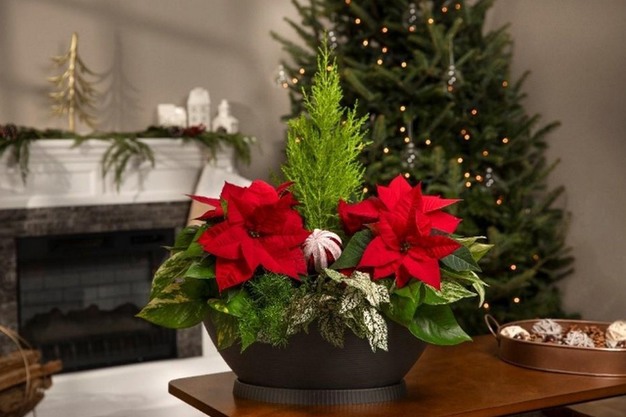
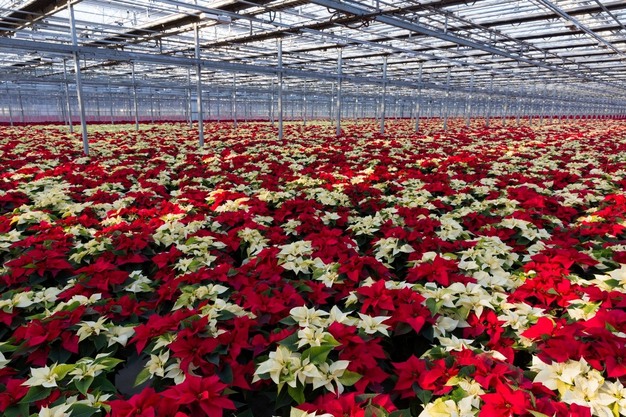
"While we've seen steady growth in demand for poinsettias themselves during the holiday season, we've also seen significant growth for arrangements, such as poinsettias in unique containers with additional plants surrounding them," says Abe. "During the holidays, we also see increasing demand for non-poinsettia holiday crops such as cyclamen, amaryllis, and Christmas cacti. And for these as well, having a variety of decorative pots and formats is well received by customers."
 © Metrolina Greenhouses
When discussing the keys to innovation and continued growth, Abe highlights two major drivers for Metrolina Greenhouses: having separate SKUs per poinsettia type and organizing focus groups with consumers.
Getting a clear view of what sells – and what doesn't
While there once was a time when the greenhouse considered red and white poinsettias under the same SKUs, Abe says that proving novel varieties with unique SKUs is key to understanding how different varieties and subcategories perform in the market. By separating red and white varieties, for example, Metrolina Greenhouses was able to identify the rapidly increasing demand for white poinsettias and subsequently focus on finding the right genetics to meet consumer preferences.
"We try so many varieties every year, of poinsettias and other crops, and we need to give each of these novelties a SKU if we want to really see how they are selling," Abe explains.
Focus groups are another tool used by Metrolina Greenhouses to decipher consumer demand before putting plants on shelves. By inviting consumers to the greenhouse, Abe says that they noticed an initial interest in novel varieties but that consumers ultimately selected classic poinsettias.
 © Metrolina Greenhouses
"We showed participants new and classic poinsettia varieties. Rose-colored, oakleaf-shaped, etc. We provided all the information to care for these varieties and keep them beautiful. And when we gave them the chance to bring a plant home, all twelve participants put back their novelty poinsettias and took classic ones instead," says Abe.
This certainly does not mean there is no demand for novelty varieties, for which Metrolina has seen an increased demand in recent years. Instead, this reinforces the need to continue offering classic poinsettia types, all the while staying on top of improved genetics and production techniques.
Challenges and opportunities for 2026
As Abe explains, employment and recruitment continue to be major challenges in the industry. With the new federal administration in 2025, it has become more difficult to have consistency in farm labor, and frequent policy changes weigh heavy on farmers across the country. Further, the shift away from family-run businesses and multigenerational farming means that businesses need to find a way to attract young talent who may not otherwise consider a career in the horticultural industry. For Abe, it is about showing people that horticulture is an attractive industry, and not just for those who have green thumbs.
"We need to build an organization that is attractive to young talent. It is not just about being a grower. There is room for people who love to work with data and technology, or in marketing and sales, in operations, etc. You can love working with plants and not be a head grower," says Abe.
At Metrolina Greenhouses, the goal is to be people-led and tech-powered. While artificial intelligence plays an increasingly important role in the company, the goal is not to replace
people with AI. Rather, the objective is to learn to work with predictive AI tools for data analytics and replenishment models.
"We counted solely on individuals' knowledge in the past, but there are now AI tools that allow us to analyze data more quickly and get our products in front of customers when they are ready to buy it," according to Abe. "We don't simply count on the 1-3% growth we typically see; we need to increase sales in the other 97% as well, and AI can help us do that."
The upside of consolidation
Of course, a significant matter at hand is the merger between Metrolina Greenhouses and South Central Growers, which was effective on January 1, 2026. Some people view consolidation negatively, pointing to it as a sign of the industry's shift away from the multigenerational and community-driven nature of agriculture. But as Abe explained (before news of the merger had even been announced), "consolidation provides potential to keep growing and innovating in the industry, and there are ways to make consolidation work for everyone and allow some of the best growers in the country to keep growing."
This same sentiment was echoed in the press release about the merger, where Abe shared that "this merger allows (both companies) to deepen our investment in the communities where we operate. Strong businesses and strong communities go hand in hand."
For more information:
Metrolina Greenhouses
Tel. +1 (704)-875-1371
metrolinagreenhouses.com/