

At its Maasland site in the Netherlands, KP Holland is running a three-year pilot as part of the 100% Groen Geteeld (100% Green Grown) programme. Together with Royal Brinkman and Agrobío, the company is working to make Kalanchoë production more sustainable, with a clear focus on controlling powdery mildew and aphids. The objective is to achieve economically viable Kalanchoë cultivation within an integrated, resilient growing system based on green, biological and technological solutions.
The pilot is part of the 100% Groen Geteeld initiative of Stichting Versnellers Sierteelt, a foundation that brings together growers aiming to accelerate sustainability in ornamental horticulture. Within the programme, 23 pilots across five crop groups—orchids, chrysanthemums, alstroemeria, gerbera and Kalanchoë—are working with suppliers on the development of sustainable and resilient production systems. Parallel pilots are also being carried out in vegetable crops, allowing knowledge and experience to be shared where possible.
Within the Kalanchoë crop group, Lankhaar, Vilosa, Slijkerman and KP Holland are participating. Royal Brinkman and Agrobío are involved with KP Holland as innovation partners in resilient growing and biological crop protection. Florpartners acts as the project management organisation.
Pilot in two trial greenhouses
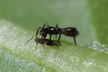
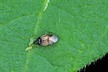
KP Holland is testing different strategies in two greenhouse compartments under commercial growing conditions. For aphid control, biological control agents are being used, including gall midges and parasitoid wasps. To manage powdery mildew, Serenade is being applied as an alternative to sulphur. Initial results show positive effects from both the biological aphid control and the use of Serenade.
A second strategy has demonstrated that sulphur has a clear negative impact on biological control agents. As a result, this approach does not fit within a fully green production strategy. Serenade appears to be a promising alternative, although further research is needed to optimise its application.
"With chemical crop protection, we used to be almost certain of keeping aphids under control. In the transition to 100% green production, more intensive and precise monitoring is required," says Maurits Kooijman, Crop Manager at KP Holland. "Biological control works, provided you monitor the crop more closely, scout more intensively and steer more sharply. This pilot represents an important step in that direction."
Collaboration as a foundation
The pilot combines KP Holland's practical growing experience with the technical knowledge of Royal Brinkman. While further development is still needed to achieve fully green and economically viable Kalanchoë production, the project highlights the importance of collaboration within the sector in building a sustainable and future-proof Kalanchoë crop.
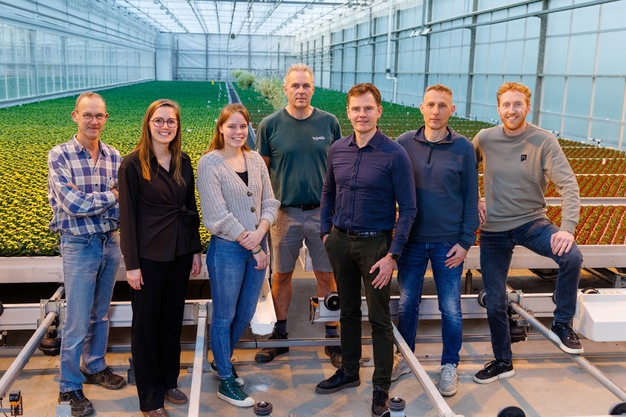 © KP Holland
Kees Kouwenhoven (Royal Brinkman), Joyce Groenewegen (Florpartners), Harmke Broekhuis (Agrobío), Maurice Olsthoorn (KP Holland), Ringo Veenman (Florpartners), Maurits Kooijman (KP Holland), and Jan Willem Keijzer (Royal Brinkman).
For more information:
KP Holland
[email protected]
www.kpholland.nl