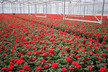


The floriculture sector in Turkey produces and exports four carnation varieties developed by the Western Mediterranean Agricultural Research Institute (BATEM) to 37 countries.
Ayse Serpil Kaya, an agricultural engineer at BATEM, and her team conducted breeding studies on native flowers as part of their research, which focused on decreasing Turkiye's reliance on foreign sources, especially for carnations.
Research carried out in BATEM's greenhouses and labs located in Antalya's Aksu district led to the development of four carnation varieties, which were designated as "BATEM Purple," "BATEM Burgundy," "BATEM Yellow Red," and "BATEM Yellow." These disease-resistant and fragrant carnations were introduced to the sector, and production commenced. Production of these four native carnation varieties commenced on 2.6 hectares of land in Antalya, and they are exported to 37 countries.
Agricultural engineer Kaya informed the press that while 83 types of carnations are currently grown in Anatolia, there are no native varieties for production. Kaya mentioned that BATEM began its work on creating native varieties in 2012, and that Flash Tarim is producing and exporting the carnations they developed.
Kaya underscored that they had acquired carnations immune to Fusarium disease, and went on: "We developed another project and carried on from 2019 to 2022. Fusarium can lead to product losses of as much as 72% in Antalya and regions where carnations are cultivated. We created market-suitable varieties resistant to this disease through our research. We are also addressing their registration. The success rate of production in the field is considerable; the quality is superb and aligns with market demands. The market value of the carnations we developed is enhanced by their fragrance and disease resistance, along with the increased economic opportunities for their cultivation."
Agricultural engineer Mehmet Ugur Kahraman, who performed tissue culture on carnations, indicated that the standard method of propagating the flower is through cloning from cuttings; however, the yield diminishes over time.
Kahraman explained that to avoid a decline in quality, they carried out studies using shoot tip culture in labs and chose the best genes through hybridization within the gene pool they established. Naci Faydaci, an agricultural engineer and production manager at Flash Tarim, a local carnation-grower company, noted that in the absence of native carnations, they had sourced all materials from Europe and propagated them in their fields.
Faydaci, who mentioned that they have been manufacturing the new carnations developed by BATEM for three years, stated, "Sales depend heavily on quality and product weight. However, this problem has never occurred with these four varieties. The size of the buds, the quality of the color, and the resistance to diseases and pests are excellent. Carnations sourced locally account for 15% of our overall production and exports. We export carnations to 37 nations, including every European country, England, and the Far East."
Faydaci pointed out that although they encountered difficulties when adapting materials sourced internationally, they achieved outstanding results with these native carnations, which did not pose such challenges. Anil Irik, who manages operations at Aktif Fide, observed that their annual output of 14 million carnation seedlings includes local and national varieties, accounting for 15%. He asserted that they aid in the development of local varieties by producing them.
Source: AA