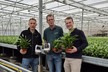


The persistence of heavy rain and windstorms recorded over recent weeks is seriously affecting cut flower production in the Lower Guadalquivir and along the northwest coast of Cádiz. Prolonged excess rainfall, a lack of solar radiation, and repeated episodes of extreme wind, which have caused structural damage to many greenhouses, are compromising both current production and the future viability of many family farms, particularly in municipalities such as Chipiona and Lebrija.
The sector is urgently calling for the declaration of a disaster area and the launch of a specific strategic plan to sustain an activity that has been one of the economic and social pillars of the territory for more than fifty years.
 © Facebook Asociación de Agricultores Costa Noroeste de Cádiz
"The problem is not just this specific storm, but an accumulation of factors that we have been dealing with for months," explains José Luis García, head of Asociaflor. "We have had almost two months of continuous rain, and the lack of radiation is being clearly felt inside the greenhouses."
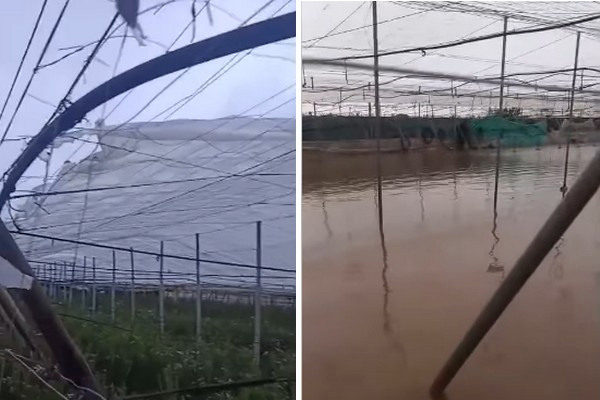
This situation has been compounded by particularly violent wind episodes that have caused direct damage to production infrastructure. "Last week, the wind event on Wednesday, January 28, ripped off a lot of plastic," he details. "In areas like Lebrija, not only were the covers torn away, but some greenhouse structures were knocked down entirely."
"With barely any time to replace them, we already had another episode on Saturday, and on Monday there was even a tornado that affected part of the town and the Las Cabezas area, dragging trailers and knocking down trees on the motorway."
According to García, efforts to restore normality are repeatedly thwarted. "The plastic we managed to install with great effort after Saturday was blown away again on Monday, and there is another storm forecast for tomorrow. Under these conditions, it is very difficult to stabilise production."
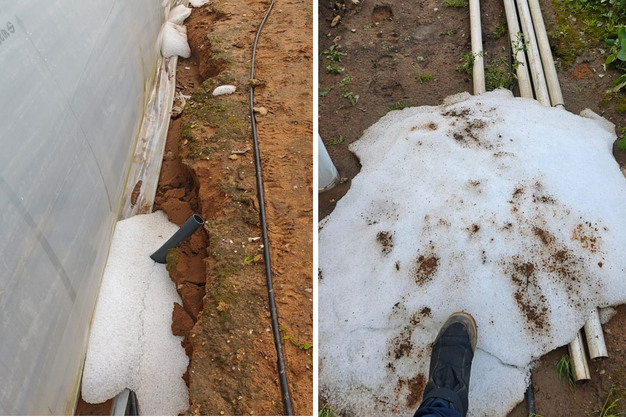
This is compounded by deterioration in the flowers themselves, which become wet, lose quality, and see their commercial value reduced, at a particularly sensitive time for the sector. "We are right in the middle of the Valentine's Day campaign. It is a key period, and many growers schedule their production for these weeks. But under these conditions, the risk is enormous," he notes.
 © COAG
Beyond the immediate damage, García warns of a deeper structural issue, namely the loss of competitiveness against third countries. "We compete with flowers coming from Colombia, Kenya, or Turkey, produced using plant protection products that have been banned here for years, and with much lower labour costs. We pay decent wages, comply with European regulations, and yet the product enters Europe under the same conditions. It is impossible to compete like that."
"Flooding affects between 350 and 400 hectares"
From COAG, the assessment is equally concerning. Luis Manuel Rivera, head of cut flowers in Andalusia, confirms that damage in the Chipiona area is widespread and still difficult to quantify. "In terms of rainfall, we are talking about between 450 and 500 litres per square metre accumulated, with the groundwater table surfacing in many plots. In some areas there are between 30 and 40 centimetres of water on the ground, and flooding affects between 350 and 400 hectares," he explains. Added to this is wind damage to greenhouses, the full extent of which is still being assessed.
"We have set up an office to collect data from growers, but until technicians complete their reports we will not be able to quantify everything accurately." COAG has requested the declaration of a disaster area, and not only for Chipiona. "We are asking for the entire northwest coast of Cádiz to be included." "Since COVID started, it has been one disaster after another: the pandemic, the war in Ukraine, Storm Bernard, the storms last March, and now Kristin. The truth is that some farmers are going through a dramatic situation, and the accumulated wear and tear is starting to take its toll even on a historically resilient sector. Farmers are very tough and we always get back up, but there comes a point when you get tired," Rivera acknowledges.
"We are the epicentre of cut flower production in Spain, and we cannot allow this activity to disappear"
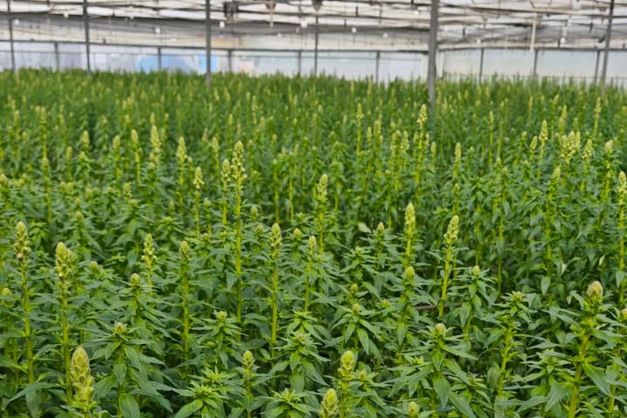
Beyond emergency aid, COAG is calling for a long-term strategy to safeguard what it considers a strategic sector. "We can proudly say that we are the epicentre of cut flower production in Spain, and that is precisely why we cannot allow this activity to be lost. We are talking about small, family-run farms, averaging around 0.5 hectares, with greenhouses adapted to each flower and decades of accumulated knowledge that cannot be allowed to disappear."
"This activity must be maintained and made attractive for young people, dignifying the profession of grower."
 © COAG
In this context, COAG insists on the need for active policies that go beyond one-off aid. "The sector must be strengthened, insurance schemes adapted to our needs must be developed, and different administrations must invest in infrastructure in this area so that it remains profitable and attractive," Rivera states. "We have also requested the creation of vocational training programmes specifically focused on intensive agriculture and cut flowers, to train young people so they can continue a production activity that has existed in the region for more than half a century."
Rivera recalls the socio-economic weight of cut flowers in the area. "The northwest coast of Cádiz has a high unemployment rate and cannot base its entire economy on tourism. Ninety percent of the flowers grown in the Lower Guadalquivir are marketed from Chipiona, and that needs to be protected."
The area's potential is recognised internationally. "In fact, Dutch growers are coming to farm in Chipiona," Rivera explains. "They have seen the experience we have, the land and the climate. Many have reached agreements with local farmers and are producing here to ship cut flowers to the Netherlands, where production costs are higher. That shows that this area has real value."
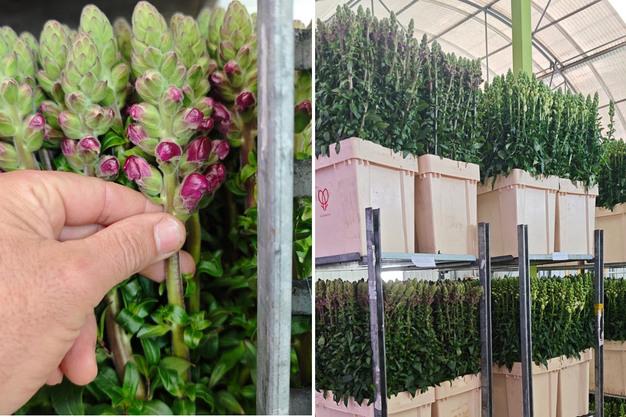 © COAG
"Despite the losses, we will be able to supply all of Europe in the coming weeks"
Despite the seriousness of the situation, the sector remains confident it will meet its most immediate commercial commitments. "We are in the middle of the Valentine's Day campaign and, although the storm has affected us, fortunately it has not wiped everything out and we will have flowers to supply all of Europe," Rivera concludes.