

As Adene's Farm Flowers celebrates its tenth anniversary this year, the business is taking the opportunity to strengthen its foundations after several years of growth. Founder Adene Nieuwoudt explains that the priority now is on refining systems and ensuring smooth operations rather than pursuing rapid expansion. "We've grown a lot in recent years, and now we're taking a moment to enjoy what we've built and make sure everything runs as well as it can," she says.
The main production hub remains Platvlei Fruit Farm in Wolseley in the Western Cape, where the majority of flowers are grown and harvested. Unlike some of the business's other locations, Platvlei is not generally open to the public, except for scheduled open days or special seasonal events. Production has expanded with the addition of the Die Boord farm, also in Wolseley, which is open to visitors and hosts flower picking during the season. Across its four main production farms, the business manages a total of 17 hectares under cultivation.
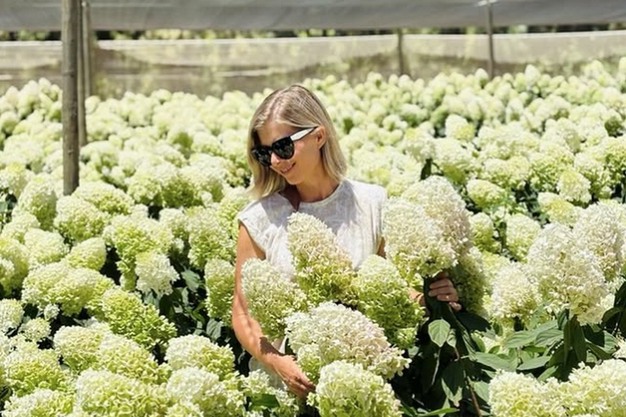
Hydrangeas play a central role in the crop mix and flower from December through to March. The paniculata hydrangeas, planted several years ago, are now in full production. On the farm, these plants are fertilised three times a week during the active growing period to maintain strong growth and consistent flowering. Nieuwoudt notes that while commercial production relies on regular, controlled feeding, home gardeners often achieve good results by applying a slow-release fertiliser in spring.
 © Adene's Farm Flowers
Adene Nieuwoudt with her paniculatas
Crop management and seasonal production cycles
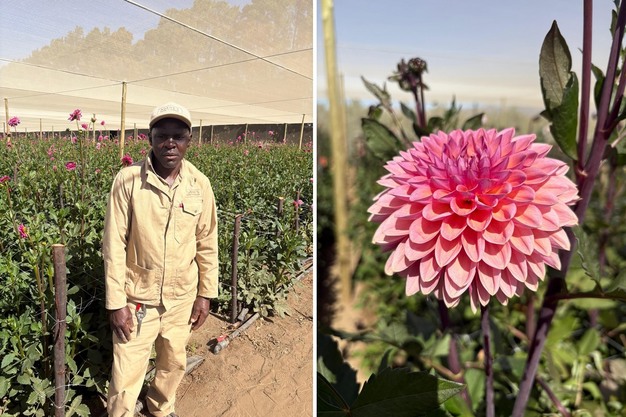
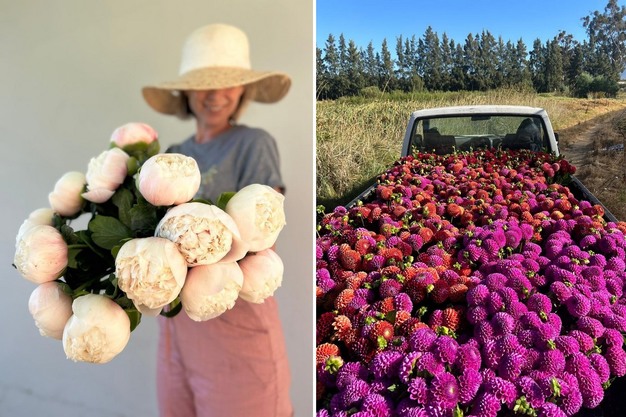
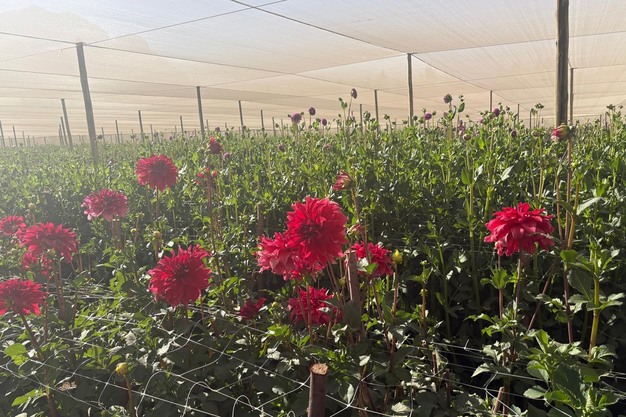
Dahlia production at the Die Boord farm highlights the intensive management required for certain crops. Dahlia tubers and cuttings are planted in September, with flowering running from December through to April. According to Simon Chitera, a general worker at Die Boord originally from Zimbabwe, dahlias are among the most demanding crops grown on the farm, particularly during peak summer conditions.
Water management remains a key challenge in Wolseley's sandy soils, which have limited water-holding capacity. Irrigation must therefore be carefully managed to ensure sufficient uptake by the plants while preventing water from draining beyond the root zone during hot periods.
 © Adene's Farm Flowers
Simon Chitera and one of the dahlia blocks at Die Boord
Peonies are another big focus point, with approximately five hectares under production. They are in bloom from October to early December and form an important part of the early-season harvest. Together with hydrangeas and dahlias, they anchor the core production period.
Rather than growing crops such as agrostemma, gypsophila or lisianthus, summer production focuses strongly on seasonal varieties including amaranthus, celosia, ammi and asters. Spring is a key planting period, with large volumes of anemones, ranunculus, stocks and craspedia produced. The business has also recently established plantings of eryngium and ornithogalum in volume.
Overall, the main harvesting season runs from mid-August through to April. From May to July, production volumes are significantly lower, allowing both the land and the team a short winter rest period before the next cycle begins.
 © Adene's Farm Flowers
Retail expansion and direct-to-consumer engagement
Beyond primary production, Adene's Farm Flowers operates a diversified retail and experiential model. Seasonal pick-your-own flower farms are hosted at Val de Vie Estate in Paarl, Lourensford Wine Estate in Somerset West, and The Big Red Barn in Pretoria. These experiences operate without advance bookings, even during peak demand periods such as Valentine's Day.
"There are always enough flowers for everyone who comes," says Nieuwoudt, adding that cold-room stock is used where necessary to support availability.
 © Adene's Farm Flowers
The business supplies approximately 20 retail stores across South Africa. While priority is given to supplying the shops with the farm's own hydrangeas, dahlias and seasonal flowers, additional stock is sourced from Kenya when required to ensure consistent availability year-round.
With established infrastructure, maturing crops and a strong national retail footprint, Adene's Farm Flowers enters its second decade focused on production consistency, operational refinement and long-term sustainability.
For more information:
Adene's Farm Flowers
www.instagram.com/adeneflowers
www.adeneflowers.co.za