


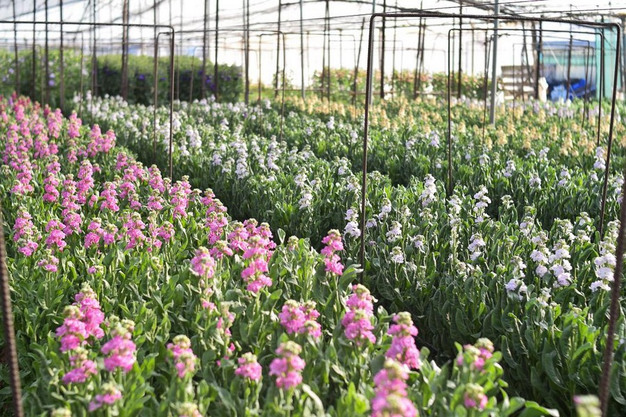
Despite market uncertainty and the weather problems of recent campaigns, the area devoted to cut flowers in Andalusia in the 2024/25 season increased by 8% compared to 2023/24 and by 21% compared to the average area cultivated over the last four campaigns. Cádiz, with Chipiona at the forefront, remains the main producing province, accounting for 59% of the surface area and 69% of Andalusia's cut flower production.
 © Santamaría Tirado
In Chipiona, cut flowers are a year round productive activity, supplying both the domestic market and the main European auctions. In recent weeks, however, the sector has been hit hard by a succession of storms that have affected the province with particular intensity.
"To these losses we must add a combination of factors that for years have been reducing the operating margins of the sector: rising costs in an activity that is not covered by the CAP, external competition and," explains José Santamaría Tirado, grower and managing director of Santamaría Tirado, "the lack of infrastructure to prevent flooding caused by the rise in the water table of the aquifer beneath this important horticultural production area".
"The rainfall of recent weeks has meant that more than 300 hectares are currently under water, in some areas reaching up to half a metre. On top of this, there are greenhouses that have suffered structural damage from wind and heavy rain, and their owners will be forced to rebuild them in a context of limited profitability".
"The fact that the CAP does not include us is noticeable; we are farmers, but without the same support" © Santamaría TiradoAccording to José Santamaría, "cut flowers are being sold at the same prices as in 2018, despite the fact that all costs have risen since then". The pandemic marked a turning point for many companies in the sector and a significant number were unable to withstand the situation and disappeared. "It caught us all by surprise, with rising energy costs, inputs, transport and structures, which has not been matched by an update in market prices. This has squeezed margins in a sector that also does not enjoy the same level of support as other agricultural crops".
"The fact that the CAP does not include us is noticeable; we are farmers, but without the same support," he states. "And now that farmers are protesting over Mercosur, it is worth remembering that the cut flower sector has already spent decades facing international competition under unequal conditions in terms of labour costs or the use of certain products authorised in third countries".
"In the past, Chipiona was a benchmark for roses, carnations and spray carnations, but pressure from imports has reduced much of that production volume to the point that rose production has almost disappeared".
"More and more Dutch companies are coming to grow flowers in Chipiona"
Nevertheless, cut flowers continue to play a key role, not only in the local economy but also at European level. "The combination of available fertile land, favourable agroclimatic conditions that allow year round production, a solid commercial structure and highly specialised workers has led many companies from Netherlands, the world leader in flower trade, to come and grow flowers in Chipiona".
This is a fundamental sector in the Northwest comarca, providing work for thousands of families and, unlike other seasonal activities such as tourism, it is a high value activity that runs throughout the year.
"It is worth remembering that one hectare of cut flowers generates more wealth than five hectares of vegetables," says the owner of the family business Santamaría Tirado.
 © Santamaría Tirado
"A small gesture from consumers can make a difference for companies affected by flooding"
During the winter months, the company grows species such as cut foliage, antirrhinum and waxflower, employing between 20 and 25 people. As José points out, the storms have severely affected the area and the municipality of Chipiona has even been declared a disaster zone. "However, that does not mean we do not have flowers for the celebration of Valentine's Day, which is just around the corner".
"In fact, at a time like this, when we have suffered losses, it is more important than ever to buy Spanish flowers".

"We have a unique product, with the lowest carbon footprint on the market and a freshness that is unquestionably higher than any imported flower. At Santamaría Tirado we have a parcel delivery service that allows us to ship the flowers the customer wants within just 24 hours of the order, either by contacting us directly or through our online sales platform Floralvia".
"A small gesture from consumers can make a real difference for companies like ours that have been affected by flooding, allowing us to continue being a source of employment for thousands of families and to keep producing flowers that are so highly valued throughout Europe".
 For more information, please contact
Santamaria Tirado
Vereda Chapitel, S/N
11550 Chipiona (Cádiz)
[email protected]
https://santamariatirado.es/