


The Valentine's season is officially over. While the full impact of Valentine's Day 2026 will become clear in the coming days and weeks, we are taking a look at some first reactions from the industry. With Valentine's Day falling on a Saturday this year, expectations were a bit lower than usual.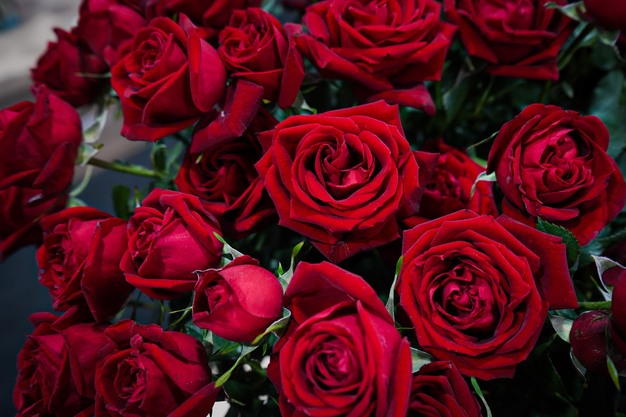 © Mirthe Walpot | FloralDaily.com
Challenges
"This year's Valentine's season has been especially challenging for the flower industry," says Jorge Ortega from Matina Flowers. "We saw a large volume of flowers entering the market very early, starting as soon as week two, mainly due to advanced harvests in Ecuador. This created an oversupply situation much earlier than expected."
On top of that, the snowstorms affecting the United States had a strong impact on logistics and distribution. "Transportation delays, store disruptions, and general uncertainty reduced buying activity across many markets. When logistics are affected, customers naturally become more cautious with their orders."
"Because of the combination of early oversupply and weather-related logistical problems, Valentine's sales did not reach the expectations we had compared to last year," Jorge says. "It has been a season that required a lot of flexibility and fast decision-making from growers and exporters."
"We believe every Valentine's season is different and comes with its own challenges, but this one certainly stands out as one of the most complicated we have faced in years."
"Expect the unexpected"
"Valentine's seasons are never the same. We can prepare extensively, but in the end, there will always be third party factors that challenge even the best planning," add Daniela Lobato Jarrín and Valeria Lobato Jarrín from Agrivaldani. "That's why at Agrivaldani we always work with contingency plans—we've learned to expect the unexpected. Every season teaches us something new, and this year has been no exception."
"This season, we strengthened our operations by bringing in our newest ally for in-house quality control: OQS. They will be working alongside us throughout the entire year, ensuring consistent standards and supporting our commitment to excellence."
"We also dedicated significant time to refining our logistics, operational structure, and team coordination. Ahead of the season, we held several meetings with our managers and supervisors. Listening to our team is essential — we always want to understand their needs, concerns, and recommendations. Their insights help us ensure that every Valentine's season runs as smoothly and successfully as possible. These meetings are also highly important to us in order to properly and responsibly organize our pre-orders."
"This year has been unusual, as demand increased significantly within a very short period—roughly two weeks," Daniela and Valeria add. "The sudden spike required agility and rapid adjustments across our production and logistics teams, but we managed to respond efficiently."
When it comes to trends, red and pink roses continue to dominate Valentine's preferences. "However, this season we saw an exceptional rise in demand for our tinted roses, particularly in shades of blue. The trend toward more expressive and bold colors is definitely growing."
Weather-wise, this Valentine's season was noticeably colder than usual, with heavy rainfall and lower temperatures. "These conditions inevitably affect production cycles, and the impact was especially evident during the last week of the season. Weather fluctuations will always be one of the biggest challenges for our industry. This was a challenge for us, but as we are not a pinching farm, we were able to complete orders."
Challenges for Colombian growers
Asocolflores adds that Colombian flower growers have faced significant economic pressures in recent months. "Increased tariffs, minimum wage adjustments, and currency depreciation have posed important challenges during this key celebration season. Colombian flower growers have undertaken a comprehensive review of their structures, optimizing operational processes, improving productivity, and implementing efficiency measures across their value chain to meet seasonal demands while maintaining competitiveness. While the challenges are significant and require difficult adjustments, we are confident that they will ultimately become opportunities to strengthen Colombian floriculture with the highest quality standards, while upholding the social and environmental sustainability principles that have long distinguished our industry."
Valentine's Day represents a critical season for Colombian floriculture. Between January and February 2025, Colombia exported close to 65,000 tons of fresh cut flowers, equivalent to 15–18 percent of its annual export volume. The United States remains the industry´s primary destination, accounting for approximately 80 percent of total export value during this season, consolidating its role as Colombia's strategic partner in the global flower market.
Roses continue to be the leading product for Valentine's Day, representing nearly 30 percent of Colombia's total cultivated flower area, with more than 10,500 hectares nationwide. While growers have observed a gradual interest in alternative colors and varieties, red roses remain by far the most demanded flower for this celebration, maintaining their symbolic association with love and romance.
Strong sales expected to continue
"Another Valentine's Day in the history books! Everyone planned lighter this year because weekend Valentine's day floral sales are historically softer. The flower dollar gets shared with dinners out and spa weekends," explains Larence Hopman from Hopman Farms.
"Friday the 13th sales were very strong across Canada and the US with may locations over 60% sold-out already on Friday night. My Sunday postmortem visits to grocery locations in Southern Ontario and Western New York show most locations wiped out of roses and bouquets. Some had no plants left either."
Lawrence expects sales to hold strong in the coming week with Lunar New Year sales, especially in urban areas.
London wholesalers busy
With the annual day of love falling on a Saturday this year, footfall was noticeably up at London's New Covent Garden Flower Market, where queues snaked out of the door right up to closing time.
Customers look beyond roses
One of the beneficiaries was Green & Bloom, where Wouter den Dulk said he hadn't seen Valentine's Day queues since he was serving clients in the previous flower market location, almost 10 years ago. "We were really busy with a very diverse crowd of clients and what was also very nice to see was that they were picking up all different types of flowers and not only roses." © New Covent Garden Market
Wouter den Dulk
There is no reason why the UK's passion for roses on February 14th should be discouraged, but for this Valentine's Day, Green & Bloom created a 'Floroscope', which came up with alternatives to the traditional red rose for any Valentine's Day customers who wanted to look elsewhere. The G&B Floroscope took the traditional horoscope and the characteristics attributed to each star sign, and matched starry-eyed lovers from Aries to Virgo with the flowers that best suit them.
"I don't have a crystal ball," joked Wouter, "but it feels like we were right this time. All types of spring flowers and tulips and daffodils were popular, not just the straightforward roses and gypsophila.
"We sold out, so we really can't complain!"
Plants prepared for the next opportunity
Damian Walloch's plant specialist firm Ilobloom doesn't expect to be front and centre on Valentine's Day, but he said orchid sales were strong and the fact that there was plenty of footfall in the market helped business nevertheless. "My products aren't necessarily the first thought of people buying for their loved ones on February 14th, he admits. We had some lovely pink Phalaenopsis, packed specially for Valentine's Day, which were great value for money and last for a long time. All orchid sales were good, but we know our time is around the corner with Mother's Day.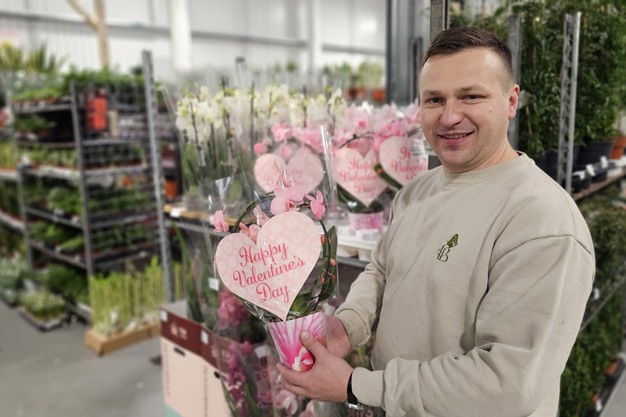 © New Covent Garden Market
Damian Walloch
"Whereas Valentine's Day is very focused, Mother's Day on Sunday March 15th brings everyone into things, from children through every age group and just the fact that there were queues out of the door here on Saturday morning is really encouraging. We'll be putting all of our efforts into getting our product mix spot on for next month now."
Foliage favourites continue to blossom
Valentine's Day isn't perhaps quite what it used to be, according to Bryan Porter at Porters Foliage, but seeing the market busy with customers this year was positive.
"It's a quieter time for wholesalers than it was in the past, due to the supermarkets and the failure of so many high street florists. However, as a whole it was a busy week and some of our customers were very busy. Others try to avoid Valentine's day as the cost of flowers has risen so much, making it harder for them to find a margin," Bryan said.
"With respect to foliage, traditional favourites like eucalyptus, ruscus and some of our more wild products such as Chamelia and wild-cut eucalyptus continue to do well at this time of year. And the blossoms and hebes stay strong as hand ties are still being made for Valentine's Day."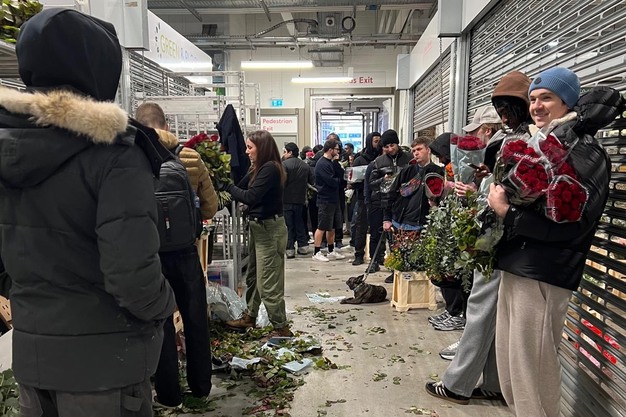 © New Covent Garden Market
The New Covent Garden Flower Market was busy right up to closing time