

Many orchids use a specialized photosynthetic pathway known as CAM, where CO₂ is absorbed at night and stored as malate. During the day, the plant relies on this stored malate to drive photosynthesis. Once the malate supply is depleted, photosynthetic activity drops sharply.
The challenge for growers is that this transition point does not occur at a fixed time. It can shift from day to day depending on temperature, light conditions, and cultivar. Without real-time insight, growers cannot accurately predict when a plant has run out of malate or CO₂. As a result, they may continue supplying light and CO₂ after the plant can no longer use them efficiently, leading to wasted energy, unnecessary input costs, and reduced crop uniformity.
To address this, Gardin uses non-invasive chlorophyll fluorescence sensors to monitor photosynthetic efficiency in real time. The system detects malate depletion, CO₂ limitation, and light stress as they occur. This allows growers to adjust CO₂ dosing, lighting levels, and climate settings at the exact moment malate depletion begins.
Designed for commercial greenhouses, Gardin operates autonomously and monitors approximately 10 m² of crop area. By delivering crop-representative measurements, it enables growers to make confident, data-driven decisions at scale.
Timing of malate depletion depends on climate
In an independent trial conducted at Plant Lighting, Gardin measured the photosynthetic efficiency of two orchid cultivars, Leeds and Freeride. Plants were grown under solar-simulating lamps and an LED spectrum consisting of 84/9/6/10% red, green, blue, and far-red light.
Measurements were taken during two temperature phases: 29 °C (growth phase) and 21 °C (chilling phase). A 15-hour photoperiod was used, with 13 hours at 150 µmol/m²/s and two one-hour periods at 50 µmol/m²/s at the beginning and end of the day. Gardin's data were validated against a research-grade reference instrument.
Across treatments, Gardin consistently detected declines in photosynthetic efficiency associated with malate depletion. The timing of this decline varied depending on temperature, light source, and cultivar, with the largest reductions observed under LED lighting.
At 29 °C, photosynthetic efficiency began to decrease after 8 hours of LED lighting for both cultivars, compared to 9 hours under sunlight. At 21 °C, efficiency declined after 7 hours across most treatments. The exception was Freeride under sunlight, which maintained efficiency until 9 hours.
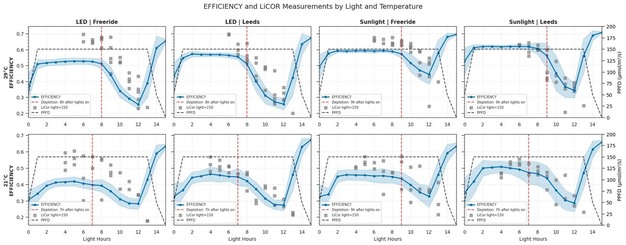 © GardinFigure 1. Gardin detected the drop in efficiency across cultivar, temperature and light source, with the timing of the drop varying between 7-9 hours of lights-on. Detection of the drop in efficiency was similar between Gardin and LI-COR.
These results confirm that the timing of malate depletion is dynamic and influenced by environmental conditions. Fixed lighting schedules or DLI targets alone cannot fully account for these shifts.
Orchid production optimisation saves energy costs
Many commercial orchid growers already adjust supplemental lighting dynamically to meet a target daily light integral (DLI), particularly during winter and the spring and autumn shoulder seasons. However, DLI-based control does not account for daily variation in CAM physiology.
 © Gardin
The case study showed that malate depletion timing varies by cultivar, temperature, and light source. Even when DLI targets are met, high-intensity lighting may continue after malate has been depleted, reducing energy-use efficiency.
If lighting is dimmed by 50 percent for up to 2 hours per day once malate depletion is detected, and assuming an LED efficacy of 2.0 µmol/J, peak winter savings over 16 weeks can reach up to 8.4 kWh per m².
During the combined 8-week spring and autumn shoulder season, dimming for up to 1 hour per day at 50 percent can yield an additional 2.1 kWh per m².
In total, this represents potential annual energy savings of up to €21,000 per hectare per year at an electricity price of €0.20 per kWh.
"I see strong potential for Gardin's use in commercial orchid cultivation, phenotyping plant research, and genetic breeding. The sensor could reliably detect the transition of CAM-phase III into IV. Moreover, it was able to rapidly detect the malate depletion across multiple cultivars simultaneously and repeatedly at varying temperatures," said Dr Sander Hogewoning, Director of Plant Lighting B.V.
Real-time detection of CAM malate depletion gives growers a practical tool to further optimise orchid production. By dimming supplemental lighting at the onset of malate depletion during winter and shoulder seasons, annual savings of up to €21,000 per hectare are achievable.
Monitoring malate depletion in real time adds a new layer of precision on top of an existing DLI strategy. Gardin's fully autonomous, remote sensors continuously track crop photosynthetic performance, enabling growers to respond to actual plant demand and make confident decisions across large production areas.
The full scientific case study can be read at the link here.
For more information:
Gardin
[email protected]
www.gardin.co.uk