


At a horticultural trade fair in Gorinchem, the Netherlands, Bioline Agrosciences is presenting a new predatory stink bug for biological crop protection. The species, marketed as Podiline and short for Podisus maculiventris, preys on several key pests, including the southern green stink bug (Nezara viridula) and the brown marmorated stink bug (Halyomorpha halys). Specimens of these pest species are also being displayed.
"Podiline is the most common predatory stink bug in North America and is found on a wide range of crops," says Hans van de Pas of Bioline Agrosciences. The insect is a polyphagous predator, feeding on a broad spectrum of crop pests. In addition to Nezara viridula, its prey includes other true bugs (such as Lygus spp. and various stink bugs), caterpillars and beetles, covering pests within the Hemiptera, Lepidoptera and Coleoptera orders.
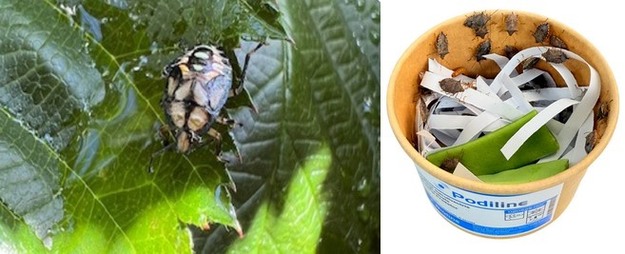 © Arlette Sijmonsma | FloralDaily.comThe predatory shield bug is relatively large (about 11 mm as an adult) and is distinguished by its shield-shaped body. P. maculiventris has two characteristic spines on its thorax. Females lay egg clusters (between 15 and 60 eggs), which hatch after 5 to 10 days. Nymphs go through five instars.
Preventive and curative
"Both adults and nymphs are active feeders," Van de Pas explains. "Podiline can be used both preventively and curatively, particularly in hotspot treatments." Introduction is possible once a pest is present, preferably at a minimum rate of five individuals per release point. "Releasing at the beginning or end of the day gives the best results. To prevent diapause, a day length of at least 13 to 14 hours is required." Podiline can be applied in both vegetable and ornamental crops.
 © Arlette Sijmonsma | FloralDaily.comChrysoline Eggline was showcased at the IPM
Easy lacewing deployment
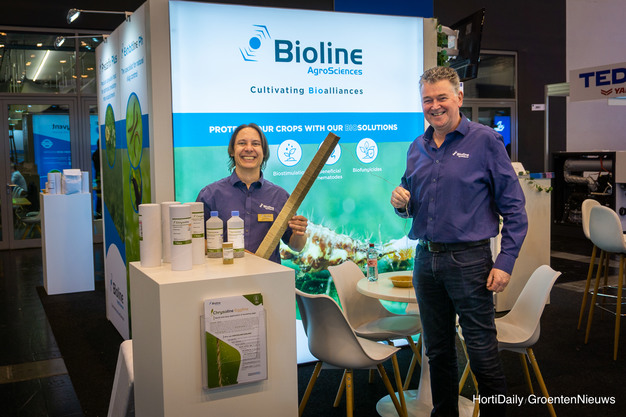
Podiline is the second new product Bioline has introduced this year. At IPM, the company also presented Chrysoline Eggline, a new system for distributing eggs of the green lacewing (Chrysoperla carnea). Lacewings are widely used in various crops to control a range of pests, but evenly distributing the eggs can be labour-intensive.
"We now supply a jute string with the eggs attached," Van de Pas explains. "The string can simply be rolled out over the crop, providing the correct dosage immediately, grouped in small clusters at regular intervals. This makes the process much faster and easier."
Both Podiline and the Chrysoline Eggline can be seen at the HortiContact at Bioline Agrosciences, in stand J18
For more information:
Hans van de Pas
Bioline
Mob.: +31 6 86 88 11 29
[email protected]
www.biolineagrosciences.com