


Greenhouse growers report delayed or inconsistent flowering in potted dahlia. A new MSU study shows that five to 10 short days are enough to reduce the time to flower while minimizing tuber production.
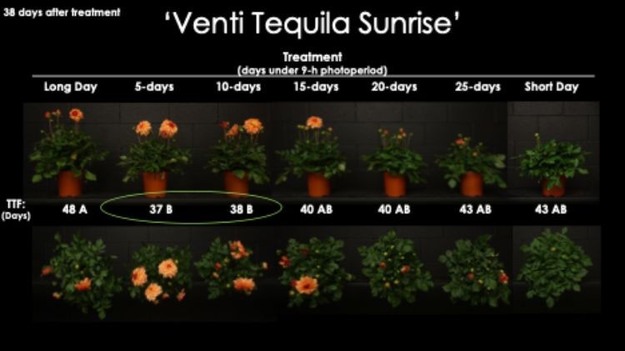 © Michigan State UniversityFigure 1. For Dahlia 'Venti Tequila Sunrise', the time to flower was marginally shorter for those plants exposed to five or 10 short days when evaluated 38 days after treatment.
Michigan is the third-largest producer of greenhouse-grown floriculture crops in the United States. However, growers report that improperly timed flowering in dahlia (Dahlia × hybrida) is a common problem, either delayed flowering resulting in overgrown plants or early flowering when plants are small.
Dahlias are classified as either day-neutral or facultative short-day (SD) plants. Day-neutral plants do not require a specific day length to initiate flowering, while facultative SD plants flower more quickly when the plant receives short days (less than 13 hours of daylight). To solve this problem, Roberto Lopez, PhD, a Michigan State University Extension floriculture specialist, and his colleagues sought to determine how many SDs are required to induce flowering under non-inductive natural long days (LD) during early to mid-summer. Their objective was to determine the number of SDs required to induce flowering in different Dahlia cultivars sold as potted annuals, without reducing flower count or inducing unwanted tubers.
The real question at hand: Can we provide enough short days to induce flowering, but few enough to avoid tuber production?
Methods
In week 11 (second week of March), rooted liners of 10 dahlia cultivars listed in Table 1 were received and placed in a greenhouse with an average daily temperature (ADT) of 70 degrees Fahrenheit, 20-hour photoperiod, and a daily light integral of 15 mol∙m–2∙d–1. Plants were transplanted into 6-inch and trade gallon pots filled with a commercial soilless substrate.
 © Michigan State University
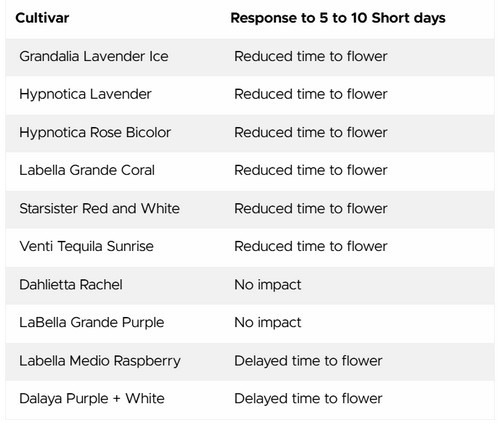
Table 1. The short-day response of different cultivars of dahlias.
Treatments began during week 14, at which point all plants were moved from their LD conditions to photoinductive 9-hour SDs for five, 10, 15, 20 or 25 days, or remained under continuous SDs (9-hour) or continuous LDs (16-hour) conditions. After their SD treatments, the plants were returned to LDs. SDs were created by opening and closing black cloth at 8 a.m. and 5 p.m., respectively. The time to first open flower (TTF) was assessed for all crops. Plants were grown for an additional four to six weeks after the first open flower. At that point, the total number of spent, open or flower buds showing color was recorded.
Results and conclusions
For the dahlia cultivars investigated, five to 10 short days (Figure 1) was enough to reduce the time to flower by three to 24 days with an increase in flower bud count. Furthermore, providing 15 or more short days promoted tuber formation, reduced flower number and reduced flower quality (Figure 2). There were some differences between cultivars (Table 1). For 'Grandalia Lavender Ice', 'Hypnotica Lavender', 'Hypnotica Rose Bicolor', 'Labella Grande Coral', 'Starsister Red & White' and 'Venti Tequila Sunrise', exposure to SDs reduced TTF compared to plants under continuous LDs.
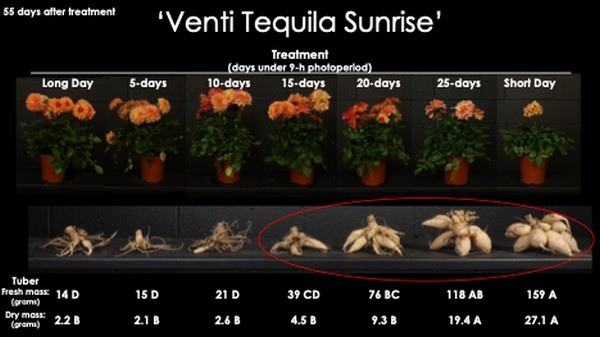 © Michigan State UniversityFigure 2. Fifty-five days after treatment, Dahlia 'Venti Tequila Sunrise' had significant tuber production and produced fewer flowers, resulting in lower-quality potted dahlias when exposed to 15 or more short days.
Conversely, 'Dahlietta Rachel', 'Labella Grande Purple' did not show a clear response to SDs, while TTF of 'Labella Medio Raspberry' and 'Dalaya Purple+White' occurred first under continuous LDs, with inconsistent increases in TTF with exposure to SDs.
Source: Michigan State University