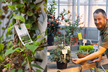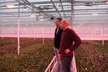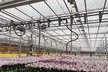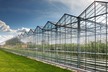


Imagine if you could escape the Iowa winter weather and enjoy warmer temperatures, sunlight, and beautiful plant growth without leaving campus. Thousands of students don't know this possibility is right above them. 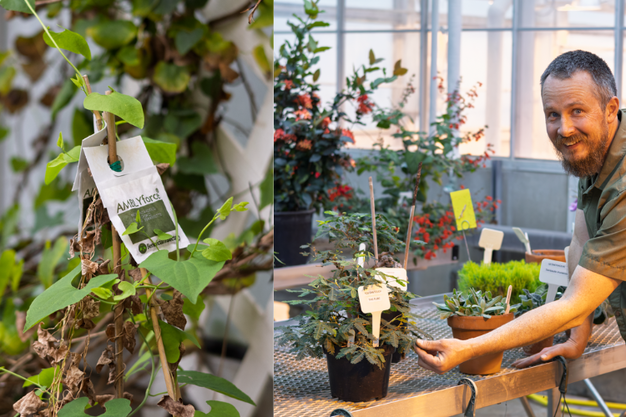 © Iowa State University
On top of Bessey Hall is a 12,000-square-foot greenhouse that houses the last remaining larger plant teaching collections on Iowa State University's campus known as the Richard W. Pohl Conservatory.
The conservatory plant collection is mostly tropical in origin, and the rest are from various parts of the world, including Iowa. The greenhouse plants are propagated from seed, cuttings, air layering or through divisions, and some have been growing for decades.
The Bessey Greenhouse, built in 1967, includes 21 rooms, with 15 open to the public. Each room is environmentally adjusted to ensure plants have the proper conditions needed to grow.
The greenhouse is jointly administered by the College of Agriculture and Life Sciences and the College of Liberal Arts and Sciences and is free and open to the public from 8 a.m. to 4 p.m. Monday through Thursday and 8 a.m. to 2 p.m. on Friday.
Kenny McCabe has been the Bessey Greenhouse manager for nine years. Alongside McCabe are three undergraduate CALS student workers: Elijah Gumm, senior in biochemistry, Natalie Moran, junior in horticulture, and Tristan Weers, senior in biochemistry.
"Working at the greenhouse gives me a wide range of experiences, including planting and transplanting, integrated pest management, taking cuttings and more," Moran said. "We're always doing new things that I wouldn't have done in class, like feeding the carnivorous plants or transplanting plants that are 50 years old. I learn something new every day, which I use to improve my education and help me in my future career."
As the only full-time employee at the facility, McCabe gives many guided tours to classes and groups of all ages and interests. Tours are limited to 15 people.
"I love giving tours to younger folks because it sparks some enthusiasm in them," McCabe said. "I give a lot of tours to high school kids, and that's great because it's further engagement for students in the future. They come up here and think it's amazing."
McCabe said people get so excited about the greenhouse material and get to see all sorts of plants they have never seen before.
The Bessey Greenhouse is mostly used for teaching resources. Various classes receive plants for labs and visit to look at plant material. Biology 2110, 2120 and 3660 are some of the classes that use greenhouse material.
Research is not a primary focus of the Bessey Greenhouse, but occasional research can be conducted by members of the Department of Ecology, Evolution and Organismal Biology. The greenhouse also allows the EEOB Graduate Student Organization to use space to grow native perennials for their annual sale at Reiman Gardens.
Unique features of the Bessey Greenhouse
- Glow in the dark petunias
- A sensory plant that reacts to touch. The plant will shrivel up when touched and restore to its unshrivelled form within an hour.
- Good bugs are used to control bad bugs
- The greenhouse has an amorphophallus titanium (corpse flower) collection, an engaged species, that includes six plants and has had nine blooms over the years.
Source: Iowa State University