

For Holdfast and Stipe, seaweed is not just a natural plant stimulant — it is the foundation of a fully circular production process. Founder Nikki Spil and Dominic Burbridge (director of Sales), together with Anke de Jong (director of Innovation), are building a system in which nothing goes to waste and sustainability is embedded at every step.
Circular chain
"In the beginning, we actually wanted to grow the seaweed ourselves," Nikki explains. "We started out as seaweed farmers." However, obtaining the right permits in the Netherlands proved complicated. Instead, the company chose to work with carefully selected partners across Northern Europe.
"We are very conscious about the seafarmers we work with," Nikki says. "We choose partners who value sustainability." Seaweed is sourced from Scandinavia and France, as well as from the Welsh company Câr-y-Môr. All suppliers harvest sustainably, using a mix of cultivated and wild sources.
At the same time, Holdfast and Stipe is working toward full organic certification, which they hope to achieve by April 2026. "We are applying for SKAL certification," Nikki explains. "That means the entire production line must be non-GMO and meet strict input requirements."
Seaweed tea
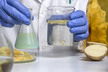
The seaweed arrives either dried in large bags or frozen, depending on the source. "We work with a dry fraction and a wet fraction," Dominic explains. "From there, we start the extraction process. In simple terms, we make tea from the seaweed. The color and active compounds are extracted, and what remains is pulp."
That extract is then concentrated into a stable product. "We need a significant amount of extract at our end," Dominic says. "But our product is so highly concentrated that a grower ultimately only needs a few liters per hectare."
 © Holdfast & Stipe / Marco Vet
"Our output, their input"
The remaining pulp does not go to waste. It is supplied to a partner company, Seawood, which produces biobased plate materials from seaweed fibers. "For three to four years now, our processes have aligned," Nikki says. "Our output is perfect as their input. We create two valuable products from the same one kilogram of seaweed in industries that can - and must - become much more sustainable."
Circularity is central to the company's philosophy: "Nature shows us the right way, there is no waste in nature, and production should follow the same principle. At the moment, we are 100 percent circular," Nikki states. "We have no inputs other than the seaweed itself." The production facility runs on green electricity, supported by solar panels. Even the water used during extraction is reused within the system.
"We operate at relatively low temperatures," Dominic adds. "That keeps the product fresh and protects the living elements in the seaweed that we don't want to damage."
Production goes from small bottles to 1,000-liter IBC containers. "If we receive a large order, we can start immediately," Dominic says. "It takes about two days to produce, and we can scale up easily."
Working alongside growers
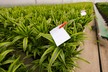
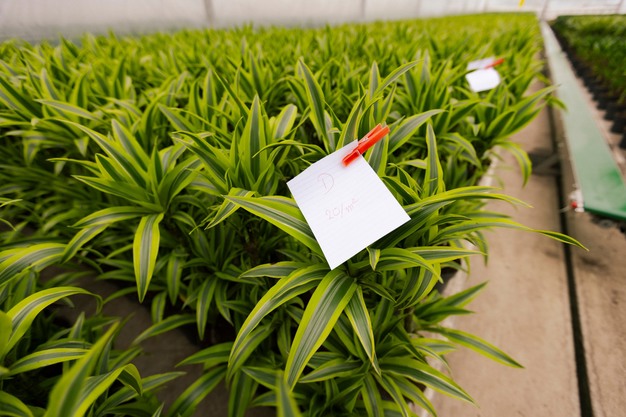
Holdfastand Stipe is active in multiple sectors. Current field trials include tropical houseplants, potatoes, tulip bulbs, grass and sugar beet. The company distinguishes between innovation trials and farmer-supported trials. "With our long-term innovation partners, we conduct larger-scale and more structured trials to demonstrate what the product does across broader sectors, and, of course, to test it with each partner under all relevant conditions, such as humidity, light, specific crops, and their own cultivation practices," Dominic explains. "We understand why it works, but you can't simply apply the product in exactly the same way on every crop or field. That's why we work closely with farmers and growers to test it and demonstrate how the seaweed fertilizer benefits their specific crops, soils, and substrates."
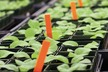
Anke and her team design trials based on growers' specific goals. "When we sit down with a grower, we ask what they want to achieve. Is it yield, stronger growth, better quality? We focus on one or two clear objectives rather than testing everything at once." In addition to more scientific innovation trials, the company also supports practical A/B testing on farms and in greenhouses. "Some growers simply want to try something new," Anke says. "We set up simple side-by-side comparisons so they can see the difference with their own eyes."
According to Nikki, the visual impact can be significant. "A farmer recently told us, 'I can see it with my farmer's eye.'" Anke adds that she has yet to meet a grower unwilling to explore new ideas. "The most enjoyable part is working together with farmers and growers." Dominic describes the collaboration as a partnership. "Because of our approach, we stand beside them. We share our knowledge, and they share theirs."
Sharing positive stories
Beyond product development, Holdfast and Stipe is also documenting its journey with growers. "Some partners want to reduce their inputs and farm more in harmony with nature, while other growers feel pressure from the market," Nikki says. "In all cases, the desire is to keep innovating and continue developing their businesses. We create short documentaries about what motivated them to work with us and follow their trials and results. They are proud, knowledgeable people, and we want to bring back that positive message."
Many of these innovation partnerships are still in early stages. Initial videos introduce the growers and their motivations, followed by updates showing measurable results and impact on crop performance and soil health. The company has also launched an academy to further share knowledge and insights with the sector.
"It's genuinely fun," Nikki concludes. "It clicks with our partners. Of course, they could have said no, as it is quite an investment of time and money from both sides, but they choose to work together. And working together like this is incredibly rewarding."
Engaging with the sector
Holdfast and Stipe considers ongoing dialogue with the sector essential. The company welcomes personal conversations with growers to discuss trial results and how they can work together on implementation and further sustainability. On April 16, they will organize a small-scale event to discuss these topics. Registration is available via the Holdfast and Stipe website.
For more information:
Holdfast and Stipe
[email protected]
www.holdfastandstipe.com