


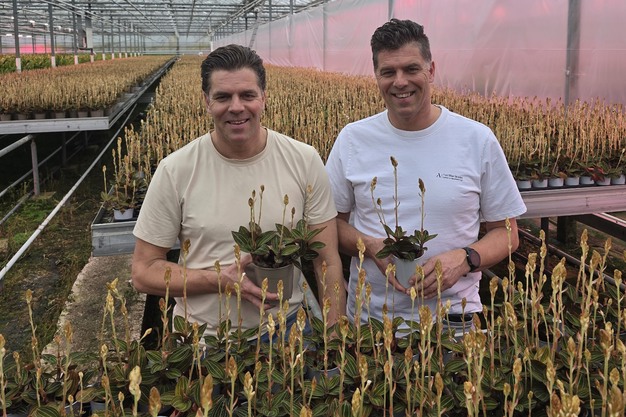
A visit to Bush Brothers in De Lier, in the Dutch region of Westland, quickly makes clear this is no ordinary orchid nursery. Across 3.6 hectares of greenhouse space, brothers Patrick and Marco Lansbergen grow hundreds of different orchid species. Some are produced in larger volumes, while others are aimed at enthusiasts and collectors. "In terms of origin, we have at least five hundred," says Patrick. "But some species we don't grow in large numbers, those are more for hobbyists."
 © Mirthe Walpot | FloralDaily.com
Patrick and Marco Lansbergen
That diversity sets Bush Brothers apart in the market. Within a single genus, the range can run to dozens of varieties. "Take Cattleya," says Patrick. "We probably have forty different species of that alone." The assortment spans a wide spectrum: from Brassia and Oncidium to Paphiopedilum and other specialist varieties. Because of the sheer number of species, selling large volumes of a single product is not straightforward. Unlike some other growers, the strength of the business lies precisely in its variety.
Different cultivations
To make that diversity work commercially, greenhouse space has to be managed carefully. Bush Brothers operates with multiple crop rotations and relatively short growing cycles. In spring, for example, space becomes available as certain terrestrial orchids are not delivered until later in the year, and that space is used for other crops.
"In spring we have quite a bit of space available," says Patrick. "So we put in Saintpaulias, for example. Those sell well around Valentine's Day and International Women's Day." Once that season ends, the crop mix is adjusted again. "We stop in week 21 and then grow more Ludisia. That's how we try to fill that space and keep the greenhouse in efficient use throughout the year."
Sales across Europe
The orchids from De Lier are sold to customers across Europe. Some countries are primarily interested in unusual species, while other markets take larger volumes. "We basically need all of Europe to move the product," says Patrick. Portugal and Spain are important markets, as are Italy, Turkey and Eastern Europe. Regional demand patterns differ clearly. "Southern countries often come for the more special things. The more standard products go more to the east."
Sensitive market
Like much of the ornamental horticulture sector, the orchid trade is sensitive to economic fluctuations. Patrick notices this particularly in Eastern Europe. "I get the impression that people there have less money to spend," he says. Demand from that region is typically strong around International Women's Day.
Weather also has a significant impact on sales. A cold spell in Northern Europe can suppress demand considerably. "In January and February it was very cold everywhere," Patrick explains. "In Denmark and Sweden, people simply weren't going into shops, so they weren't buying plants either." Once conditions improve, demand can recover quickly. He saw this play out at auction, where prices doubled within a week following an improvement in the weather.
Sustainability
Sustainability is a topic that comes up increasingly in the sector, but Patrick notes that customers rarely ask about it in practice. "It's almost never requested," he says. The company has nevertheless taken several measures. The greenhouse is equipped with LED lighting, and Bush Brothers operates a combined heat and power (CHP) unit. "With the CHP we can generate our own electricity. And when needed, we can also feed back into the grid." There are also plans to connect to a district heating network in the future, reducing dependence on natural gas. "We've signed up for it, but it will still be some time before it's in place."
Major setback
The most significant challenge in recent years was an unexpected crop failure. A pest infestation led to the loss of a large portion of production. "There was a small insect in the buds," Patrick recalls. "As a result, we ended up having to discard around 300,000 plants." The financial impact was severe, an extra year of growing, the associated labour and energy costs, and the need to rent additional greenhouse space. "It really hits you hard. We're still renting for another four years because of it."
Staying grounded and moving on
Despite the difficult period, the brothers have tried to keep a level head. Patrick says running the business together helps. "Sometimes you lie awake worrying," he admits. "But my brother and I are fairly pragmatic. You have to keep going." Support from a neighbouring grower also played a role, he bought the greenhouse and is renting it back to the brothers in the interim. "Fortunately, we have a good neighbour," Patrick says with a smile.
A long-term process
Growing orchids requires patience. Bush Brothers sources young plants from Thailand, where they are propagated through tissue culture. The brothers select the starting material themselves and send it to Thailand. After around eighteen months, the plants are returned to the Netherlands. "They come back in flasks," Patrick explains. "We cut those open and take the plantlets out." Several growth stages in the greenhouse follow, with the plants requiring multiple interventions. From pricking out to staking takes two years, and during that time nothing can go wrong, making it a four-year process in total.
With a grain of salt
Alongside growing and trading, the brothers have invested in their market positioning. Three years ago they launched the Bush Brothers brand, giving their plants a recognisable identity through uniform packaging, custom sleeves, labels and pot covers. The name is a nod to their search for new orchid species in the wild.
"We go out into the bush looking for new species," Patrick says with a laugh. That said, it shouldn't be taken too literally, the company logo carries the Latin motto Cum grano salis, meaning "with a grain of salt." "It's a bit of a reminder not to take the story too seriously," he explains.
Looking ahead
Following a difficult few years, the focus is now on stability. The greenhouse is full again and the business is back on track, though uncertainty about the future remains. The brothers are renting their greenhouse for several more years and will need to find a new location when that period ends. For now, the emphasis is on recovery and rebuilding. "First, we need to make sure we're running well again," says Patrick. "Then we'll see what comes next."
For more information:
Bush Brothers
[email protected]
www.bushbrothers.nl