

Powdery mildew is one of the most persistent and economically damaging diseases affecting gerbera production. While some cultivars show partial resistance, most commercial varieties rely heavily on fungicide applications to maintain quality and marketability. Traditional breeding for resistance is time-intensive and difficult to apply to established cultivars, and transgenic approaches can face significant regulatory hurdles.
A recent project, led by Dr. Dayton Wilde and his team at the University of Georgia and supported by AFE, explored an alternative: using CRISPR gene editing to develop powdery mildew-resistant gerbera more efficiently.
 © American Floral Endowment
Building a gene editing platform for gerbera
Before targeting disease resistance, researchers first needed to establish reliable tissue culture and transformation systems for gerbera. Optimized protocols were successfully developed for multiple cultivars.
To confirm that CRISPR technology could work in gerbera, the team first targeted a model gene called phytoene desaturase (PDS). When this gene is disrupted, plants develop a distinctive albino phenotype, providing a visible indicator of successful gene editing. Using CRISPR/Cas12 constructs, researchers produced albino plants and confirmed the presence of targeted DNA mutations, demonstrating that gene editing is feasible in gerbera.
This represents the first reported example of CRISPR-based gene editing in Gerbera.
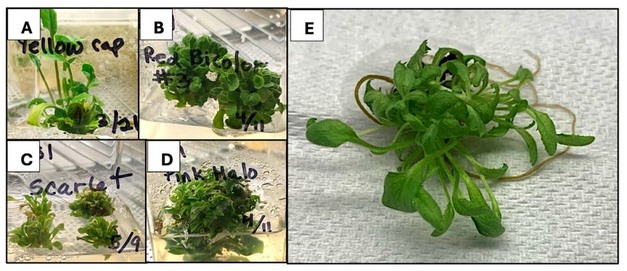 © American Floral EndowmentOptimized shoot tissue cultures of four gerbera cultivars were established.
Targeting susceptibility genes for powdery mildew resistance
With proof of concept established, the team turned its focus to MLO genes, which are known to make plants susceptible to powdery mildew infection. In other crops, such as tomato, wheat, grape, and, most recently, petunia, disabling specific MLO genes has successfully conferred durable resistance.
Researchers identified gerbera MLO gene orthologs and developed CRISPR/Cas9 constructs designed to target them. Transgenic lines carrying these constructs were initiated, though full recovery and evaluation of edited plants are still in progress. Selection and characterization of these lines are ongoing, with future work focused on confirming mutations and evaluating resistance to powdery mildew.
Industry implications
This research lays the groundwork for developing non-transgenic, gene-edited gerbera cultivars with improved disease resistance. CRISPR technology offers the potential to introduce precise mutations without incorporating foreign DNA, which may reduce regulatory barriers and accelerate commercialization.
While challenges remain, emerging tools such as morphogenic regulators and alternative CRISPR delivery systems (including RNA or ribonucleoprotein methods) may improve efficiency in future efforts, and with the recent publication of a chromosome-level gerbera genome sequence, gene editing efforts in this species are expected to become even more streamlined and precise. As the first demonstration of CRISPR gene editing in gerbera, this project represents an important step toward sustainable disease management and the long-term improvement of ornamental crops.
Research like this highlights the important role that American Floral Endowment (AFE) funding plays in advancing innovation within the floriculture industry. By supporting early-stage, high-impact research, AFE enables scientists to explore new technologies, such as CRISPR gene editing, that have the potential to address persistent production challenges, such as powdery mildew in gerbera. Projects like this often represent the first steps in a longer research pathway that establishes critical tools and knowledge that can lead to improved cultivars, more sustainable disease management strategies, and long-term benefits for growers and breeders. Continued investment in AFE-funded research helps ensure that the industry remains competitive, resilient, and prepared for future challenges.
The full report can be read at the link here.

American Floral Endowment
Tel.: +1 (703) 838-5211
[email protected]
www.endowment.org