

Maurits Kooijman and Marco Kortekaas from KP Holland recently started growing peace lilies (Spathiphyllum) in a new greenhouse facility. These plants naturally grow on the shaded forest floors of tropical environments, meaning they are adapted to low-light, humid conditions.
"Recreating tropical growing conditions in a greenhouse is not always straightforward. The amount of light plants can tolerate changes throughout the year and depends on many factors, such as the season, plant age, whether chalk is applied to the greenhouse roof, the propagation method, and the climate conditions inside the greenhouse," said Maurits Kooijman, the Head Grower at KP Holland.
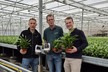
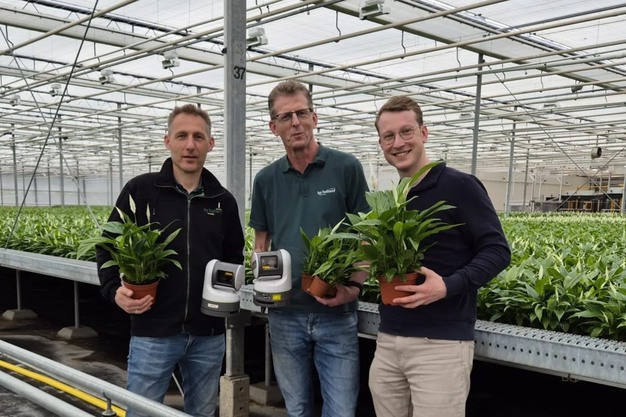 © GardinFrom left to right: Maurits Kooijman and Marco Kortekaas from KP Holland, and Tim Noordijke
from Gardin.
Every time something changes in the greenhouse, growers must decide how much sunlight to allow into the crop and how much to block using shading screens. Too little light slows growth,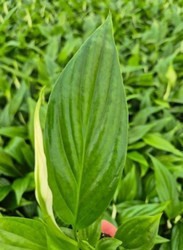 © Gardin but too much light can quickly lead to plant stress. A striking example occurred on January 17th, 2026. Despite January being one of the darkest months in the Netherlands, the plants experienced light stress during a bright winter day. The damage was only noticed almost two weeks later, when the leaves began to show yellow spots and discolouration.
Right: Figure 2a - A healthy dark green leaf in January
"One of the biggest challenges is that light stress is not immediately visible. Plants can already be damaged long before symptoms appear. In crops like Spathiphyllum, this eventually shows up as chlorosis or yellow spots on the leaves, significantly lowering the market value of the plants. Without photosynthesis data, it would have been very difficult to determine when the stress event actually occurred," said Marco Kortekaas, Grower at KP Holland.
Showing the invisible
Gardin's crop monitoring system is designed for commercial operations. It continuously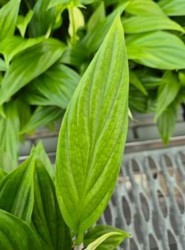 © Gardin monitors plants across areas of up to 10 m², taking chlorophyll fluorescence measurements that provide real-time insights into photosynthetic performance, so growers can detect stress early and optimise conditions before visible damage reduces crop value. KP Holland used Gardin to see when the plants began experiencing light stress. Whenever conditions in the greenhouse changed such as season, lighting, plant stage, or shading strategy, the impact on the plants could be measured in real time.
Right: Figure 2b - A stressed leaf in January, showing chlorotic spots and yellowing of the leaf
"From winter to summer, tropical pot plants gradually adapt to increasing light intensities. Measuring photosynthetic efficiency is a powerful way to understand this process, and the Gardin sensor makes these plant responses clearly visible," said Tim Noordijke, Plant Scientist at Gardin.
This created a biofeedback loop, allowing the growers to test adjustments, measure the plant response, and optimise their shading strategy accordingly. By detecting light stress early, KP Holland could intervene before visible damage such as chlorotic or yellow leaves appeared. Gardin's insights delivered improvements to multiple aspects of their growing strategy.
Cultivation optimization
1. Young plants require significantly less light: When the young plants were placed in the greenhouse, Gardin's measurements immediately showed they could not yet handle the same light levels as mature plants. As shown in Figure 2, their photosynthetic efficiency dropped below the minimum threshold of 38% during the day, even though they received the same light intensity as the adult plants.
You can compare this to a car engine. Photosynthetic efficiency reflects how efficiently the plant is running. When efficiency drops, it means the plant is forced to run at a higher "engine speed" (RPM) to process the incoming light. The 38% threshold acts as a safety line: above 38% the plant is running smoothly, and below 38% the plant is over-revving. If the plant is pushed to run at high "RPM" for too long, the photosynthetic system becomes overloaded, increasing the risk of light damage, just like an engine that is driven too hard for too long will wear out or break down.
This stress is not only visible during the day. It also shows up at night, where the plants fail to fully recover, showing a damaged engine. The consistently low night-time efficiency indicates ongoing stress, which can eventually lead to symptoms such as leaf yellowing. As shown in Figure 2, their photosynthetic efficiency dropped below the minimum efficiency during the day while receiving the same light intensity as the adult plants. This means the young plants need to work too hard, causing the engine of photosynthesis to break. This then leads to a low and stressed recovery during the night, clearly showing a permanent state of stress, which will lead to yellowing of the leaves if not resolved.
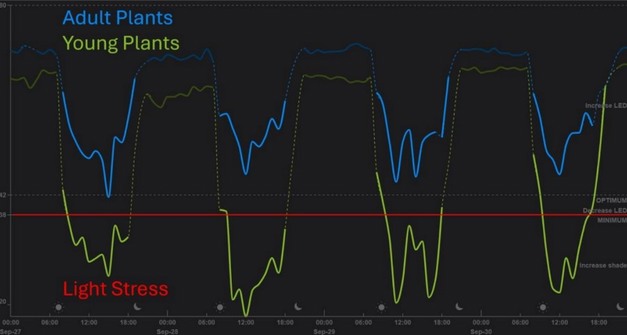 © GardinFigure 3 - Photosynthetic efficiency of adult and young plants from the 27th until the 30th of September
Based on Gardin's recommendation to decrease the light intensity for young plants, KP Holland now places young plants in a darker section of the greenhouse for two weeks before moving them into the main cultivation area.
2. Removing chalk requires major screen adjustments
After summer, chalk is removed from the greenhouse roof. This significantly increases both the intensity and directness of incoming light.
With Gardin, KP Holland discovered that plants began experiencing light stress much earlier than expected once the chalk was removed. As a result, they adjusted their screen strategy, closing the screens at approximately 50% lower radiation levels than when the chalk was on. This prevented a loss in plant quality.
3. Rapidly changing weather conditions
On days with rapidly alternating clouds and sun, the greenhouse climate computer did not always react quickly enough. Radiation thresholds for closing the screens had not yet been reached, but the plants were already experiencing light stress.
"Maintaining consistent plant quality is extremely important for us, especially for our relationships with retail customers. If the quality drops, it directly affects the value of our plants. Gardin helped us clearly identify when our plants were receiving too much light. By adjusting our shading strategy based on that insight, the plants are healthier and growing better, which helps us consistently deliver the quality our customers expect."
Based on Gardin's recommendations, Maurits and Marco adjusted their shading settings in their climate computer.
Reflection
According to the growers at KP Holland, the Gardin sensors provided a new way of understanding the interaction between the crop and the greenhouse climate. The insights also allowed KP Holland to confidently test and validate their cultivation strategies.
"We often had ideas about how the plants would react to light, but now we can actually measure it. Sometimes the data confirmed our assumptions, and sometimes it surprised us. The interesting part is that plants can already be stressed long before you see any damage. With Gardin, we can see what the plant is experiencing in real time and by adjusting our shading strategy based on that insight, the plants are now healthier and growing better than before," says Maurits Kooijman.
By improving their shading strategy throughout the season, KP Holland gained a much better understanding of how their crop responds to light under different conditions. For pot plant growers, where visual quality directly determines product value, the ability to detect stress early can make a significant difference.
"Gardin helped us clearly identify when our plants were receiving too much light. By adjusting our shading strategy based on that insight, the plants are now healthier and growing better than before. We now use the data every day to monitor how the plants respond," concludes Maurits.
For more information:
Gardin
[email protected]
www.gardin.co.uk