

Together with growers, Royal FloraHolland is building a sustainable future in which flowers and plants are grown with respect for people and the environment. Transport packaging plays a key role in this. Jessy Lee Kemmers, Manager of Product Range & Yields for Transport Packaging, explains the steps the organisation is taking in this area.
The beige flower buckets are widely recognised and can be found in many places where flowers are sold, from market stalls to florists. More than 90% of the flowers traded through Royal FloraHolland are transported in these buckets. Jessy Lee Kemmers explains that they have been in use since the 1980s. The buckets are reused multiple times and have remained in circulation for so long partly due to the deposit system. Growers pay a deposit when collecting the buckets and receive it back when the buckets are sold via Royal FloraHolland with flowers inside. Buyers then pay a deposit for the packaging and receive it back upon return.
 © Royal FloraHolland
Their robustness is another important factor. According to Jessy Lee Kemmers, the flower buckets are almost indestructible, with some still in circulation since 1983. Maintaining their quality is also a priority. Royal FloraHolland operates its own washing facility, ensuring that buckets are thoroughly cleaned upon return. This prevents the spread of diseases and helps extend the lifespan of the flowers. When buckets do break, the material is reused to produce new ones. Around 20% of a new bucket consists of recycled material. Under the Packaging and Packaging Waste Regulation (PPWR), this must increase to 35% by 2030. Royal FloraHolland is working towards this target by developing new initiatives, supporting partners, and adapting its IT systems. The organisation is steadily moving towards a fully circular system for transport packaging.
Standardisation: efficient and sustainable
Sustainability is a key focus at Royal FloraHolland, including in packaging. Standardisation plays an essential role. By using the same base dimensions for packaging, load carriers such as trolleys and CC containers can be used more efficiently. This leads to a more efficient supply chain. Royal FloraHolland aims to further reduce the number of transport packaging items and increase standardisation. To achieve this, the organisation works continuously with growers, buyers, suppliers, and other partners to improve the sustainability of its transport packaging.
A good example is the recently introduced Fc555 flower bucket. This new design removes the need for a single-use cardboard collar or reusable Fc596 support shelving. As a result, packaging costs are reduced, and handling is minimised across the supply chain, from growers to buyers. The introduction of this bucket is expected to reduce cardboard use by 250,000 kilos per year within the barberton daisy product group alone, starting in spring 2026. Further savings are anticipated as other product groups adopt the new bucket.
Not imposing, but collaborating
According to Jessy Lee Kemmers, growers and buyers are open to sustainability, but their needs must be clearly understood. Royal FloraHolland recognises that imposing solutions that do not align with market needs is unlikely to succeed. Instead, sustainability must be approached collaboratively. In some cases, legislation such as the PPWR helps drive adoption. However, the organisation aims to stay ahead of regulations and pursue sustainability through intrinsic motivation, while ensuring that solutions remain commercially viable.
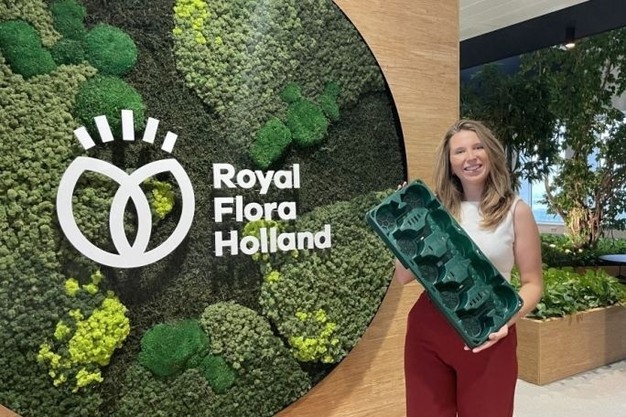
Replacing single-use plant trays with reusable alternatives remains challenging. One issue is that consumers may take reusable trays home, delaying their return and requiring a larger number of trays in circulation. There are also questions about whether reusable trays are always more sustainable when additional transport movements are considered. Royal FloraHolland aims to play a leading role in developing sustainable solutions and is therefore collaborating on the Euro Plant Tray initiative, which focuses on reusable plant trays across the European floriculture chain.
Share your sustainable initiative
Jessy Lee Kemmers concludes with a call to action for all parties in the floriculture sector. Royal FloraHolland welcomes initiatives that combine sustainability with transport packaging and encourages stakeholders to engage in dialogue. The organisation is open to collaboration with growers, buyers, and other partners to drive progress.
Royal FloraHolland also supports stakeholders in navigating new regulations such as the PPWR. In collaboration with the VGB (Association of Wholesalers in Floricultural Products), it has developed a website providing key information about PPWR in the context of floriculture. Through these efforts, the organisation aims to help the sector become more sustainable and make a meaningful impact.