

Impatiens necrotic spot virus and tomato spotted wilt virus differ from tobacco mosaic virus in their mode of transmission from host to host.
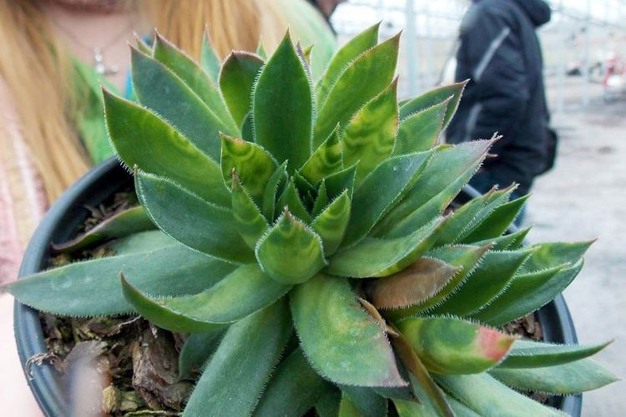 © Heidi Lindberg, MSU Extension
Once a plant with a virus has been found in the greenhouse, it is important to understand the types of viruses and their transmission. Common viruses that affect floriculture crops include tomato spotted wilt virus (Photo 1), impatiens necrotic spot virus (Photo 2) and tobacco mosaic virus (Photo 3). The host range and method of transmission of these viruses varies; this impacts the management strategy that should be implemented. For more on how to manage these viruses, see "How to manage plant viruses in the greenhouse" from Michigan State University Extension.
Tomato spotted wilt virus and impatiens necrotic spot virus are Tospoviruses, which are vectored by insects and seed. Tobacco mosaic virus is a Tobamovirus, which is vectored mechanically. For more information on the biology of viruses, check out the book "Plant Virus and Viroid Diseases in the Tropics" by K. Subramanya Sastry.
 © Jan Byrne, MSU / Heidi Lindberg, MSU ExtensionPhotos 1-3. Symptoms of tomato spotted wilt virus on osteospermum (left), impatiens necrotic spot virus on hens and chicks (middle) and tobacco mosaic virus on petunia (right).
Virus transmission
Viruses can be spread in different ways. Some of the ways are:
- From a parent plant to the next generation of plants via seeds or propagated cuttings.
- By an insect vector, such as tomato spotted wilt virus and impatiens necrotic spot virus.
- By a mechanical vector, such as tobacco mosaic virus.
Insect vectors
The majority (76%) of the known plant viruses are transmitted by insect species in the order Hemiptera, according to the International Committee on Taxonomy of Viruses. Insects in this group include aphids and whiteflies, which are common greenhouse pests. These insects, with thin, needle-like mouthparts called stylets (e.g., aphids), are common vectors of insect-transmitted viruses. They insert their mouthparts into plant tissue, or phloem (watch a video on how aphids feed on plants). Western flower thrips (F. occidentalis) also feed in this way.
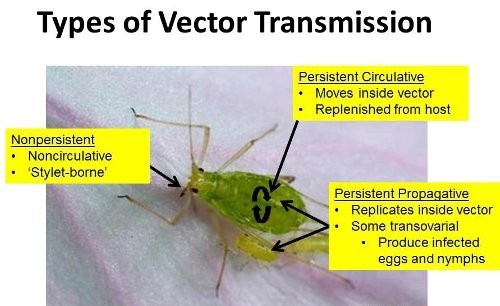
Insects can transmit viruses in two main ways: non-persistently and persistently (Figure 1). Non-persistent viruses can be picked up by the insect quickly and spread by the insect for a relatively short time (minutes or hours) after feeding on or probing an infected plant. These are viruses that can spread around quickly as the insects move around in the crop.
Persistent viruses take longer (days) for the insect to pick up and are carried within an insect for a long period of time, in many cases for the entire lifetime of the insect. In general, these viruses take longer to spread around in the crop.
 © Joseph Berger, Bugwood.org
Figure 1. There are multiple types of vector transmission of viruses. Tomato spotted wilt virus and impatiens necrotic spot virus are persistent propagative viruses
Tomato spotted wilt virus and impatiens necrotic spot virus, both Tospoviruses, are transmitted via insect feeding. Both viruses are classified as persistent propagative viruses, meaning they are carried throughout the life of the insect and can replicate within them. They can also be transmitted between insect generations if an infected female lays eggs, which will likely also be infected.
Mechanical vectors
Unlike tomato spotted wilt virus and impatiens necrotic spot virus, tobacco mosaic virus is not spread via seed or insects. The main mode of transfer is by mechanical means such as pruners, hands or plants touching each other. This virus is highly transmittable and can be a challenge to manage in a greenhouse, especially if a relatively high number of infected plants are present and it is not immediately noticed.
Source: Michigan State University