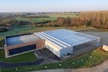


A €3 million investment has led to the creation of 600 m² of new laboratories and 1,600 m² of next-generation greenhouses, selected as part of the France 2030 program to strengthen food sovereignty.
This facility will help the 1,500 vegetable growers from the four Northern Brittany cooperatives behind OBS become more resilient to climate, economic and geopolitical challenges, heightened by ongoing global tensions.
The inauguration also provided an opportunity to highlight these issues and showcase OBS's new capabilities, positioning it as a tailor-made seed partner for Breton producers within both the French and international sectors.
Research and production capacity tripled
Launched in 2021, OBS's transformation builds on more than 50 years of continuous progress from its founding in 1970 to the first cauliflower hybrid in 1984, and a mycosphaerella-resistant variety in 2008. The creation of OBS Innovation in 2016 marked a key step forward in applied research.
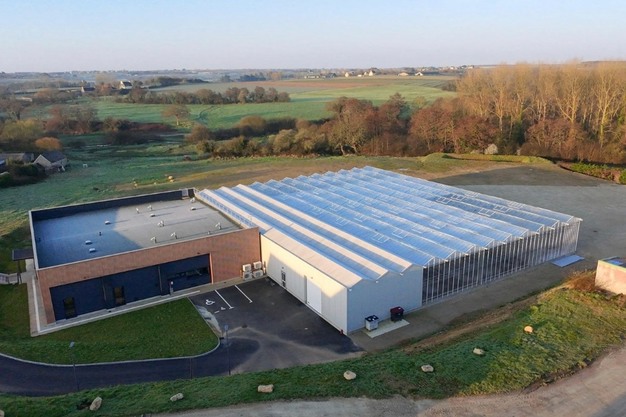
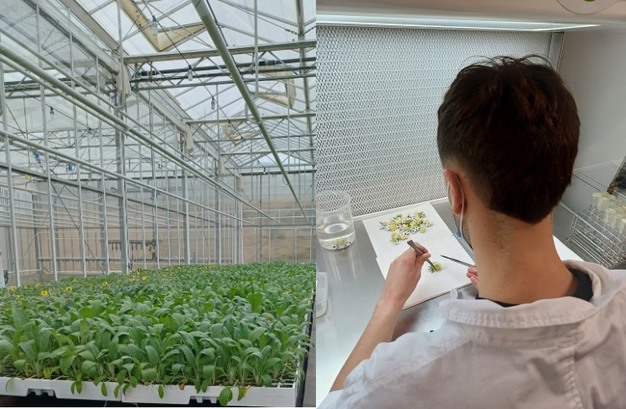
In 2024, a new production facility powered by self-generated solar energy set the stage for the rollout of the new complex. With laboratories expanding from 200 to 600 m² and next-generation greenhouses from 500 to 1,600 m², soon also equipped with photovoltaic panels, OBS is reinforcing its capacity to deliver high-level research and breeding solutions for vegetable production in Northern Brittany.
 © Breton Selection Organization
Aerial view of the OBS laboratories
Improved working conditions and faster experimentation
Breeders and researchers, 22 specialists, including two PhDs, out of a team of 34, will now benefit from a high-performance facility dedicated to varietal creation and selection. The new setup makes it possible to recreate outdoor growing conditions on site, significantly speeding up observation and results.
Greater autonomy and the emergence of new roles
The new facilities make it possible to bring in-house activities that were previously outsourced, such as molecular marker work in applied research and seed quality control.
While partnerships remain important, this shift provides greater autonomy and control.
 © Breton Selection Organization
Access to scientific progress and the deployment of AI
OBS is preparing for new plant improvement techniques, including NGTs (New Genomic Techniques), whose authorization for use in Europe is expected to be finalized by 2026. Genomic sequencing, an accelerated breeding technique involving gene modification within the same species, is already being practiced outside Europe by multinational companies, which are direct competitors of OBS.
Another key asset for plant breeders is artificial intelligence. Already used in general-purpose tools, AI will be further developed to handle the thousands of data points collected and requiring analysis. "Within 3 to 4 years, my team will include new roles such as bioinformaticians and data scientists. They will process vast amounts of data and leverage sophisticated algorithms," explains Céline Jacq, CEO of OBS.
Attractiveness for partnership development
"Research requires both time and investment: out of 100 French breeding companies, 67 including OBS are engaged in varietal creation. All of them allocate between 13% and 25% of their annual turnover to innovation," adds Céline Jacq.
With its new infrastructure, OBS is strengthening its attractiveness to welcome more PhD students and apprentices from research institutes and higher education institutions (INRA, agronomy institutes, University of Western Brittany, etc.).
"It is now absolutely concerning indeed, very alarming, that the national, European and international context is making a negative impact on the vegetable sector in northern Brittany. The cooperatives that are members of OBS have repeatedly raised the alarm on this issue, particularly at the recent International Agricultural Show. Cost control remains a constant concern for all 1,500 producers in the vegetable-growing area.
OBS's objective with this high-tech investment in laboratories and acclimatization greenhouses is clear: we will continue to act as a trusted partner for our producers and support the future of their local production. More than ever, our union of cooperatives remains true to its DNA: meeting the needs of Breton producers.
Varietal creation, along with the multiplication of plants and seeds derived from it, is essential to address market changes, climate change, and labor shortages. Our research provides these solutions, and OBS alone can offer them at a redistribution price to producers that is second to none. This is how we maintain the trust of our members," adds Jean-Marc Roué, President of OBS.
Meeting consumer demand
Producers' demands are themselves driven by consumer expectations: color, shape, taste, availability, diversity, and shelf life. OBS will continue to expand its offering by developing production windows, for the same species, with "month-by-month" varieties, such as cauliflower produced from October to the end of May; and by broadening its historical range (cauliflower, romanesco, shallot, artichoke, Rosé de Roscoff onion, Paimpol bean). The new areas will enable more efficient research on pumpkins, appreciated by consumers in particular for its chestnut flavor.
Based on a true symbiosis between producers and researchers, OBS aims to continue securing, both quantitatively and qualitatively, the supply of seeds and plants within a short supply chain, a guarantee of independence. "We work in the Breton region, on a limited range where we are leaders in winter cauliflowers, and we take great care of our producers, the only ones capable of producing cauliflowers from September to June!" summarizes Céline Jacq.
While preserving its uniqueness, OBS can remain the "Breton Tom Thumb" in the face of multinational giants in the seed sector, striding ahead to sow the seeds of the future and contribute, from the tip of Brittany to French food sovereignty.
For more information:
Breton Selection Organization
Email: [email protected]
https://obs.bzh/en/