


At the AIPH Horticultural Industry Conference in Sydney, water scarcity took center stage during a panel discussion titled "How can the industry respond to water pressure?". Bringing together perspectives from production, research, and technology, the session highlighted both the urgency of the issue and the practical pathways forward for growers.
Chaired by Chris Philpott of The Water Conservancy, the panel featured Andy Cameron of Greenlife Industry NSW & ACT and Eduardo Barbosa of Hort Innovation.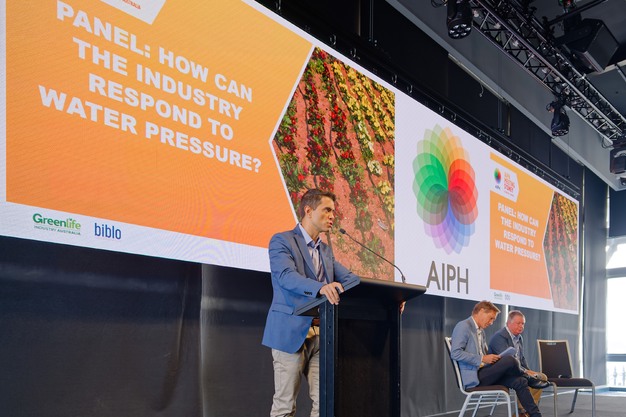 © Ludovic Vilbert, Inwardout Studio
Climate pressure reshaping water use
Opening the discussion, Andy Cameron pointed to the clear and measurable impact of climate change on water availability. In Australia, average temperatures have already risen by around 1 to 1.5°C, driving higher evaporation rates and increasing pressure on water resources. At the same time, rainfall patterns are shifting.
"Rain is no longer steady and predictable," he explained. "We are seeing shorter, sharper bursts, which means more runoff and less effective use of water."
This changing dynamic is forcing growers to rethink how water is captured, stored, and reused. Rather than relying on traditional dam systems where excess water is lost, Andy stressed the importance of closed-loop systems that allow water to be recycled and reapplied.
From abundance to efficiency
Historically, many nurseries operated under the assumption that water was readily available. According to Andy, that mindset is no longer viable.
"Ten or twenty years ago, water would go into a dam and overflow. Today, it's about keeping that water clean, capturing it, and using it again."
Investment in infrastructure is therefore becoming critical. This includes water treatment systems, recycling solutions, and precision irrigation technologies that reduce waste and improve efficiency.
At the same time, growers are being pushed to redesign production systems for a hotter, drier future. This involves not only improving irrigation but also selecting more resilient plant varieties and adapting entire growing strategies to new climate realities.
Data-driven irrigation gains momentum
From a technology standpoint, Eduardo highlighted a major shift currently underway in irrigation management. Traditionally, irrigation decisions were largely based on experience and observation. While still valuable, this approach is increasingly being supplemented by data.
"We can now measure things we couldn't before," he said, pointing to advances in sensors and monitoring systems. Growers can track soil moisture, plant water use, and drainage in real time, enabling far more precise irrigation.
This shift from fixed schedules to responsive irrigation is already delivering tangible results. By watering plants based on actual need rather than assumptions, growers can significantly reduce water use while improving crop uniformity and quality.
Eduardo cited an example from the United States where a grower saved approximately 360 million gallons of water in a single year through improved irrigation technology.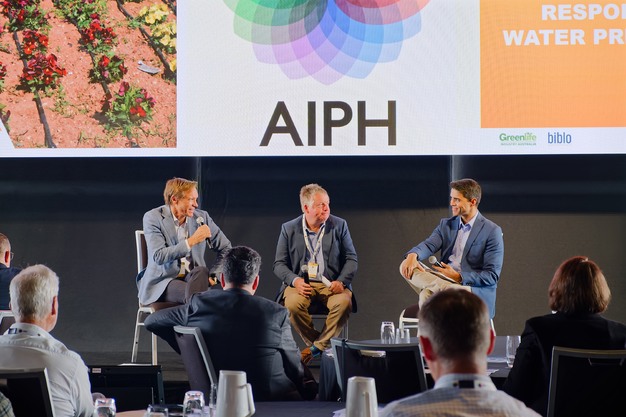 © Ludovic Vilbert, Inwardout Studio
The rise of connected systems and AI
The panel also explored how connectivity and artificial intelligence are shaping the next phase of horticultural production. Through the integration of IoT (Internet of Things) devices, sensors can now communicate directly with irrigation controllers, allowing systems to adjust automatically.
Growers, in turn, can monitor operations remotely via smartphones, gaining full visibility over water use at any time.
Looking ahead, Eduardo sees AI as a key enabler in managing increasingly complex datasets.
"When you have multiple variables—weather, sensors, crop types—AI can help bring all that information together and support better decisions," he explained.
Rather than replacing grower expertise, these tools are designed to enhance decision-making and reduce uncertainty.
Adoption remains a key challenge
Despite the clear benefits, both panellists acknowledged that technology adoption remains uneven across the industry.
"There is a lot available, but horticulture has sometimes been slower to adopt new technologies," Andy noted. "Once growers embrace it, it will be a game changer."
Eduardo added that a lack of technical capability can act as a barrier. To address this, initiatives focused on demonstration and education are essential to help growers understand and implement new solutions effectively.
Water security: a business imperative
Beyond efficiency, the discussion underscored a more fundamental issue: water security.
"If you don't have water, you don't have a business," Andy stated plainly.
While some regions in Australia currently have sufficient supply, the panel warned against complacency. Climate variability is increasing, and long-term planning is essential. Businesses that invest early in water security and resilience are more likely to withstand future disruptions.
The conversation also touched on broader geopolitical and regional tensions around water, reinforcing the idea that access to water is not just an agricultural issue, but a global one.
Rethinking the landscape
Finally, the panel emphasized that the responsibility for water efficiency extends beyond production. The way plants are used in landscapes must also adapt.
Maintaining green environments remains essential for cooling urban areas and supporting ecosystems. However, this must be balanced with reduced reliance on potable water and a greater tolerance for drier conditions between rainfall events.