

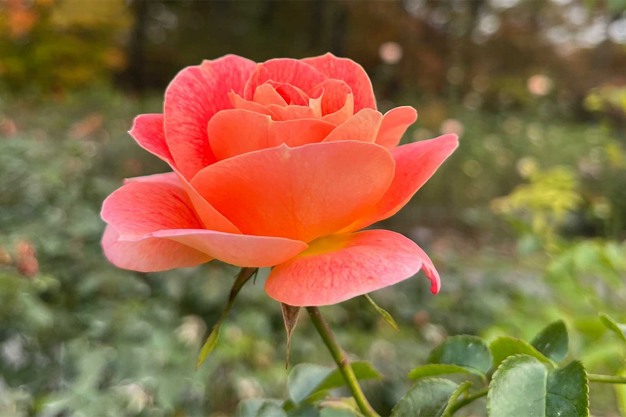
According to Greek mythology, red roses first appeared when Aphrodite pricked her foot on a thorn, spilling blood on a white rose. Since then, roses' thorns have captured the imaginations of countless poets and forlorn lovers.
But they aren't the only plants with these dangerous protrusions, technically called prickles. Prickles have evolved independently in species across the plant kingdom. Their main function: warding off herbivores. They're even present in certain eggplant and rice crops. Yet, for years, it's been unclear how the trait pops up so frequently in such unrelated species.
Now, in a breakthrough discovery, Cold Spring Harbor Laboratory (CSHL) has found that the same ancient gene family is responsible for prickles across many plants, despite millions of years of evolutionary separation.
CSHL postdoc James Satterlee was inspired to investigate prickles upon touring a field where his advisor, Professor & HHMI Investigator Zachary Lippman, grows hundreds of nightshades. Think tomatoes, potatoes, and eggplants. Satterlee recalls:
"I noticed many had very prominent prickles. So, I asked, 'What do we know about that? What's going on with this adaptation?' It turns out we knew almost nothing."
With scientists in Spain, Satterlee began analyzing eggplants, which led him to a gene family called LONELY GUY (LOG). LOG genes are normally responsible for making a hormone that causes cell division and expansion. Satterlee discovered that certain LOG mutations also eliminate prickles in eggplants. Lippman and Satterlee wondered: Could LOG-related genes be responsible for prickle gains and losses across multiple plants over millions of years?
The team started combing through prior studies and contacting collaborators around the globe. Satterlee and Lippman worked with the New York Botanical Garden to examine specimens with and without prickles. Collaborators at Cornell University used genome editing to eliminate prickles in desert raisins, a foraged berry native to Australia. Another colleague in France suppressed prickles in roses. In total, the team came to associate prickles with LOG-related genes in about 20 species.
Lippman says while this discovery could be used to engineer plants without prickles, it also has big implications for understanding convergent evolution in all life. That is, how completely different species independently develop similar traits. He explains:
"You're really asking about life in general—evolution of traits. How do they emerge? How are they modified? What are the underlying mechanisms? What can we learn about things we take for granted?"
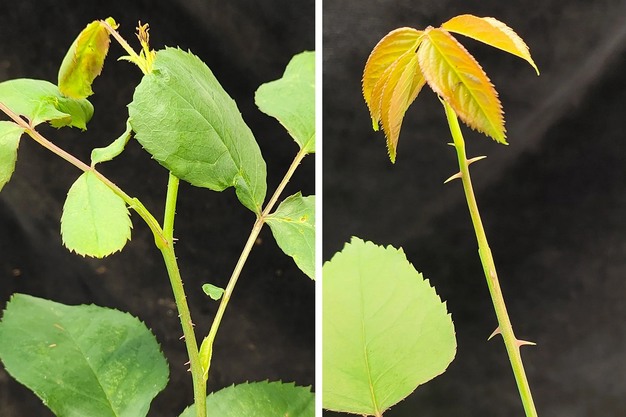
The answer could someday make lesser-known species like desert raisins a new fruit in supermarkets. At the very least, it should make life easier for horticulturalists plucking roses' pesky thorns.
Source: cshl.edu