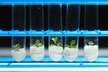


Plants are propagated by tissue culture for several reasons. Tissue culture allows for the rapid production of large numbers of clones that are disease- and virus-free in a sterile, controlled environment. It is also used to multiply plants that are difficult to propagate through vegetative cuttings or other methods. During the laboratory phase, tissue culture–produced plants are grown under low light in highly controlled conditions.
When growers transplant tissue culture–derived plantlets into trays for root development, they may experience a high percentage of shrinkage, or crop loss. This occurs because the greenhouse environment is much harsher than laboratory conditions, which can stress the young plants during the transition.
To improve success as plants move from the laboratory to the greenhouse, growers should include an acclimation step that provides a less harsh microclimate before exposure to the final growing environment. Acclimation conditions should include moist but not saturated substrate, high humidity, low light levels (approximately 100 µmol/m²/s, with a daily light integral of 5 mol/m²/d), low air movement, and warm temperatures between 74 and 78 °F.
There are two main methods for acclimating tissue culture plantlets and creating this microclimate: using a sole-source electric lighting growth chamber, known as vertical indoor propagation (VIP), or acclimating plants within the greenhouse. Some large propagators who have experienced high losses in the greenhouse have converted seed germination chambers into VIP rooms by installing LED lighting. These chambers use side or top lighting along with fogging systems to maintain high relative humidity. Light levels are low, typically 70 to 100 µmol/m²/s, and lights often run continuously under constant temperature and humidity, requiring irrigation only two to four times per day.
Read more at e-Gro