


The Horticultural Trades Association (HTA) launched its Scottish Environmental Horticulture Manifesto at Pentland Plants near Edinburgh. If the Scottish government adopts the practical recommendations, it could unlock a £5.1 billion opportunity for Scotland's economy by 2030, fostering greener jobs, healthier, more resilient communities, and stronger local businesses.
The environmental horticulture sector, which includes retailers, growers, manufacturers, wholesalers, landscapers and garden designers, already supports nearly 60,000 jobs and contributes £2.6 billion to Scotland's GDP. The manifesto demonstrates that, with the right policies in place, this economic contribution could almost double by 2030, helping to deliver Scotland's ambitions for economic growth, wellbeing and net zero ambitions.
Rising operational costs are creating an increasingly challenging environment for HTA members, the majority of whom are family-run small and medium-sized enterprises (SMEs). Key recommendations include a fairer business rates system and smarter investment to ensure Scottish firms are not paying higher business rates than those south of the border, thereby undermining national competitiveness. Furthermore, the sector seeks faster, fairer planning decisions to address the "postcode lottery" effect and unlock barriers to sustainable growth, including allowing sites to be retrofitted for energy efficiency, and consistency in kerbside collections across all Local Authorities for recyclable non-black plastic plant pots.
The manifesto also seeks targeted investment grants to improve the sector's water resilience and energy efficiency, and to strengthen peat-free practices and the adoption of automation. Garden centre retailers, often excluded from existing funding schemes, need to be explicitly included, while also simplifying grant applications to ensure quicker environmental and economic returns.
Beyond business investment, the HTA calls for nurturing future skills and green jobs. This includes introducing a statutory requirement to 'grow plants' into the curriculum during Key Stages 1 and 2 to foster health and wellbeing benefits and help children build an understanding of science and the natural world. Horticultural roles must also be formally recognised within the Scottish Government's green jobs definitions to ensure careers are valued and visible. The HTA also proposes that links between industry and providers such as Scotland's Rural College (SRUC) and The Royal Botanic Garden Edinburgh (RBGE) should be further strengthened, as well as establishing new tree-production apprenticeships through publicly owned tree nurseries within Forestry and Land Scotland.
Green spaces are vital to Scotland's health and resilience, with 85% of Scots reporting that they benefit their mental health. Establishing a cross-departmental Horticulture and Green Spaces Group would help explore legal protections and maintenance standards for these spaces, as well as secure and safeguard funds for local planting and community projects. The value of Social and Therapeutic Horticulture is reinforced, with Trellis Scotland estimating the economic benefits per person from reduced public service use ranging from £830 to £31,520 after one year.
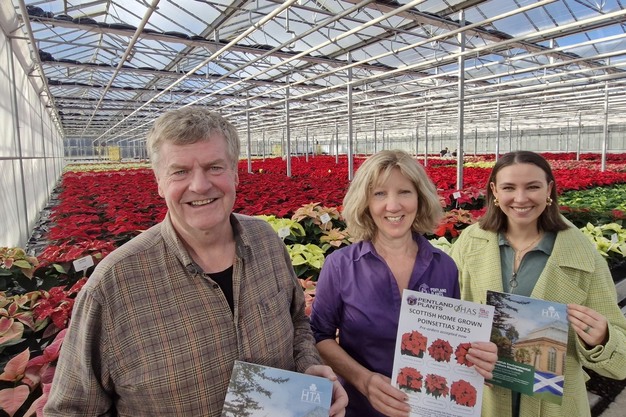 © Horticultural Trades AssociationL-R: Stan Green, Carolyn Spray (Pentland Plants), Katie Neenan
Looking ahead, the HTA encourages Scotland to lead the way in developing a comprehensive action plan for the production of ornamental and productive plants and trees. This should include considering supply, skills gaps, and grant support for non-forestry production, and issuing multi-year contracts to support nurseries in fulfilling native tree planting. A feasibility study could also be conducted to highlight which imported plants and trees could be grown in the UK.
Stan Green, Managing Director of Growforth and Chair of the HTA Scottish Policy Group, added: "Horticulture connects the economy, the environment, and our daily lives in fundamental ways. This manifesto lands at a pivotal moment as the Land Reform (Scotland) Bill is debated, highlighting how vital land use and long-term planning are for Scotland's future. Our industry has a central role to play in this, and by working collaboratively, we can ensure Scotland leads the way in demonstrating how cultivating plants cultivates prosperity, strengthens communities, and protects our natural world."
Katie Neenan, HTA Senior Public Affairs and Policy Executive, commented: "This manifesto acts as a practical roadmap for a greener, healthier, and more prosperous Scotland. Our sector is a vital part of local economies and communities, offering real solutions to national challenges. We are outlining clear, actionable steps the Scottish Government can take to foster growth, support businesses, and enhance both our natural environment and public health."
The full manifesto can be read at the link here.
For more information:
Horticultural Trades Association
[email protected]
www.hta.org.uk