

 © HortiPro BV
Since this summer, Thomas de Leijer has joined the team at HortiPro. The 27-year-old plant scientist, who graduated from Wageningen University & Research (WUR), started in August as a Commercial Technical Advisor for the company, which specializes in biological crop protection.
During his studies, Thomas developed a strong interest in crop protection. "I'm really looking forward to working with colleagues, crop advisors, and growers to find sustainable, future-focused solutions for both open-field and greenhouse crops," he says.
What are pheromones and how can growers use them?
One of Thomas's focus areas at HortiPro will be pheromones. But what exactly are they, and how can horticulture make use of them?
"In agriculture and horticulture, chemical and biological crop protection products have long been used to protect plants from pests and diseases," Thomas explains. "The downside of chemical pesticides is that they can harm the environment. Non-selective products, whether chemical or biological, don't just kill harmful insects, they can also affect beneficial ones, including pollinators like bees and bumblebees. On top of that, repeated use of the same active ingredient can lead to pest resistance."
Over time, awareness of these drawbacks has grown, and many chemical products have been restricted or banned altogether. As a result, growers are increasingly looking for new ways to protect their crops while reducing dependence on chemicals. One of these techniques is the use of pheromones.
What are pheromones?
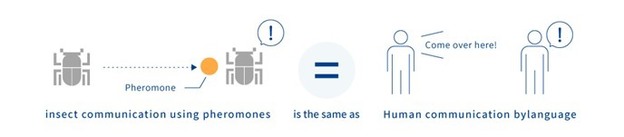
Pheromones are natural scent compounds that allow animals, including insects, to communicate with others of the same species. "These scent signals are invisible and move through the air," Thomas explains. "Insects release and detect pheromones to send messages. For example, they may use a sex pheromone to find a mate, or an alarm pheromone to warn others of danger. You can think of pheromones as a kind of 'scent language' insects use to talk to each other."
 © HortiPro BV
Image source: https://www.fjf.co.jp/en/ecomone/pheromone_trap/index.html
Applications of pheromones in cultivation
"Thanks to scientific research, we now know which pheromones are produced by key pest insects and what these signals actually mean," Thomas explains. "Once scientists have decoded these chemical messages, they can reproduce the pheromones in a lab. The synthetic versions can then be used to influence insect behaviour in a controlled way."
Disrupting mating
A practical example of this is the use of female sex pheromones to confuse male insects, such as with products like Isonet T. When large amounts of the female pheromone are released into the air, the males can no longer locate the females. As a result, fewer insects mate, fewer eggs are laid, and the overall crop damage is reduced.
Signaling/monitoring
By combining a pheromone with a trap, for example, a sticky trap or a delta trap, growers and advisors can accurately assess pest levels in the crop. "By counting the number of insects caught in the traps," Thomas explains, "the grower can decide whether or not action is needed. Pheromone-based monitoring helps determine the best timing for applying biological or chemical controls."
Finally, Thomas sums up the main advantages of pheromone use. "Pheromones are highly targeted, so they don't harm beneficial insects. They leave no residues on crops or in the environment. And because they allow early detection, growers can intervene before pest pressure becomes severe. In short, pheromones are an excellent addition to the toolbox for improving Integrated Crop Management (ICM)."
 For more information:
Eric Kerklaan, Thomas de Leijer, and Lennart Simonse
HortiPro
[email protected]
www.hortipro.com