


Growers, traders and industry experts from the fresh produce and ornamental horticulture sectors gathered in the Netherlands for the Tuinbouw Footprint Event 2026, where the focus shifted from broad sector-wide sustainability discussions toward the practical use of footprint calculations as a management tool.
View the photo report here (link in Dutch)
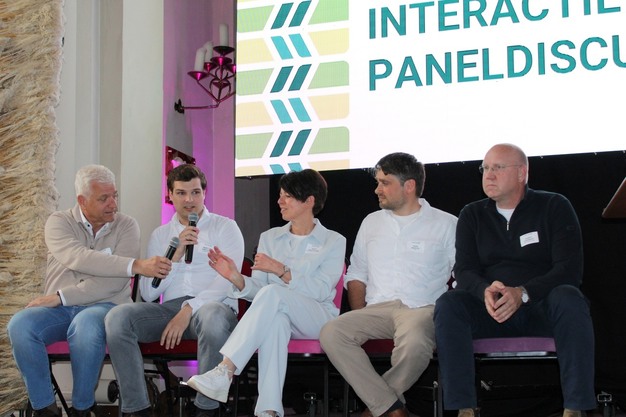 © Martijn Haas | FloralDaily.comJelte van Kammen (HarvestHouse) Martijn van Vliet (Florpartners) Edith Bentvelzen (Ter Laak Orchids/Riza growers) Dave Marcus (KAVB) and Albert Haasnoot (Royal FloraHolland)
The afternoon opened with a panel discussion chaired by Rob Veenman, covering a range of current sustainability themes. Jelte van Kammen of Harvest House addressed the 'First Sustainable Generation' initiative, while Martijn van Vliet of Florpartners provided an update on '100% Grown Green'. Edith Bentvelsen of Ter Laak Orchios / Riza Growers shared her experience as a nominee for 'Ranking the Grower'. Dave Marcus of KAVB and Albert Haasnoot of Royal FloraHolland gave updates on sustainability developments within the bulb sector and the Floriculture Sustainability Initiative (FSI), respectively.
The supply chain impact of trading companies
Following the plenary discussion, Marissa van Adrichem, Sustainability Manager at Best Fresh, explained how an international trading company maps its environmental footprint. For an organisation active in cultivation, trade and logistics, 96% of total environmental impact sits within the supply chain (Scope 3), with only 4% directly related to the company's own operations and energy consumption.
Van Adrichem stressed that collaboration with suppliers is essential to reducing this indirect impact. "Forty percent of the impact comes from purchased products and services. These are indirect emissions that we cannot easily change, but that we do need to address." She advised companies to start with the data they already have, even if incomplete, as a basis for steering sustainability targets.
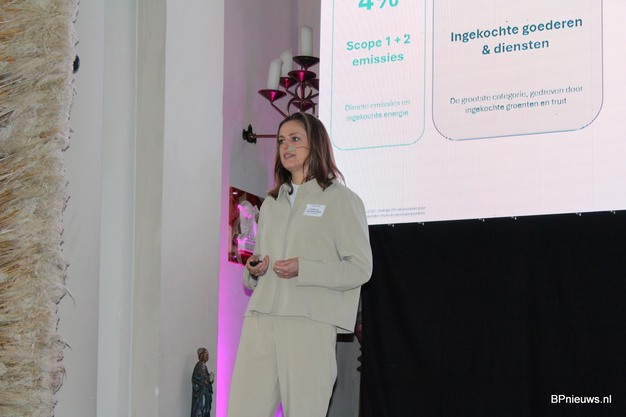 © Martijn Haas | FloralDaily.com Marissa van Adrichem of Best Fresh Group.
Calculation models as a strategic instrument
For John Vreugdenhil, who holds financial responsibility at ornamental horticulture company KP Holland, the footprint calculation serves as the quantitative foundation of business strategy. The company now has three years of validated data, providing insight into trends and the effectiveness of investments. At KP Holland, energy consumption accounts for 80% to 90% of the total footprint.
Vreugdenhil argued that objective figures are essential when communicating with external stakeholders. "It is an excellent tool for making things measurable. I think it's important that we can tell a story that is not just a good story, but one that is also accurate and well-substantiated."
KP Holland works with a flexible roadmap toward climate neutrality by 2045, monitoring both major investments and incremental annual improvements in the use of crop inputs.
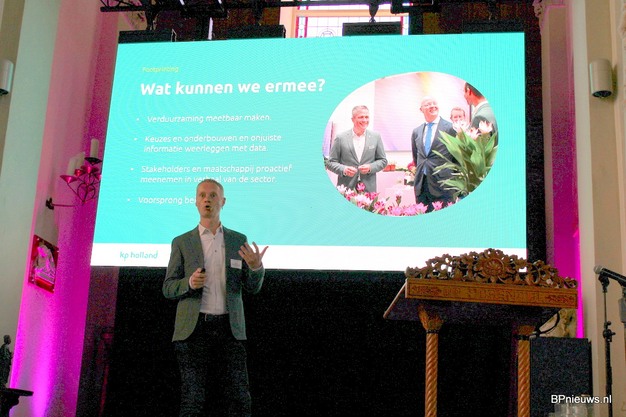 © Martijn Haas | FloralDaily.comJohn Vreugdenhil of KP Holland
From measuring to sustainable choices
LCA experts Katharina Schuster and Charlotte van Hal of Greenhouse Sustainability reinforced the importance of data. They argued that certificates only provide process information and do not answer the question of what a product's actual environmental impact is. Only through a Life Cycle Assessment (LCA) can environmental pressure be expressed as a scientifically grounded figure.
Van Hal compared the footprint to a compass. "Think of the footprint as a compass. Because only when you start measuring can you truly make sustainable choices. The compass gives you direction, and the data provides the substantiation."
Beyond CO₂ emissions, the experts highlighted the relevance of other impact categories, including ecotoxicity, particularly in relation to the use of crop protection products and fertilisers. New software solutions now allow bulk calculations across large product ranges, making it possible to assess the impact per product throughout the entire supply chain.
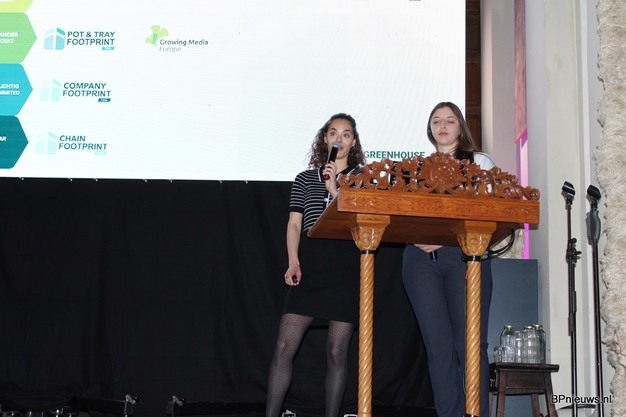 © Martijn Haas | FloralDaily.comCharlotte van Hal and Katharina Schuster of Greenhouse Sustainability
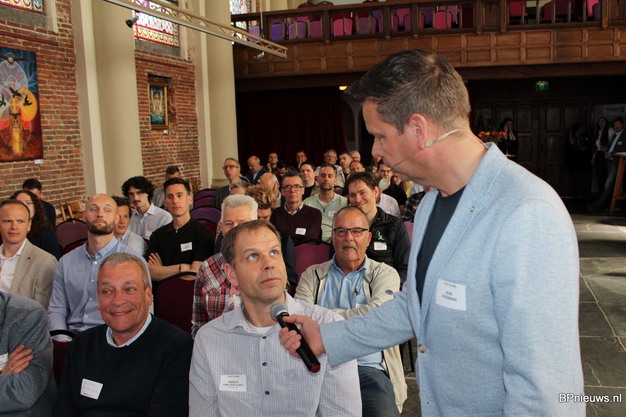 © Martijn Haas | FloralDaily.comModerator Rob Veenman in conversation with Marco van der Goes of HouwenPlant
External pressure and legislation
A recurring theme across the presentations was the growing pressure from legislation and the financial sector. The Corporate Sustainability Reporting Directive (CSRD) and the European Packaging and Packaging Waste Regulation (PPWR) are compelling companies to be transparent about their full supply chains. Banks and accountants are increasingly using footprint data as a condition for credit provision and annual reporting.
The afternoon programme continued with a focus on external perception and strategic planning. Megan James of Tuinbranche Nederland presented a vision for the future of garden retail, addressing the shift from reputational pressure toward building trust across the sector. Boudewijn Zuijderhoudt of Epiic and Chris Boers of aaff then shared their practical experience in developing roadmaps for future-proof cultivation, emphasising that a structured plan is essential for translating sustainability goals into concrete business operations.
Following a contribution by Dennis Gebbink of Sportclub Only Friends on social inclusivity, the event closed with the announcement of the overall winner of 'Ranking the Grower' 2026. Under the guidance of Jacco Strating, the performances of category winners LG Flowers, Ter Laak Orchios and Koppert Cress were reviewed to determine the most sustainable company in the sector. Ter Laak Orchios took home the trophy.
View the photo report here (link in Dutch)
For more information:
Greenhouse Sustainability
[email protected]
www.greenhouse-sustainability.com