

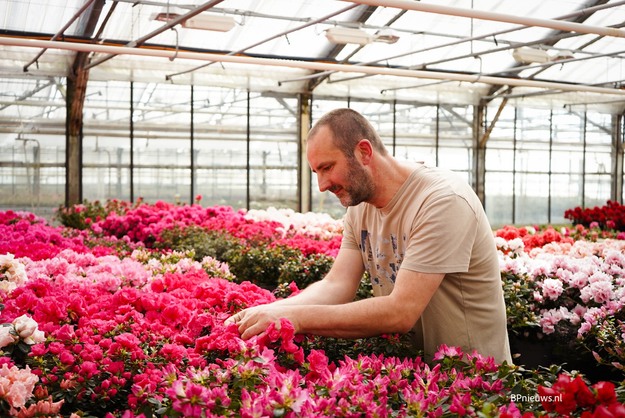
At FlorAmor's nursery in Lochristi, Belgium, hundreds of azaleas are arranged in rows for Hortinno's flowering trials. Breeder Steven Engelen and Christoph Stevens walk through the greenhouses to explain how new Hortinno varieties are developed, step by step.
 © Mirthe Walpot | FloralDaily.com
Steven Engelen
A great deal of selection
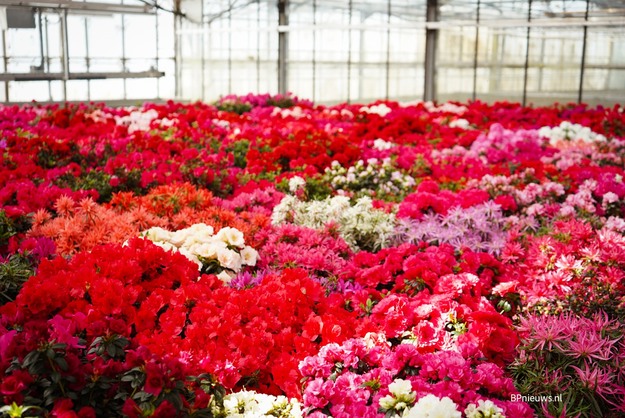
The process begins with parent plants used for crossing. Every step is recorded in software, from sowing date to flowering time. "Each year we evaluate at least 30,000 seedlings," says Steven. "What we sow in December will be in flower the following spring."
That is when the real work begins: selection. Plants are first assessed on leaf quality, flower abundance, and overall appearance. From thousands of seedlings, around one hundred remain after the first round. Each receives a passport number and is tracked from that point forward.
 © Mirthe Walpot | FloralDaily.com
One key requirement is a flowering period of at least fifty days. "That is the promise of Hortinno," says Christoph. "We record exactly when a plant comes into bud and when it has finished flowering."
A multi-year development process follows. Plants are potted up, propagated, and tested — including for winter hardiness. From a single selected plant, five are initially made. If a variety is confirmed for the range, production scales to tens of plants in the first year and ultimately to thousands. It typically takes nine to ten years before a variety can be commercially launched.
Mutations and 'Vogel varieties'
Alongside conventional crossing, irradiation plays a role in the breeding programme. By exposing plants to gamma radiation, mutations are induced. "Sometimes, within a few weeks, you have a new sibling with exactly the same characteristics but in different colours," Christoph explains.
 © Mirthe Walpot | FloralDaily.com
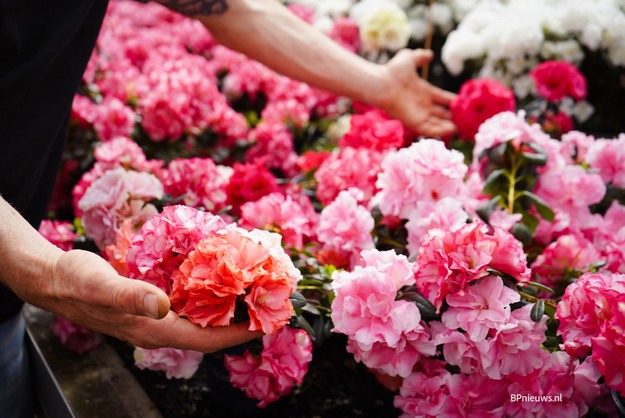
An example of a whole lot of brothers and sisters together
A well-known example is the so-called Vogel varieties, named after breeder Hellmut Vogel. A natural mutation once produced an early-flowering red azalea. Through selection and propagation, this gave rise to dozens of variants. Today, a significant share of total azalea production originates from this group.
No longer a disposable product
Hortinno's ambition is clear: indoor azaleas should also be suitable for the garden. "We want to move away from the idea that it is a disposable product," says Christoph. "After those fifty days of flowering, you should simply be able to put the plant outside."
This connects to a broader focus on future-proof cultivation. Chemical growth regulation and intervention are avoided wherever possible. "We look for varieties that are naturally compact, so that stopping or chemical treatments are no longer necessary."
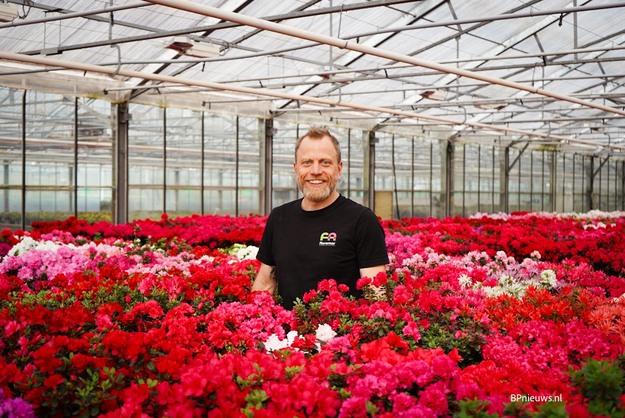 © Mirthe Walpot | FloralDaily.comChristoph Stevens
Kill your darlings
Existing varieties face the same rigorous assessment as new ones. "You have to be willing to let go," says Christoph. "Kill your darlings, otherwise quality cannot be maintained." In the third evaluation phase, performance in the nursery is assessed alongside appearance. Can a plant be produced efficiently? Is it sufficiently robust? Only then does it have a genuine chance of a place in the range.
From niche to million-unit product
What began with a single collection, the Christine line, has grown into a broad range that now includes the Spring and Lime collections. Around 25 years ago, Hortinno azaleas were still a niche product, with approximately 100,000 plants in a total market of 96 million.
The position today is markedly different: around 15 million azaleas are sold annually, of which approximately 3 million carry the Hortinno label.
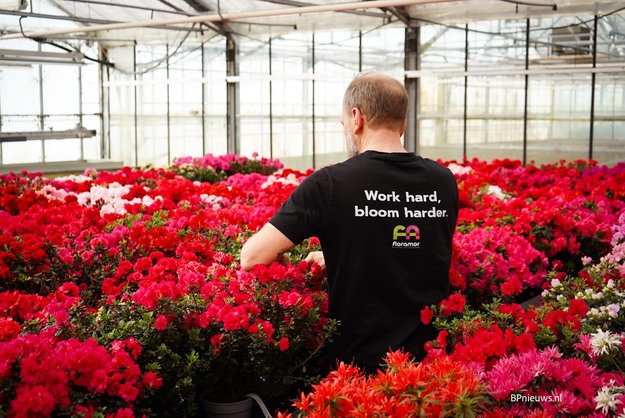 © Mirthe Walpot | FloralDaily.com
Broader than azalea
FlorAmor is also active in the breeding of rhododendron and kalmia. The process is comparable, though each crop presents its own challenges. Steven walks through the greenhouses three times a week to assess, select, and, as he puts it himself, "throw away a great deal." Visitors are actively involved in the selection process: potential new varieties of azalea, rhododendron, and kalmia are displayed in the greenhouse and can be evaluated via a QR code.
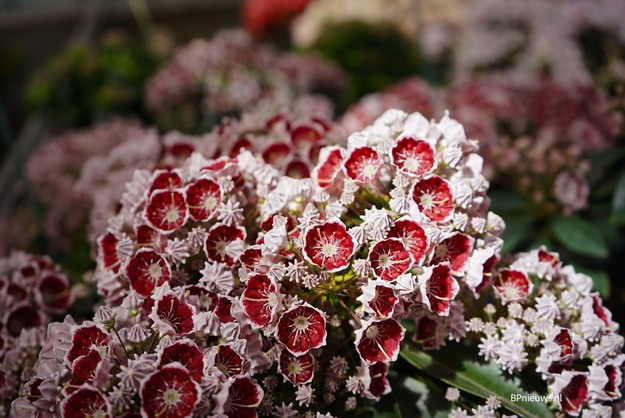 © Mirthe Walpot | FloralDaily.com Kalmia Maxymo, for example, is a success with very distinctive flowers
Festive moment
At a recent flowering trial event, around forty customers visited FlorAmor to view and assess the Hortinno varieties. "We find it important to look after our customers and we are always glad to welcome them," says Christoph. During the event, three new introductions were officially named and given a sponsor: Azalea Norabelle, Kalmia Maxymo, and Evergreen Red are now formally part of the range.
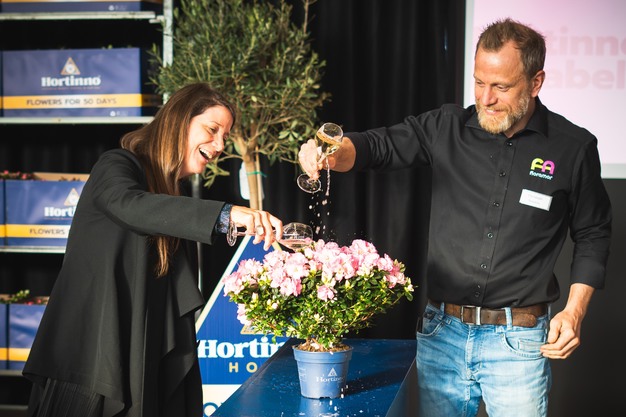 © FlorAmor / Tom GorreThe christening of azalea Norabelle by Erica Ratti (Rattiflora Como)
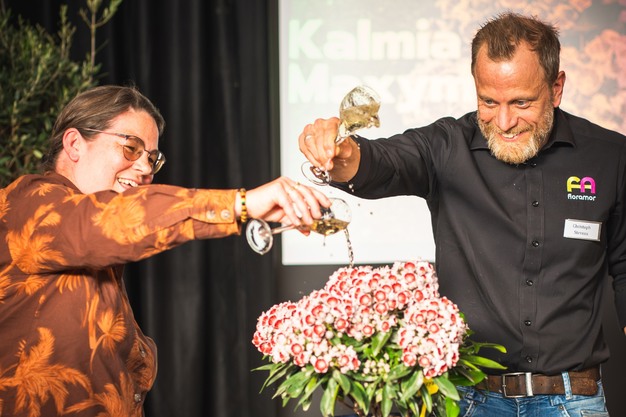 © FlorAmor / Tom GorreThe christening of Kalmia Maxymo by Els Pauwels (Viaverda)
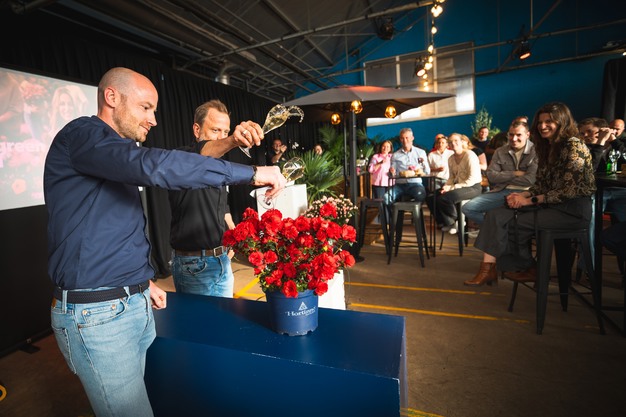 © FlorAmor / Tom GorreThe christening of Evergreen Red by Tim Van Werde (Kom op tegen Kanker)
A new corporate identity for Hortinno was also presented at the event, underlining FlorAmor's ambition to keep innovating, while respecting the long process that precedes every launch. As Steven puts it: "Breeding is mostly about discarding and continuously improving. That is the only way to move forward."
For more information:
FlorAmor
Tel: +32 (0)9 353 88 88
[email protected]
www.floramor.be